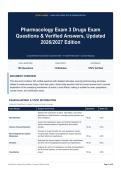
[STUDY GUIDE] • HIGH-YIELD PRACTICE & REVIEW EDITION
Pharmacology Exam 3 Drugs Exam
Questions & Verified Answers, Updated
2026/2027 Edition
Comprehensive Examination Question Bank • In-Depth Rationales • Concept Mapping
TOTAL QUESTIONS EXAM TOPICS RATIONALES
192 Questions 12 Modules 100% Verified
DOCUMENT OVERVIEW
This document contains 192 verified questions with detailed rationales covering pharmacology principles
related to cardiovascular drugs. Each item pairs a board-style question with the correct answer and a concise
explanation of the underlying mechanism of action or side effects, making it suitable for exam preparation,
course review, and certification study.
EXAM BLUEPRINT & TOPIC DISTRIBUTION
Systematic breakdown of subject domains and exam coverage.
Topic Module Scope & Core Focus Questions Share (%)
Explores the mechanism of action, side effects, and clinical
applications of beta blockers in managing blood pressure and
Beta Blockers heart conditions. 16 Qs 8.3%
Covers the mechanisms, types, and clinical implications of
calcium channel blockers in hypertension and cardiac
Calcium Channel Blockers function. 16 Qs 8.3%
Focuses on drugs that alter the renin-angiotensin system,
Renin-Angiotensin System including ACE inhibitors and angiotensin receptor blockers,
Modulators and their effects on hypertension. 16 Qs 8.3%
Examines the various classes of diuretics, their mechanisms,
Diuretics and their role in managing fluid balance and hypertension. 16 Qs 8.3%
Analyzes the action of vasodilators, including nitrovasodilators
and K channel openers, on blood pressure and cardiac
Vasodilators output. 16 Qs 8.3%
Confidential • Student Study Edition • Practice & Review Guide Page 1 of 63
,STUDENT STUDY & MASTERY EDITION PRACTICE & REVIEW GUIDE
Discusses the mechanisms of action, therapeutic uses, and
Anticoagulants and Antiplatelet side effects of various anticoagulants and antiplatelet
Agents medications. 16 Qs 8.3%
Explores the different classes of antiarrhythmic drugs, their
Arrhythmia Medications mechanisms of action, and clinical applications. 16 Qs 8.3%
Focuses on the pharmacologic treatment strategies for heart
failure, including beta blockers, ACE inhibitors, and novel
Heart Failure Pharmacotherapy agents. 16 Qs 8.3%
Covers the mechanisms, uses, and side effects of
Pain Management and NSAIDs non-steroidal anti-inflammatory drugs and other analgesics. 16 Qs 8.3%
Examines the pharmacological options for managing gout,
Gout Treatments including uricosuric agents and anti-inflammatory drugs. 16 Qs 8.3%
Analyzes the role of corticosteroids and other
Corticosteroids and immunosuppressive agents in managing inflammatory
Immunosuppressants conditions. 16 Qs 8.3%
Discusses the pharmacological treatments for respiratory
Bronchodilators and Respiratory conditions, focusing on bronchodilators and their
Agents mechanisms. 16 Qs 8.3%
Total Exam Coverage 12 Integrated Topic Modules 192 Qs 100.0%
Confidential • Student Study Edition • Practice & Review Guide Page 2 of 63
,STUDENT STUDY & MASTERY EDITION PRACTICE & REVIEW GUIDE
TOPIC 1: BETA BLOCKERS
16 Questions • 8.3% of Exam • Explores the mechanism of action, side effects, and clinical applications of beta blockers in managing
blood pressure and heart conditions.
QUESTION 1
Propanolol, metoprolol
Correct Answer: Beta blockers.
Rationale: Propanolol and metoprolol are both types of medications classified under the broader category of beta blockers,
which is the primary classification system used in pharmacology. This is because beta blockers are defined by their
mechanism of action, which involves blocking the beta receptors in the body, and both propanolol and metoprolol fit this
definition, regardless of their specific uses or effects.
QUESTION 2
Gold standard to treat HTN
Correct Answer: Beta blockers.
Rationale: Beta blockers are considered a cornerstone in treating hypertension (HTN) because they effectively reduce
cardiac output and peripheral resistance, thereby lowering blood pressure, without significantly affecting potassium levels.
This unique mechanism of action makes beta blockers an ideal choice for HTN management, especially in patients with
heart failure or those who cannot tolerate diuretics or ACE inhibitors.
QUESTION 3
What do beta blockers reduce in the BP equation?
Correct Answer: SV and HR.
Rationale: Beta blockers are a type of medication that reduce the force of the heart's contractions, thereby decreasing
cardiac output (CO) and subsequently systolic blood pressure (SBP). Since the mean arterial pressure (MAP) equation is
MAP = CO x total peripheral resistance
(TPR), reducing CO or increasing TPR would decrease MAP, but since the question focuses on the BP equation, which is
typically given as BP = CO x TPR or BP = 80(1.34 x CO x TPR), the correct reduction related to beta blockers directly
impacts the CO term, resulting in the correct answer being "SV and HR".
Confidential • Student Study Edition • Practice & Review Guide Page 3 of 63
, STUDENT STUDY & MASTERY EDITION PRACTICE & REVIEW GUIDE
QUESTION 4
Side effects of beta blockers
Correct Answer: Exercise intolerance, bradycardia, rebound effect, impotence, decompensation.
Rationale: Beta blockers work by blocking the effects of epinephrine, a hormone that increases heart rate and blood
pressure, which can lead to exercise intolerance due to the heart's reduced ability to pump blood efficiently. The reduction in
heart rate also manifests as bradycardia, and the body's compensatory mechanisms can lead to a rebound effect,
impotence, and eventually decompensation when the blockade is too severe, causing an inability of the heart to maintain
adequate blood flow.
QUESTION 5
Verapamil and Diltiazem synergize with
Correct Answer: Beta blockers bc of bradycardia.
Rationale: Verapamil and Diltiazem are calcium channel blockers that not only block calcium channels but also slow the
heart rate by increasing the refractory period of the heart, leading to bradycardia. Beta blockers, which are commonly used
to treat bradycardia, synergize with Verapamil and Diltiazem due to their complementary effects on heart rate regulation,
making the combination effective in achieving a desired therapeutic outcome.
QUESTION 6
Adverse effects of blocking B1
Correct Answer: Worsen HF, brady, AV block, withdrawal syndrome.
Rationale: Blocking the B1 receptor, also known as the muscarinic acetylcholine receptor, can lead to worsening of heart
failure (HF) because the parasympathetic nervous system's inhibitory effect on the heart is reduced, resulting in an
overactive sympathetic nervous system that can further impair the heart's function. Additionally, blocking B1 receptors can
also cause bradycardia (slowed heart rate), AV block (disrupted electrical conduction in the heart), and withdrawal
syndrome due to the body's physiological dependence on the parasympathetic nervous system's stimulation of these
receptors.
Confidential • Student Study Edition • Practice & Review Guide Page 4 of 63
Pharmacology Exam 3 Drugs Exam
Questions & Verified Answers, Updated
2026/2027 Edition
Comprehensive Examination Question Bank • In-Depth Rationales • Concept Mapping
TOTAL QUESTIONS EXAM TOPICS RATIONALES
192 Questions 12 Modules 100% Verified
DOCUMENT OVERVIEW
This document contains 192 verified questions with detailed rationales covering pharmacology principles
related to cardiovascular drugs. Each item pairs a board-style question with the correct answer and a concise
explanation of the underlying mechanism of action or side effects, making it suitable for exam preparation,
course review, and certification study.
EXAM BLUEPRINT & TOPIC DISTRIBUTION
Systematic breakdown of subject domains and exam coverage.
Topic Module Scope & Core Focus Questions Share (%)
Explores the mechanism of action, side effects, and clinical
applications of beta blockers in managing blood pressure and
Beta Blockers heart conditions. 16 Qs 8.3%
Covers the mechanisms, types, and clinical implications of
calcium channel blockers in hypertension and cardiac
Calcium Channel Blockers function. 16 Qs 8.3%
Focuses on drugs that alter the renin-angiotensin system,
Renin-Angiotensin System including ACE inhibitors and angiotensin receptor blockers,
Modulators and their effects on hypertension. 16 Qs 8.3%
Examines the various classes of diuretics, their mechanisms,
Diuretics and their role in managing fluid balance and hypertension. 16 Qs 8.3%
Analyzes the action of vasodilators, including nitrovasodilators
and K channel openers, on blood pressure and cardiac
Vasodilators output. 16 Qs 8.3%
Confidential • Student Study Edition • Practice & Review Guide Page 1 of 63
,STUDENT STUDY & MASTERY EDITION PRACTICE & REVIEW GUIDE
Discusses the mechanisms of action, therapeutic uses, and
Anticoagulants and Antiplatelet side effects of various anticoagulants and antiplatelet
Agents medications. 16 Qs 8.3%
Explores the different classes of antiarrhythmic drugs, their
Arrhythmia Medications mechanisms of action, and clinical applications. 16 Qs 8.3%
Focuses on the pharmacologic treatment strategies for heart
failure, including beta blockers, ACE inhibitors, and novel
Heart Failure Pharmacotherapy agents. 16 Qs 8.3%
Covers the mechanisms, uses, and side effects of
Pain Management and NSAIDs non-steroidal anti-inflammatory drugs and other analgesics. 16 Qs 8.3%
Examines the pharmacological options for managing gout,
Gout Treatments including uricosuric agents and anti-inflammatory drugs. 16 Qs 8.3%
Analyzes the role of corticosteroids and other
Corticosteroids and immunosuppressive agents in managing inflammatory
Immunosuppressants conditions. 16 Qs 8.3%
Discusses the pharmacological treatments for respiratory
Bronchodilators and Respiratory conditions, focusing on bronchodilators and their
Agents mechanisms. 16 Qs 8.3%
Total Exam Coverage 12 Integrated Topic Modules 192 Qs 100.0%
Confidential • Student Study Edition • Practice & Review Guide Page 2 of 63
,STUDENT STUDY & MASTERY EDITION PRACTICE & REVIEW GUIDE
TOPIC 1: BETA BLOCKERS
16 Questions • 8.3% of Exam • Explores the mechanism of action, side effects, and clinical applications of beta blockers in managing
blood pressure and heart conditions.
QUESTION 1
Propanolol, metoprolol
Correct Answer: Beta blockers.
Rationale: Propanolol and metoprolol are both types of medications classified under the broader category of beta blockers,
which is the primary classification system used in pharmacology. This is because beta blockers are defined by their
mechanism of action, which involves blocking the beta receptors in the body, and both propanolol and metoprolol fit this
definition, regardless of their specific uses or effects.
QUESTION 2
Gold standard to treat HTN
Correct Answer: Beta blockers.
Rationale: Beta blockers are considered a cornerstone in treating hypertension (HTN) because they effectively reduce
cardiac output and peripheral resistance, thereby lowering blood pressure, without significantly affecting potassium levels.
This unique mechanism of action makes beta blockers an ideal choice for HTN management, especially in patients with
heart failure or those who cannot tolerate diuretics or ACE inhibitors.
QUESTION 3
What do beta blockers reduce in the BP equation?
Correct Answer: SV and HR.
Rationale: Beta blockers are a type of medication that reduce the force of the heart's contractions, thereby decreasing
cardiac output (CO) and subsequently systolic blood pressure (SBP). Since the mean arterial pressure (MAP) equation is
MAP = CO x total peripheral resistance
(TPR), reducing CO or increasing TPR would decrease MAP, but since the question focuses on the BP equation, which is
typically given as BP = CO x TPR or BP = 80(1.34 x CO x TPR), the correct reduction related to beta blockers directly
impacts the CO term, resulting in the correct answer being "SV and HR".
Confidential • Student Study Edition • Practice & Review Guide Page 3 of 63
, STUDENT STUDY & MASTERY EDITION PRACTICE & REVIEW GUIDE
QUESTION 4
Side effects of beta blockers
Correct Answer: Exercise intolerance, bradycardia, rebound effect, impotence, decompensation.
Rationale: Beta blockers work by blocking the effects of epinephrine, a hormone that increases heart rate and blood
pressure, which can lead to exercise intolerance due to the heart's reduced ability to pump blood efficiently. The reduction in
heart rate also manifests as bradycardia, and the body's compensatory mechanisms can lead to a rebound effect,
impotence, and eventually decompensation when the blockade is too severe, causing an inability of the heart to maintain
adequate blood flow.
QUESTION 5
Verapamil and Diltiazem synergize with
Correct Answer: Beta blockers bc of bradycardia.
Rationale: Verapamil and Diltiazem are calcium channel blockers that not only block calcium channels but also slow the
heart rate by increasing the refractory period of the heart, leading to bradycardia. Beta blockers, which are commonly used
to treat bradycardia, synergize with Verapamil and Diltiazem due to their complementary effects on heart rate regulation,
making the combination effective in achieving a desired therapeutic outcome.
QUESTION 6
Adverse effects of blocking B1
Correct Answer: Worsen HF, brady, AV block, withdrawal syndrome.
Rationale: Blocking the B1 receptor, also known as the muscarinic acetylcholine receptor, can lead to worsening of heart
failure (HF) because the parasympathetic nervous system's inhibitory effect on the heart is reduced, resulting in an
overactive sympathetic nervous system that can further impair the heart's function. Additionally, blocking B1 receptors can
also cause bradycardia (slowed heart rate), AV block (disrupted electrical conduction in the heart), and withdrawal
syndrome due to the body's physiological dependence on the parasympathetic nervous system's stimulation of these
receptors.
Confidential • Student Study Edition • Practice & Review Guide Page 4 of 63