[STUDY GUIDE] • HIGH-YIELD PRACTICE & REVIEW EDITION
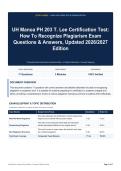
UH Manoa PH 203 T. Lee Certification Test:
How To Recognize Plagiarism Exam
Questions & Answers, Updated 2026/2027
Edition
Comprehensive Examination Question Bank • In-Depth Rationales • Concept Mapping
TOTAL QUESTIONS EXAM TOPICS RATIONALES
17 Questions 3 Modules 100% Verified
DOCUMENT OVERVIEW
This document contains 17 questions with correct answers and detailed rationales focused on recognizing
plagiarism in academic work. It is suitable for students preparing for certification in academic integrity and
ethics, providing a comprehensive review of various plagiarism scenarios and how to address them effectively.
EXAM BLUEPRINT & TOPIC DISTRIBUTION
Systematic breakdown of subject domains and exam coverage.
Topic Module Scope & Core Focus Questions Share (%)
This topic addresses the identification of direct copying from
Word-for-Word Plagiarism original source material without proper citation. 7 Qs 41.2%
This topic covers instances where ideas are rephrased
Paraphrasing Plagiarism without appropriate attribution to the original source. 5 Qs 29.4%
This topic focuses on cases where the student's work does
Non-Plagiarism Scenarios not constitute plagiarism. 5 Qs 29.4%
Total Exam Coverage 3 Integrated Topic Modules 17 Qs 100.0%
Confidential • Student Study Edition • Practice & Review Guide Page 1 of 17
,STUDENT STUDY & MASTERY EDITION PRACTICE & REVIEW GUIDE
TOPIC 1: WORD-FOR-WORD PLAGIARISM
7 Questions • 41.2% of Exam • This topic addresses the identification of direct copying from original source material without proper
citation.
QUESTION 1
In the case below, the original source material is given along with a sample of student
work. ORIGINAL SOURCE MATERIAL: [SOURCE 1] Learning is a complex set of
processes that may vary according to the developmental level of the learner, the nature
of the task, and the context in which the learning is to occur. As already indicated, no
one theory can capture all the variables involved in learning. References: Gredler, M. E.
(2001). Learning and instruction: Theory into practice (4th Ed.). Upper Saddle, NJ:
Prentice-Hall. [SOURCE 2] A learning theory, there, comprises a set of constructs
linking observed changes in performance with what is thought to bring about those
changes. References: Driscoll, M. P. (2000). Psychology of learning for instruction (2nd
Ed.). Needham Heights, MA: Allyn & Bacon. STUDENT VERSION: A learning theory is
made up of a set of constructs linking observed changes in performance with whatever
is thought to bring about those changes. Therefore since "learning is a complex set of
processes that may vary according to the developmental level of the learner, the nature
of the task, and the context in which the learning is to occur," it is apparent that no one
theory can capture all the variables involved in learning (Driscoll, 2000, p.10).
References: Driscoll, M. P. (2000). Psychology of learning for instruction (2nd Ed.).
Needham Heights, MA: Allyn & Bacon. Which of the following is true for the Student
Version above?
[A] Word-for-Word plagiarism
[B] Paraphrasing plagiarism
[C] This is not plagiarism
Correct Answer: A. Word-for-Word plagiarism.
Confidential • Student Study Edition • Practice & Review Guide Page 2 of 17
, STUDENT STUDY & MASTERY EDITION PRACTICE & REVIEW GUIDE
QUESTION 2
In the case below, the original source material is given along with a sample of student
work. ORIGINAL SOURCE MATERIAL: Suppose you study a group of successful
companies and you find that they emphasize customer focus, or quality improvement,
or empowerment; how do you know that you haven't merely discovered the
management practice equivalent of having buildings? How do you know that you've
discovered something that distinguishes the successful companies from other
companies? You don't know. You can't know--not unless you have a control set, a
comparison group. References: Collins, J. C., & Porras, J. I. (2002). Built to last:
Successful habits of visionary companies. New York, NY: Harper Paperbacks.
STUDENT VERSION: One has to ask oneself how you know that you've discovered
something that distinguishes the successful companies from other companies?
Otherwise, you can fall into a trap that is the same as identifying "the management
practice equivalent of having buildings" (Collins & Porras, 2002, p. 14). References:
Collins, J. C., & Porras, J. I. (2002). Built to last: Successful habits of visionary
companies. New York, NY: Harper Paperbacks. Which of the following is true for the
Student Version above?
[A] Word-for-Word plagiarism
[B] Paraphrasing plagiarism
[C] This is not plagiarism
Correct Answer: A. Word-for-Word plagiarism.
Confidential • Student Study Edition • Practice & Review Guide Page 3 of 17
UH Manoa PH 203 T. Lee Certification Test:
How To Recognize Plagiarism Exam
Questions & Answers, Updated 2026/2027
Edition
Comprehensive Examination Question Bank • In-Depth Rationales • Concept Mapping
TOTAL QUESTIONS EXAM TOPICS RATIONALES
17 Questions 3 Modules 100% Verified
DOCUMENT OVERVIEW
This document contains 17 questions with correct answers and detailed rationales focused on recognizing
plagiarism in academic work. It is suitable for students preparing for certification in academic integrity and
ethics, providing a comprehensive review of various plagiarism scenarios and how to address them effectively.
EXAM BLUEPRINT & TOPIC DISTRIBUTION
Systematic breakdown of subject domains and exam coverage.
Topic Module Scope & Core Focus Questions Share (%)
This topic addresses the identification of direct copying from
Word-for-Word Plagiarism original source material without proper citation. 7 Qs 41.2%
This topic covers instances where ideas are rephrased
Paraphrasing Plagiarism without appropriate attribution to the original source. 5 Qs 29.4%
This topic focuses on cases where the student's work does
Non-Plagiarism Scenarios not constitute plagiarism. 5 Qs 29.4%
Total Exam Coverage 3 Integrated Topic Modules 17 Qs 100.0%
Confidential • Student Study Edition • Practice & Review Guide Page 1 of 17
,STUDENT STUDY & MASTERY EDITION PRACTICE & REVIEW GUIDE
TOPIC 1: WORD-FOR-WORD PLAGIARISM
7 Questions • 41.2% of Exam • This topic addresses the identification of direct copying from original source material without proper
citation.
QUESTION 1
In the case below, the original source material is given along with a sample of student
work. ORIGINAL SOURCE MATERIAL: [SOURCE 1] Learning is a complex set of
processes that may vary according to the developmental level of the learner, the nature
of the task, and the context in which the learning is to occur. As already indicated, no
one theory can capture all the variables involved in learning. References: Gredler, M. E.
(2001). Learning and instruction: Theory into practice (4th Ed.). Upper Saddle, NJ:
Prentice-Hall. [SOURCE 2] A learning theory, there, comprises a set of constructs
linking observed changes in performance with what is thought to bring about those
changes. References: Driscoll, M. P. (2000). Psychology of learning for instruction (2nd
Ed.). Needham Heights, MA: Allyn & Bacon. STUDENT VERSION: A learning theory is
made up of a set of constructs linking observed changes in performance with whatever
is thought to bring about those changes. Therefore since "learning is a complex set of
processes that may vary according to the developmental level of the learner, the nature
of the task, and the context in which the learning is to occur," it is apparent that no one
theory can capture all the variables involved in learning (Driscoll, 2000, p.10).
References: Driscoll, M. P. (2000). Psychology of learning for instruction (2nd Ed.).
Needham Heights, MA: Allyn & Bacon. Which of the following is true for the Student
Version above?
[A] Word-for-Word plagiarism
[B] Paraphrasing plagiarism
[C] This is not plagiarism
Correct Answer: A. Word-for-Word plagiarism.
Confidential • Student Study Edition • Practice & Review Guide Page 2 of 17
, STUDENT STUDY & MASTERY EDITION PRACTICE & REVIEW GUIDE
QUESTION 2
In the case below, the original source material is given along with a sample of student
work. ORIGINAL SOURCE MATERIAL: Suppose you study a group of successful
companies and you find that they emphasize customer focus, or quality improvement,
or empowerment; how do you know that you haven't merely discovered the
management practice equivalent of having buildings? How do you know that you've
discovered something that distinguishes the successful companies from other
companies? You don't know. You can't know--not unless you have a control set, a
comparison group. References: Collins, J. C., & Porras, J. I. (2002). Built to last:
Successful habits of visionary companies. New York, NY: Harper Paperbacks.
STUDENT VERSION: One has to ask oneself how you know that you've discovered
something that distinguishes the successful companies from other companies?
Otherwise, you can fall into a trap that is the same as identifying "the management
practice equivalent of having buildings" (Collins & Porras, 2002, p. 14). References:
Collins, J. C., & Porras, J. I. (2002). Built to last: Successful habits of visionary
companies. New York, NY: Harper Paperbacks. Which of the following is true for the
Student Version above?
[A] Word-for-Word plagiarism
[B] Paraphrasing plagiarism
[C] This is not plagiarism
Correct Answer: A. Word-for-Word plagiarism.
Confidential • Student Study Edition • Practice & Review Guide Page 3 of 17