[STUDY GUIDE] • HIGH-YIELD PRACTICE & REVIEW EDITION
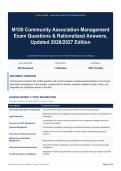
M100 Community Association Management
Exam Questions & Rationalized Answers,
Updated 2026/2027 Edition
Comprehensive Examination Question Bank • In-Depth Rationales • Concept Mapping
TOTAL QUESTIONS EXAM TOPICS RATIONALES
362 Questions 11 Modules 100% Verified
DOCUMENT OVERVIEW
This document contains 362 verified questions with correct answers covering essential aspects of community
association management. Each question is paired with the answer, making it suitable for study, review, and
preparation for certification exams in the field.
EXAM BLUEPRINT & TOPIC DISTRIBUTION
Systematic breakdown of subject domains and exam coverage.
Topic Module Scope & Core Focus
Community Association Fundamentals An overview of the basic principles and functions of community associations.
Exploration of the laws and regulations governing community associations, including the Fair
Legal Framework Housing Act.
An examination of various insurance policies and risk management strategies relevant to
Insurance and Risk Management community associations.
Financial Management Key concepts in budgeting, accounting, and financial reporting for community associations.
Insights into the roles and responsibilities of board members and effective governance
Governance and Board Dynamics practices.
Maintenance and Facilities
Management Best practices for maintaining community facilities and managing service contracts.
Discussion of ethical considerations and professional standards in community association
Ethics and Professional Standards management.
Strategies for resolving disputes within community associations through mediation and other
Conflict Resolution and Mediation methods.
Confidential • Student Study Edition • Practice & Review Guide Page 1 of 114
,STUDENT STUDY & MASTERY EDITION PRACTICE & REVIEW GUIDE
Community Engagement and Techniques for fostering community involvement and effective communication among
Communication members.
Understanding compliance with federal and state regulations affecting community
Regulatory Compliance associations.
Property Management Practices Fundamental practices related to property management within community associations.
Total Exam Coverage 11 Integrated Topic Modules • 362 Examination Questions
Confidential • Student Study Edition • Practice & Review Guide Page 2 of 114
,STUDENT STUDY & MASTERY EDITION PRACTICE & REVIEW GUIDE
QUESTION 1
True or false. A good resource for identifying potential contractors are referrals from
supply firms doing business with the community association.
Correct Answer: True
A manager can obtain the names of potential contractors for a specific job from referrals from supply firms
doing business with the community association. Before a manager sends a contractor a bid request, he or
she should call first to see if the company is interested in bidding. He or she should avoid sending out bid
requests and waiting for a response—only to find out that none of the receivers were interested or available.
QUESTION 2
Contractual transfers
Correct Answer: This involves entering into a contract that will, among other things, transfer the community
association's legal responsibility for any loss. An example would be contracting for landscape services,
instead of using community association employees, and incorporating clauses such as a hold harmless
provision in the contract, or the association contracts with a community association management company.
Contractual transfers are a type of risk control activity.
QUESTION 3
Which of the following is not a common insurance coverage and endorsement for
property exposures to loss?
[a] commercial package policy (CPP) insurance
[b] boiler and machinery insurance
[c] flood insurance
[d] hired and non-owned automobile liability insurance
Correct Answer: D. hired and non-owned automobile liability insurance Common insurance coverages and
endorsements for property exposures to loss include commercial package policy insurance, boiler and
machinery insurance, building ordinance insurance, flood insurance, and electronic data
processing. Hired and non-owned automobile liability insurance, a common insurance coverage and
endorsement for liability exposures to loss, covers legal claims arising out of the use of automobiles that are
not owned by the community association, but that are used while acting on behalf of the association.
Confidential • Student Study Edition • Practice & Review Guide Page 3 of 114
, STUDENT STUDY & MASTERY EDITION PRACTICE & REVIEW GUIDE
QUESTION 4
True or false. If a community association has just one part-time employee, it doesn't
need a written personnel manual or employee handbook.
Correct Answer: False
Even if a community association has just one part-time employee, it should have a written set of policies and
procedures that define the relationship between the community association and the employee and that
explain the rights and responsibilities of both the employer and the employee. The content and wording of
any manual or handbook have legal ramifications. As a result, a personnel specialist or attorney should be
directly involved in the adoption of a personnel manual or employee handbook.
QUESTION 5
True or false. It is perfectly acceptable to hold a board meeting in the home of the
association president.
Correct Answer: False
If a community association does not have a meeting room, board meetings should be scheduled in public
places.
Avoid meetings in homes of board members, as the space will not always be adequate. Nor is a board
member's home a public and neutral site that will encourage owners' attendance.
QUESTION 6
Hearing notice
Correct Answer: A written notice to an alleged violator that a hearing will beheld to consider his or her
alleged violation. Issuing a hearing notice is one of the steps in a due process procedure for enforcing rules.
A hearing notice may contain the nature of the alleged violation, the action requested to cure the alleged
violation, the time and place of a hearing, an invitation to attend the hearing and produce any statement,
evidence or witnesses on his or her behalf, a statement that a sanction may be imposed, and the maximum
amount of any sanction.
Confidential • Student Study Edition • Practice & Review Guide Page 4 of 114
M100 Community Association Management
Exam Questions & Rationalized Answers,
Updated 2026/2027 Edition
Comprehensive Examination Question Bank • In-Depth Rationales • Concept Mapping
TOTAL QUESTIONS EXAM TOPICS RATIONALES
362 Questions 11 Modules 100% Verified
DOCUMENT OVERVIEW
This document contains 362 verified questions with correct answers covering essential aspects of community
association management. Each question is paired with the answer, making it suitable for study, review, and
preparation for certification exams in the field.
EXAM BLUEPRINT & TOPIC DISTRIBUTION
Systematic breakdown of subject domains and exam coverage.
Topic Module Scope & Core Focus
Community Association Fundamentals An overview of the basic principles and functions of community associations.
Exploration of the laws and regulations governing community associations, including the Fair
Legal Framework Housing Act.
An examination of various insurance policies and risk management strategies relevant to
Insurance and Risk Management community associations.
Financial Management Key concepts in budgeting, accounting, and financial reporting for community associations.
Insights into the roles and responsibilities of board members and effective governance
Governance and Board Dynamics practices.
Maintenance and Facilities
Management Best practices for maintaining community facilities and managing service contracts.
Discussion of ethical considerations and professional standards in community association
Ethics and Professional Standards management.
Strategies for resolving disputes within community associations through mediation and other
Conflict Resolution and Mediation methods.
Confidential • Student Study Edition • Practice & Review Guide Page 1 of 114
,STUDENT STUDY & MASTERY EDITION PRACTICE & REVIEW GUIDE
Community Engagement and Techniques for fostering community involvement and effective communication among
Communication members.
Understanding compliance with federal and state regulations affecting community
Regulatory Compliance associations.
Property Management Practices Fundamental practices related to property management within community associations.
Total Exam Coverage 11 Integrated Topic Modules • 362 Examination Questions
Confidential • Student Study Edition • Practice & Review Guide Page 2 of 114
,STUDENT STUDY & MASTERY EDITION PRACTICE & REVIEW GUIDE
QUESTION 1
True or false. A good resource for identifying potential contractors are referrals from
supply firms doing business with the community association.
Correct Answer: True
A manager can obtain the names of potential contractors for a specific job from referrals from supply firms
doing business with the community association. Before a manager sends a contractor a bid request, he or
she should call first to see if the company is interested in bidding. He or she should avoid sending out bid
requests and waiting for a response—only to find out that none of the receivers were interested or available.
QUESTION 2
Contractual transfers
Correct Answer: This involves entering into a contract that will, among other things, transfer the community
association's legal responsibility for any loss. An example would be contracting for landscape services,
instead of using community association employees, and incorporating clauses such as a hold harmless
provision in the contract, or the association contracts with a community association management company.
Contractual transfers are a type of risk control activity.
QUESTION 3
Which of the following is not a common insurance coverage and endorsement for
property exposures to loss?
[a] commercial package policy (CPP) insurance
[b] boiler and machinery insurance
[c] flood insurance
[d] hired and non-owned automobile liability insurance
Correct Answer: D. hired and non-owned automobile liability insurance Common insurance coverages and
endorsements for property exposures to loss include commercial package policy insurance, boiler and
machinery insurance, building ordinance insurance, flood insurance, and electronic data
processing. Hired and non-owned automobile liability insurance, a common insurance coverage and
endorsement for liability exposures to loss, covers legal claims arising out of the use of automobiles that are
not owned by the community association, but that are used while acting on behalf of the association.
Confidential • Student Study Edition • Practice & Review Guide Page 3 of 114
, STUDENT STUDY & MASTERY EDITION PRACTICE & REVIEW GUIDE
QUESTION 4
True or false. If a community association has just one part-time employee, it doesn't
need a written personnel manual or employee handbook.
Correct Answer: False
Even if a community association has just one part-time employee, it should have a written set of policies and
procedures that define the relationship between the community association and the employee and that
explain the rights and responsibilities of both the employer and the employee. The content and wording of
any manual or handbook have legal ramifications. As a result, a personnel specialist or attorney should be
directly involved in the adoption of a personnel manual or employee handbook.
QUESTION 5
True or false. It is perfectly acceptable to hold a board meeting in the home of the
association president.
Correct Answer: False
If a community association does not have a meeting room, board meetings should be scheduled in public
places.
Avoid meetings in homes of board members, as the space will not always be adequate. Nor is a board
member's home a public and neutral site that will encourage owners' attendance.
QUESTION 6
Hearing notice
Correct Answer: A written notice to an alleged violator that a hearing will beheld to consider his or her
alleged violation. Issuing a hearing notice is one of the steps in a due process procedure for enforcing rules.
A hearing notice may contain the nature of the alleged violation, the action requested to cure the alleged
violation, the time and place of a hearing, an invitation to attend the hearing and produce any statement,
evidence or witnesses on his or her behalf, a statement that a sanction may be imposed, and the maximum
amount of any sanction.
Confidential • Student Study Edition • Practice & Review Guide Page 4 of 114