[STUDY GUIDE] • HIGH-YIELD PRACTICE & REVIEW EDITION
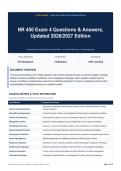
NR 450 Exam 4 Questions & Answers,
Updated 2026/2027 Edition
Comprehensive Examination Question Bank • In-Depth Rationales • Concept Mapping
TOTAL QUESTIONS EXAM TOPICS RATIONALES
275 Questions 12 Modules 100% Verified
DOCUMENT OVERVIEW
This document contains 275 verified questions with correct answers focused on critical concepts in biology
related to medical conditions, treatments, and management strategies. Each question is paired with an
answer, providing a comprehensive resource for students preparing for exams or seeking to enhance their
understanding of biological sciences in a medical context.
EXAM BLUEPRINT & TOPIC DISTRIBUTION
Systematic breakdown of subject domains and exam coverage.
Topic Module Scope & Core Focus
Explores the mechanism and therapeutic uses of calcium channel blockers in various
Calcium Channel Blockers medical conditions.
Bone Marrow Suppression Covers the causes, effects, and management of bone marrow suppression in patients.
Vitamin B12 Deficiency Discusses the symptoms, causes, and treatment options for vitamin B12 deficiency.
Management of Pain Examines various strategies for pain management across a range of conditions.
Hematologic Disorders Focuses on various hematologic conditions, their presentations, and treatment options.
Gastrointestinal Disorders Analyzes common gastrointestinal disorders and their management strategies.
Neurological Conditions Investigates neurological disorders, including their symptoms and diagnostic approaches.
Cancer Management Details management and treatment protocols for different types of cancer.
Respiratory Diseases Describes common respiratory diseases and their associated management techniques.
Cardiovascular Diseases Explores cardiovascular conditions, their risk factors, and management strategies.
Endocrine Disorders Covers various endocrine disorders and their implications for patient management.
Autoimmune Diseases Examines the characteristics and management of various autoimmune diseases.
Confidential • Student Study Edition • Practice & Review Guide Page 1 of 74
,STUDENT STUDY & MASTERY EDITION PRACTICE & REVIEW GUIDE
Total Exam Coverage 12 Integrated Topic Modules • 275 Examination Questions
Confidential • Student Study Edition • Practice & Review Guide Page 2 of 74
,STUDENT STUDY & MASTERY EDITION PRACTICE & REVIEW GUIDE
QUESTION 1
Cirrhosis
Correct Answer: Excessive, irreversible scarring of the liver usually caused by a chronic reaction a hepatic
inflammation and necrosis.
QUESTION 2
Chronic alcoholism 2) viral hepatitis 3) non-alcoholic steatohepatitis (fatty liver)
• drugs and chemical toxins
• bile duct disease
• cardiovascular disease
• genetic disease
Correct Answer: Causes of cirrhosis.
QUESTION 3
• ascites
• esophageal varices
• hepatic encephalopathy
Correct Answer: Complications of cirrhosis.
QUESTION 4
Ascites
Correct Answer: Collection of free fluid within the peritoneal cavity caused by increased hydrostatic
pressure from portal HTN resulting in fluid shifts (form of third spacing)
QUESTION 5
Esophageal varices
Correct Answer: Thin walled esophageal veins become distended and torturous from increased pressure
that can result in bleeding.
Confidential • Student Study Edition • Practice & Review Guide Page 3 of 74
, STUDENT STUDY & MASTERY EDITION PRACTICE & REVIEW GUIDE
QUESTION 6
Sengstaken-Blakemore tube
Correct Answer: Treatment for bleeding esophageal varices.
QUESTION 7
Hepatic encephalopathy
Correct Answer: A complex cognitive syndrome that results from liver failure and cirrhosis with
manifestations of sleep/mood disturbances, mental status changes, and speech problems.
QUESTION 8
Wernicke-korsakoff syndrome (WKS)
Correct Answer: Combined presence of wernicke's encephalopathy and korsakoff's syndrome typically seen
in alcoholics with a thiamine deficiency (vision changes, ataxia, impaired memory)
QUESTION 9
• fecal oral route
• flu-like symptoms
• self limiting
Correct Answer: Manifestations of HAV.
QUESTION 10
• unprotected sexual intercourse with infected partner, sharing needles, accidental needle-stick, blood transfusions, HD,
close contact with open wounds, immunocompromised populations
• anorexia, N/V, fever, fatigue, RUQ pain, dark urine/light stool, joint pain, jaundice
Correct Answer: Manifestations of HBV.
Confidential • Student Study Edition • Practice & Review Guide Page 4 of 74
NR 450 Exam 4 Questions & Answers,
Updated 2026/2027 Edition
Comprehensive Examination Question Bank • In-Depth Rationales • Concept Mapping
TOTAL QUESTIONS EXAM TOPICS RATIONALES
275 Questions 12 Modules 100% Verified
DOCUMENT OVERVIEW
This document contains 275 verified questions with correct answers focused on critical concepts in biology
related to medical conditions, treatments, and management strategies. Each question is paired with an
answer, providing a comprehensive resource for students preparing for exams or seeking to enhance their
understanding of biological sciences in a medical context.
EXAM BLUEPRINT & TOPIC DISTRIBUTION
Systematic breakdown of subject domains and exam coverage.
Topic Module Scope & Core Focus
Explores the mechanism and therapeutic uses of calcium channel blockers in various
Calcium Channel Blockers medical conditions.
Bone Marrow Suppression Covers the causes, effects, and management of bone marrow suppression in patients.
Vitamin B12 Deficiency Discusses the symptoms, causes, and treatment options for vitamin B12 deficiency.
Management of Pain Examines various strategies for pain management across a range of conditions.
Hematologic Disorders Focuses on various hematologic conditions, their presentations, and treatment options.
Gastrointestinal Disorders Analyzes common gastrointestinal disorders and their management strategies.
Neurological Conditions Investigates neurological disorders, including their symptoms and diagnostic approaches.
Cancer Management Details management and treatment protocols for different types of cancer.
Respiratory Diseases Describes common respiratory diseases and their associated management techniques.
Cardiovascular Diseases Explores cardiovascular conditions, their risk factors, and management strategies.
Endocrine Disorders Covers various endocrine disorders and their implications for patient management.
Autoimmune Diseases Examines the characteristics and management of various autoimmune diseases.
Confidential • Student Study Edition • Practice & Review Guide Page 1 of 74
,STUDENT STUDY & MASTERY EDITION PRACTICE & REVIEW GUIDE
Total Exam Coverage 12 Integrated Topic Modules • 275 Examination Questions
Confidential • Student Study Edition • Practice & Review Guide Page 2 of 74
,STUDENT STUDY & MASTERY EDITION PRACTICE & REVIEW GUIDE
QUESTION 1
Cirrhosis
Correct Answer: Excessive, irreversible scarring of the liver usually caused by a chronic reaction a hepatic
inflammation and necrosis.
QUESTION 2
Chronic alcoholism 2) viral hepatitis 3) non-alcoholic steatohepatitis (fatty liver)
• drugs and chemical toxins
• bile duct disease
• cardiovascular disease
• genetic disease
Correct Answer: Causes of cirrhosis.
QUESTION 3
• ascites
• esophageal varices
• hepatic encephalopathy
Correct Answer: Complications of cirrhosis.
QUESTION 4
Ascites
Correct Answer: Collection of free fluid within the peritoneal cavity caused by increased hydrostatic
pressure from portal HTN resulting in fluid shifts (form of third spacing)
QUESTION 5
Esophageal varices
Correct Answer: Thin walled esophageal veins become distended and torturous from increased pressure
that can result in bleeding.
Confidential • Student Study Edition • Practice & Review Guide Page 3 of 74
, STUDENT STUDY & MASTERY EDITION PRACTICE & REVIEW GUIDE
QUESTION 6
Sengstaken-Blakemore tube
Correct Answer: Treatment for bleeding esophageal varices.
QUESTION 7
Hepatic encephalopathy
Correct Answer: A complex cognitive syndrome that results from liver failure and cirrhosis with
manifestations of sleep/mood disturbances, mental status changes, and speech problems.
QUESTION 8
Wernicke-korsakoff syndrome (WKS)
Correct Answer: Combined presence of wernicke's encephalopathy and korsakoff's syndrome typically seen
in alcoholics with a thiamine deficiency (vision changes, ataxia, impaired memory)
QUESTION 9
• fecal oral route
• flu-like symptoms
• self limiting
Correct Answer: Manifestations of HAV.
QUESTION 10
• unprotected sexual intercourse with infected partner, sharing needles, accidental needle-stick, blood transfusions, HD,
close contact with open wounds, immunocompromised populations
• anorexia, N/V, fever, fatigue, RUQ pain, dark urine/light stool, joint pain, jaundice
Correct Answer: Manifestations of HBV.
Confidential • Student Study Edition • Practice & Review Guide Page 4 of 74