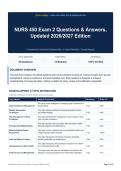
[STUDY GUIDE] • HIGH-YIELD PRACTICE & REVIEW EDITION
NURS 450 Exam 2 Questions & Answers,
Updated 2026/2027 Edition
Comprehensive Examination Question Bank • In-Depth Rationales • Concept Mapping
TOTAL QUESTIONS EXAM TOPICS RATIONALES
44 Questions 14 Modules 100% Verified
DOCUMENT OVERVIEW
This document contains 44 verified questions with correct answers focusing on nursing concepts such as pain
management, urinary incontinence, and post-operative care. Each question is designed to enhance
understanding of nursing principles, making it suitable for study, review, and certification preparation.
EXAM BLUEPRINT & TOPIC DISTRIBUTION
Systematic breakdown of subject domains and exam coverage.
Topic Module Scope & Core Focus Questions Share (%)
This topic covers strategies for managing urge incontinence in
Urge Incontinence Management female clients. 3 Qs 6.8%
Bladder Assessment This topic includes methods for assessing bladder function
Techniques and related findings. 3 Qs 6.8%
Pain Management in Renal This topic addresses the management of pain related to renal
Conditions colic and other conditions. 3 Qs 6.8%
This topic explores risks associated with decreased mobility
Post-operative Mobility Risks following surgeries like nephrectomy. 3 Qs 6.8%
Musculoskeletal System This topic involves assessing the musculoskeletal system and
Assessment recognizing age-related changes. 7 Qs 15.9%
This topic discusses the functions of muscles and joints,
Joint and Muscle Function including examples and assessments. 3 Qs 6.8%
This topic emphasizes the importance of calcium and vitamin
Osteoporosis and Bone Health D in maintaining bone health. 3 Qs 6.8%
This topic covers the care and management of patients with
Fracture Care and Management fractures, including assessment and intervention strategies. 4 Qs 9.1%
Confidential • Student Study Edition • Practice & Review Guide Page 1 of 18
,STUDENT STUDY & MASTERY EDITION PRACTICE & REVIEW GUIDE
This topic focuses on caring for patients post-surgery,
Post-surgical Patient Care addressing possible complications and recovery strategies. 5 Qs 11.4%
Muscle Strain and Pain This topic involves recognizing muscle strains and assessing
Assessment pain levels in patients. 2 Qs 4.5%
Osteomalacia Nutritional This topic discusses dietary recommendations for patients
Guidance with osteomalacia. 2 Qs 4.5%
Anticoagulation Therapy This topic covers the implications of anticoagulation therapy in
Awareness patients with atrial fibrillation. 2 Qs 4.5%
This topic focuses on assessing neurological symptoms such
Neurological Assessments as paresthesia. 2 Qs 4.5%
This topic includes assessing gait and mobility in older adults
Gait and Mobility Assessment or post-operative patients. 2 Qs 4.5%
Total Exam Coverage 14 Integrated Topic Modules 44 Qs 100.0%
Confidential • Student Study Edition • Practice & Review Guide Page 2 of 18
, STUDENT STUDY & MASTERY EDITION PRACTICE & REVIEW GUIDE
TOPIC 1: URGE INCONTINENCE MANAGEMENT
3 Questions • 6.8% of Exam • This topic covers strategies for managing urge incontinence in female clients.
QUESTION 1
The nurse is teaching a female client who is experiencing urge incontinence how to
manage her condition at home. Which statement by the client indicates a need for
further teaching?
[A] "I will empty my bladder when I first get up in the morning"
[B] "I will wait five minutes once I get the urge to go to the bathroom"
[C] "I will perform pelvic muscle exercises every day"
[D] "I will drink coffee with breakfast and lunch to help my condition"
Correct Answer: D.
QUESTION 2
The nurse is monitoring a patient who prescribed cyclobenzaprine (Flexeril) for lumbar
pain. Which of the following side effects is most important to monitor for ?
[A] Diarrhea
[B] Drowsiness
[C] Polyuria
[D] Dry mouth
Correct Answer: B.
QUESTION 3
60 YOM for TKA. PMH: OA of R knee, afib, CAD, HLD, smoker, drinks socially, no
surgical hx. Meds: diltiazem, atorvastatin, warfarin, and acetaminophen. Allergies:
latex, PCN. Which information requires priority intervention? Select all that apply.
[A] Client is at risk for myocardial infarction
[B] Client is at risk for inadequate finances
[C] Client at risk for an anaphylactic reaction.
[D] Client is at risk for hemorrhage.
[E] Client is at risk for respiratory complications
[F] Client may have an increased anxiety level
Confidential • Student Study Edition • Practice & Review Guide Page 3 of 18
NURS 450 Exam 2 Questions & Answers,
Updated 2026/2027 Edition
Comprehensive Examination Question Bank • In-Depth Rationales • Concept Mapping
TOTAL QUESTIONS EXAM TOPICS RATIONALES
44 Questions 14 Modules 100% Verified
DOCUMENT OVERVIEW
This document contains 44 verified questions with correct answers focusing on nursing concepts such as pain
management, urinary incontinence, and post-operative care. Each question is designed to enhance
understanding of nursing principles, making it suitable for study, review, and certification preparation.
EXAM BLUEPRINT & TOPIC DISTRIBUTION
Systematic breakdown of subject domains and exam coverage.
Topic Module Scope & Core Focus Questions Share (%)
This topic covers strategies for managing urge incontinence in
Urge Incontinence Management female clients. 3 Qs 6.8%
Bladder Assessment This topic includes methods for assessing bladder function
Techniques and related findings. 3 Qs 6.8%
Pain Management in Renal This topic addresses the management of pain related to renal
Conditions colic and other conditions. 3 Qs 6.8%
This topic explores risks associated with decreased mobility
Post-operative Mobility Risks following surgeries like nephrectomy. 3 Qs 6.8%
Musculoskeletal System This topic involves assessing the musculoskeletal system and
Assessment recognizing age-related changes. 7 Qs 15.9%
This topic discusses the functions of muscles and joints,
Joint and Muscle Function including examples and assessments. 3 Qs 6.8%
This topic emphasizes the importance of calcium and vitamin
Osteoporosis and Bone Health D in maintaining bone health. 3 Qs 6.8%
This topic covers the care and management of patients with
Fracture Care and Management fractures, including assessment and intervention strategies. 4 Qs 9.1%
Confidential • Student Study Edition • Practice & Review Guide Page 1 of 18
,STUDENT STUDY & MASTERY EDITION PRACTICE & REVIEW GUIDE
This topic focuses on caring for patients post-surgery,
Post-surgical Patient Care addressing possible complications and recovery strategies. 5 Qs 11.4%
Muscle Strain and Pain This topic involves recognizing muscle strains and assessing
Assessment pain levels in patients. 2 Qs 4.5%
Osteomalacia Nutritional This topic discusses dietary recommendations for patients
Guidance with osteomalacia. 2 Qs 4.5%
Anticoagulation Therapy This topic covers the implications of anticoagulation therapy in
Awareness patients with atrial fibrillation. 2 Qs 4.5%
This topic focuses on assessing neurological symptoms such
Neurological Assessments as paresthesia. 2 Qs 4.5%
This topic includes assessing gait and mobility in older adults
Gait and Mobility Assessment or post-operative patients. 2 Qs 4.5%
Total Exam Coverage 14 Integrated Topic Modules 44 Qs 100.0%
Confidential • Student Study Edition • Practice & Review Guide Page 2 of 18
, STUDENT STUDY & MASTERY EDITION PRACTICE & REVIEW GUIDE
TOPIC 1: URGE INCONTINENCE MANAGEMENT
3 Questions • 6.8% of Exam • This topic covers strategies for managing urge incontinence in female clients.
QUESTION 1
The nurse is teaching a female client who is experiencing urge incontinence how to
manage her condition at home. Which statement by the client indicates a need for
further teaching?
[A] "I will empty my bladder when I first get up in the morning"
[B] "I will wait five minutes once I get the urge to go to the bathroom"
[C] "I will perform pelvic muscle exercises every day"
[D] "I will drink coffee with breakfast and lunch to help my condition"
Correct Answer: D.
QUESTION 2
The nurse is monitoring a patient who prescribed cyclobenzaprine (Flexeril) for lumbar
pain. Which of the following side effects is most important to monitor for ?
[A] Diarrhea
[B] Drowsiness
[C] Polyuria
[D] Dry mouth
Correct Answer: B.
QUESTION 3
60 YOM for TKA. PMH: OA of R knee, afib, CAD, HLD, smoker, drinks socially, no
surgical hx. Meds: diltiazem, atorvastatin, warfarin, and acetaminophen. Allergies:
latex, PCN. Which information requires priority intervention? Select all that apply.
[A] Client is at risk for myocardial infarction
[B] Client is at risk for inadequate finances
[C] Client at risk for an anaphylactic reaction.
[D] Client is at risk for hemorrhage.
[E] Client is at risk for respiratory complications
[F] Client may have an increased anxiety level
Confidential • Student Study Edition • Practice & Review Guide Page 3 of 18