[STUDY GUIDE] • HIGH-YIELD PRACTICE & REVIEW EDITION
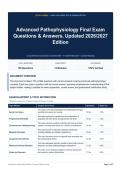
Advanced Pathophysiology Final Exam
Questions & Answers, Updated 2026/2027
Edition
Comprehensive Examination Question Bank • In-Depth Rationales • Concept Mapping
TOTAL QUESTIONS EXAM TOPICS RATIONALES
159 Questions 14 Modules 100% Verified
DOCUMENT OVERVIEW
This document contains 159 verified questions with correct answers covering advanced pathophysiology
concepts. Each item pairs a question with the correct answer, ensuring comprehensive understanding of the
subject matter, making it suitable for exam preparation, course review, and professional certification study.
EXAM BLUEPRINT & TOPIC DISTRIBUTION
Systematic breakdown of subject domains and exam coverage.
Topic Module Scope & Core Focus Questions Share (%)
This topic covers the physiological and pathological changes
Spinal Cord Injury resulting from spinal cord injuries. 12 Qs 7.5%
This topic explores the mechanisms and implications of
Programmed Cell Death apoptosis and other forms of programmed cell death. 12 Qs 7.5%
This topic examines conditions affecting the heart and blood
Cardiovascular Pathophysiology vessels, including heart failure and vascular complications. 12 Qs 7.5%
This topic focuses on disorders related to metabolism,
Metabolic Disorders including diabetes and related complications. 12 Qs 7.5%
This topic discusses various congenital heart anomalies and
Congenital Heart Defects their physiological effects. 12 Qs 7.5%
This topic addresses disorders related to blood cells, immune
Blood and Immune Disorders response, and their pathophysiological implications. 11 Qs 6.9%
This topic covers diseases related to hormonal imbalances
Endocrine Disorders and endocrine system dysfunctions. 11 Qs 6.9%
Confidential • Student Study Edition • Practice & Review Guide Page 1 of 47
,STUDENT STUDY & MASTERY EDITION PRACTICE & REVIEW GUIDE
Gastrointestinal This topic focuses on diseases affecting the gastrointestinal
Pathophysiology system and their systemic effects. 11 Qs 6.9%
This topic examines various respiratory conditions and their
Respiratory Disorders impact on pulmonary function. 11 Qs 6.9%
This topic discusses the biological mechanisms of cancer
Cancer Biology development and progression. 11 Qs 6.9%
This topic addresses kidney diseases, their pathophysiology,
Kidney Disorders and resulting systemic effects. 11 Qs 6.9%
This topic explores various neurological conditions and their
Neurological Disorders pathophysiological basis. 11 Qs 6.9%
This topic focuses on blood-related conditions, including
Hematological Disorders anemias and coagulation disorders. 11 Qs 6.9%
Reproductive System This topic discusses disorders of the reproductive system and
Pathophysiology their physiological implications. 11 Qs 6.9%
Total Exam Coverage 14 Integrated Topic Modules 159 Qs 100.0%
Confidential • Student Study Edition • Practice & Review Guide Page 2 of 47
,STUDENT STUDY & MASTERY EDITION PRACTICE & REVIEW GUIDE
TOPIC 1: SPINAL CORD INJURY
12 Questions • 7.5% of Exam • This topic covers the physiological and pathological changes resulting from spinal cord injuries.
QUESTION 1
Physiologic jaundice
Correct Answer: A 3-day old infant is noted to have a mildly elevated unconjugated bilirubin level and
icterus. Your concern is that this child may have:
a. physiologic jaundice
b. kernicterus
c. glucose-6-phosphate dehydrogenase deficiency
d. pathologic jaundice.
QUESTION 2
Lysosomes
Correct Answer: Which cell component is capable of cellular autodigestion when it is released during cell
injury?
a. lysosomes
b. ribosomesc. smooth endoplasmic reticulum
d. golgi complex.
QUESTION 3
Which component of the cell produces hydrogen peroxide (H2O2) by using oxygen to
remove hydrogen atoms from specific substrates in an oxidative reaction?
[A)] lysosomes
[B)] peroxisomes
[C)] ribosomes
[D)] oxyhydrosomes
Correct Answer: Ans: B- peroxisomes.
Confidential • Student Study Edition • Practice & Review Guide Page 3 of 47
, STUDENT STUDY & MASTERY EDITION PRACTICE & REVIEW GUIDE
QUESTION 4
What term is used to describe the complication that can result from a spinal cord injury
above T6 that is producing paroxysmal hypertension, as well as piloerection ans
sweating above the spinal cord lesion?
[A)] craniosacral dysreflexia
[B)] parasympathetic dysreflexia
[C)] autonomic hyperreflexia
[D)] retrograde hyperreflexia
Correct Answer: Ans: C- autonomic hyperreflexia.
QUESTION 5
A patient diagnosed with diabetic ketoacidosis (DKA) has the following laboratory
values: arterial pH 7.20, serum glucose 500 mg/dL, positive urine glucose and ketones,
serum postassium (K+) 2 mEq/L, and serum sodium (Na+) 130 mEq/L. The patient
reports that he has been sick with the "flu" for a week. What relationship do these
values have to his insulin deficiency?
[A)] increased glucose use causes the shift of fluid from the intravascular to the intracellular space
[B)] decreased glucose use causes fatty acid use, ketogenesis, metabolic acidosis, and osmotic diuresis
[C)] increased glucose and fatty acids stimulate renal diuresis, electrolyte loss, and metabolic alkalosis
[D)] decreased glucose use results in protein catabolism, tissue wasting, respiratory acidosis, and electrolyte loss
Correct Answer: Ans: B- decreased glucose use causes fatty acid use, ketogenesis, metabolic acidosis, and
osmotic diuresis.
QUESTION 6
Capillary permeability
Correct Answer: The cause of pulmonary edema in ARDS is the result of increased:
a. oncotic pressure increase by fulminant trauma to the lungs
b. capillary hydrostatic pressure
c. levels of serum sodium and water
d. capillary permeability.
Confidential • Student Study Edition • Practice & Review Guide Page 4 of 47
Advanced Pathophysiology Final Exam
Questions & Answers, Updated 2026/2027
Edition
Comprehensive Examination Question Bank • In-Depth Rationales • Concept Mapping
TOTAL QUESTIONS EXAM TOPICS RATIONALES
159 Questions 14 Modules 100% Verified
DOCUMENT OVERVIEW
This document contains 159 verified questions with correct answers covering advanced pathophysiology
concepts. Each item pairs a question with the correct answer, ensuring comprehensive understanding of the
subject matter, making it suitable for exam preparation, course review, and professional certification study.
EXAM BLUEPRINT & TOPIC DISTRIBUTION
Systematic breakdown of subject domains and exam coverage.
Topic Module Scope & Core Focus Questions Share (%)
This topic covers the physiological and pathological changes
Spinal Cord Injury resulting from spinal cord injuries. 12 Qs 7.5%
This topic explores the mechanisms and implications of
Programmed Cell Death apoptosis and other forms of programmed cell death. 12 Qs 7.5%
This topic examines conditions affecting the heart and blood
Cardiovascular Pathophysiology vessels, including heart failure and vascular complications. 12 Qs 7.5%
This topic focuses on disorders related to metabolism,
Metabolic Disorders including diabetes and related complications. 12 Qs 7.5%
This topic discusses various congenital heart anomalies and
Congenital Heart Defects their physiological effects. 12 Qs 7.5%
This topic addresses disorders related to blood cells, immune
Blood and Immune Disorders response, and their pathophysiological implications. 11 Qs 6.9%
This topic covers diseases related to hormonal imbalances
Endocrine Disorders and endocrine system dysfunctions. 11 Qs 6.9%
Confidential • Student Study Edition • Practice & Review Guide Page 1 of 47
,STUDENT STUDY & MASTERY EDITION PRACTICE & REVIEW GUIDE
Gastrointestinal This topic focuses on diseases affecting the gastrointestinal
Pathophysiology system and their systemic effects. 11 Qs 6.9%
This topic examines various respiratory conditions and their
Respiratory Disorders impact on pulmonary function. 11 Qs 6.9%
This topic discusses the biological mechanisms of cancer
Cancer Biology development and progression. 11 Qs 6.9%
This topic addresses kidney diseases, their pathophysiology,
Kidney Disorders and resulting systemic effects. 11 Qs 6.9%
This topic explores various neurological conditions and their
Neurological Disorders pathophysiological basis. 11 Qs 6.9%
This topic focuses on blood-related conditions, including
Hematological Disorders anemias and coagulation disorders. 11 Qs 6.9%
Reproductive System This topic discusses disorders of the reproductive system and
Pathophysiology their physiological implications. 11 Qs 6.9%
Total Exam Coverage 14 Integrated Topic Modules 159 Qs 100.0%
Confidential • Student Study Edition • Practice & Review Guide Page 2 of 47
,STUDENT STUDY & MASTERY EDITION PRACTICE & REVIEW GUIDE
TOPIC 1: SPINAL CORD INJURY
12 Questions • 7.5% of Exam • This topic covers the physiological and pathological changes resulting from spinal cord injuries.
QUESTION 1
Physiologic jaundice
Correct Answer: A 3-day old infant is noted to have a mildly elevated unconjugated bilirubin level and
icterus. Your concern is that this child may have:
a. physiologic jaundice
b. kernicterus
c. glucose-6-phosphate dehydrogenase deficiency
d. pathologic jaundice.
QUESTION 2
Lysosomes
Correct Answer: Which cell component is capable of cellular autodigestion when it is released during cell
injury?
a. lysosomes
b. ribosomesc. smooth endoplasmic reticulum
d. golgi complex.
QUESTION 3
Which component of the cell produces hydrogen peroxide (H2O2) by using oxygen to
remove hydrogen atoms from specific substrates in an oxidative reaction?
[A)] lysosomes
[B)] peroxisomes
[C)] ribosomes
[D)] oxyhydrosomes
Correct Answer: Ans: B- peroxisomes.
Confidential • Student Study Edition • Practice & Review Guide Page 3 of 47
, STUDENT STUDY & MASTERY EDITION PRACTICE & REVIEW GUIDE
QUESTION 4
What term is used to describe the complication that can result from a spinal cord injury
above T6 that is producing paroxysmal hypertension, as well as piloerection ans
sweating above the spinal cord lesion?
[A)] craniosacral dysreflexia
[B)] parasympathetic dysreflexia
[C)] autonomic hyperreflexia
[D)] retrograde hyperreflexia
Correct Answer: Ans: C- autonomic hyperreflexia.
QUESTION 5
A patient diagnosed with diabetic ketoacidosis (DKA) has the following laboratory
values: arterial pH 7.20, serum glucose 500 mg/dL, positive urine glucose and ketones,
serum postassium (K+) 2 mEq/L, and serum sodium (Na+) 130 mEq/L. The patient
reports that he has been sick with the "flu" for a week. What relationship do these
values have to his insulin deficiency?
[A)] increased glucose use causes the shift of fluid from the intravascular to the intracellular space
[B)] decreased glucose use causes fatty acid use, ketogenesis, metabolic acidosis, and osmotic diuresis
[C)] increased glucose and fatty acids stimulate renal diuresis, electrolyte loss, and metabolic alkalosis
[D)] decreased glucose use results in protein catabolism, tissue wasting, respiratory acidosis, and electrolyte loss
Correct Answer: Ans: B- decreased glucose use causes fatty acid use, ketogenesis, metabolic acidosis, and
osmotic diuresis.
QUESTION 6
Capillary permeability
Correct Answer: The cause of pulmonary edema in ARDS is the result of increased:
a. oncotic pressure increase by fulminant trauma to the lungs
b. capillary hydrostatic pressure
c. levels of serum sodium and water
d. capillary permeability.
Confidential • Student Study Edition • Practice & Review Guide Page 4 of 47