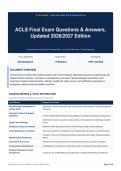
[STUDY GUIDE] • HIGH-YIELD PRACTICE & REVIEW EDITION
ACLS Final Exam Questions & Answers,
Updated 2026/2027 Edition
Comprehensive Examination Question Bank • In-Depth Rationales • Concept Mapping
TOTAL QUESTIONS EXAM TOPICS RATIONALES
240 Questions 11 Modules 100% Verified
DOCUMENT OVERVIEW
This document contains 240 verified questions with correct answers addressing advanced cardiovascular life
support (ACLS) concepts. It provides a comprehensive overview of pharmacological interventions and
protocols in cardiac arrest scenarios, making it suitable for study, review, and certification preparation in
emergency medicine and resuscitation practices.
EXAM BLUEPRINT & TOPIC DISTRIBUTION
Systematic breakdown of subject domains and exam coverage.
Topic Module Scope & Core Focus
Pharmacological Management in Explores the various medications used during cardiac arrest scenarios, including dosing and
Cardiac Arrest indications.
Advanced Cardiac Life Support
Guidelines Covers the latest ACLS protocols and guidelines for managing cardiovascular emergencies.
Examines the common causes of cardiac arrest and the importance of identifying reversible
Cardiac Arrest Etiology factors.
Emergency Response Protocols Details the initial steps and protocols to follow during a cardiac arrest emergency.
Airway Management Techniques Discusses procedures for establishing and maintaining airway patency in critical situations.
Focuses on the use of monitoring devices and assessment techniques during resuscitation
Monitoring and Assessment efforts.
Post-Cardiac Arrest Care Reviews recommended practices and interventions following successful resuscitation.
Tachyarrhythmia Management Investigates the management of rapid heart rhythms, including pharmacological options.
Electrical Therapies in Cardiac
Emergencies Covers the use of defibrillation and cardioversion in treating life-threatening arrhythmias.
Confidential • Student Study Edition • Practice & Review Guide Page 1 of 48
,STUDENT STUDY & MASTERY EDITION PRACTICE & REVIEW GUIDE
Clinical Considerations for High-Risk
Patients Examines special considerations when managing patients with underlying health conditions.
Quality Improvement in Resuscitation Explores strategies for improving the quality of resuscitation efforts and outcomes.
Total Exam Coverage 11 Integrated Topic Modules • 240 Examination Questions
Confidential • Student Study Edition • Practice & Review Guide Page 2 of 48
,STUDENT STUDY & MASTERY EDITION PRACTICE & REVIEW GUIDE
QUESTION 1
Dosing of epinephrine in the setting of VF/pVT and asystole/PEA
Correct Answer: 1 Mg every 3-5 minutes.
QUESTION 2
Dosing of amiodarone (first and second dose) in the setting of cardiac arrest
Correct Answer: 300Mg first dose
150mg second dose after 3-5 min.
QUESTION 3
Dosing of lidocaine (first and second dose) in the setting of cardiac arrest
Correct Answer: 1-1.5Mg/kg first dose
0.5-0.75 mg/kg second dose, repeat in 5-10 min.
QUESTION 4
What is the maximum dose of lidocaine?
Correct Answer: 3 Doses or 3mg/kg.
QUESTION 5
ROSC is typically signified by a PETCO2 of what?
Correct Answer: 40 MmHg or more.
Confidential • Student Study Edition • Practice & Review Guide Page 3 of 48
, STUDENT STUDY & MASTERY EDITION PRACTICE & REVIEW GUIDE
QUESTION 6
The "Hs" of reversible causes of cardiac arrest
Correct Answer: 1. Hypovolemia
2. Hypoxia
3. Hydrogen ions (acidosis)
4. Hypo/hyperkalemia
5. Hypothermia.
QUESTION 7
The "Ts" of reversible causes of cardiac arrest
Correct Answer: 1. Tension pneumothorax
2. Tamponade, cardiac
3. Toxins
4. Thrombosis, pulmonary
5. Thrombosis, coronary.
QUESTION 8
In the setting of cardiac arrest, once an advanced airway is in place, 1 breath should be
given every ______ seconds. Should chest compressions be interrupted once an
advanced airway is in place?
Correct Answer: 6-8 Seconds (8-10 breaths/min) with continuous chest compressions.
QUESTION 9
If PETCO2 falls below ______, attempts should be made to improve chest
compressions
Correct Answer: 10.
Confidential • Student Study Edition • Practice & Review Guide Page 4 of 48
ACLS Final Exam Questions & Answers,
Updated 2026/2027 Edition
Comprehensive Examination Question Bank • In-Depth Rationales • Concept Mapping
TOTAL QUESTIONS EXAM TOPICS RATIONALES
240 Questions 11 Modules 100% Verified
DOCUMENT OVERVIEW
This document contains 240 verified questions with correct answers addressing advanced cardiovascular life
support (ACLS) concepts. It provides a comprehensive overview of pharmacological interventions and
protocols in cardiac arrest scenarios, making it suitable for study, review, and certification preparation in
emergency medicine and resuscitation practices.
EXAM BLUEPRINT & TOPIC DISTRIBUTION
Systematic breakdown of subject domains and exam coverage.
Topic Module Scope & Core Focus
Pharmacological Management in Explores the various medications used during cardiac arrest scenarios, including dosing and
Cardiac Arrest indications.
Advanced Cardiac Life Support
Guidelines Covers the latest ACLS protocols and guidelines for managing cardiovascular emergencies.
Examines the common causes of cardiac arrest and the importance of identifying reversible
Cardiac Arrest Etiology factors.
Emergency Response Protocols Details the initial steps and protocols to follow during a cardiac arrest emergency.
Airway Management Techniques Discusses procedures for establishing and maintaining airway patency in critical situations.
Focuses on the use of monitoring devices and assessment techniques during resuscitation
Monitoring and Assessment efforts.
Post-Cardiac Arrest Care Reviews recommended practices and interventions following successful resuscitation.
Tachyarrhythmia Management Investigates the management of rapid heart rhythms, including pharmacological options.
Electrical Therapies in Cardiac
Emergencies Covers the use of defibrillation and cardioversion in treating life-threatening arrhythmias.
Confidential • Student Study Edition • Practice & Review Guide Page 1 of 48
,STUDENT STUDY & MASTERY EDITION PRACTICE & REVIEW GUIDE
Clinical Considerations for High-Risk
Patients Examines special considerations when managing patients with underlying health conditions.
Quality Improvement in Resuscitation Explores strategies for improving the quality of resuscitation efforts and outcomes.
Total Exam Coverage 11 Integrated Topic Modules • 240 Examination Questions
Confidential • Student Study Edition • Practice & Review Guide Page 2 of 48
,STUDENT STUDY & MASTERY EDITION PRACTICE & REVIEW GUIDE
QUESTION 1
Dosing of epinephrine in the setting of VF/pVT and asystole/PEA
Correct Answer: 1 Mg every 3-5 minutes.
QUESTION 2
Dosing of amiodarone (first and second dose) in the setting of cardiac arrest
Correct Answer: 300Mg first dose
150mg second dose after 3-5 min.
QUESTION 3
Dosing of lidocaine (first and second dose) in the setting of cardiac arrest
Correct Answer: 1-1.5Mg/kg first dose
0.5-0.75 mg/kg second dose, repeat in 5-10 min.
QUESTION 4
What is the maximum dose of lidocaine?
Correct Answer: 3 Doses or 3mg/kg.
QUESTION 5
ROSC is typically signified by a PETCO2 of what?
Correct Answer: 40 MmHg or more.
Confidential • Student Study Edition • Practice & Review Guide Page 3 of 48
, STUDENT STUDY & MASTERY EDITION PRACTICE & REVIEW GUIDE
QUESTION 6
The "Hs" of reversible causes of cardiac arrest
Correct Answer: 1. Hypovolemia
2. Hypoxia
3. Hydrogen ions (acidosis)
4. Hypo/hyperkalemia
5. Hypothermia.
QUESTION 7
The "Ts" of reversible causes of cardiac arrest
Correct Answer: 1. Tension pneumothorax
2. Tamponade, cardiac
3. Toxins
4. Thrombosis, pulmonary
5. Thrombosis, coronary.
QUESTION 8
In the setting of cardiac arrest, once an advanced airway is in place, 1 breath should be
given every ______ seconds. Should chest compressions be interrupted once an
advanced airway is in place?
Correct Answer: 6-8 Seconds (8-10 breaths/min) with continuous chest compressions.
QUESTION 9
If PETCO2 falls below ______, attempts should be made to improve chest
compressions
Correct Answer: 10.
Confidential • Student Study Edition • Practice & Review Guide Page 4 of 48