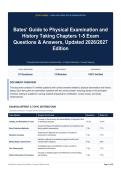
[STUDY GUIDE] • HIGH-YIELD PRACTICE & REVIEW EDITION
Bates' Guide to Physical Examination and
History Taking Chapters 1-5 Exam
Questions & Answers, Updated 2026/2027
Edition
Comprehensive Examination Question Bank • In-Depth Rationales • Concept Mapping
TOTAL QUESTIONS EXAM TOPICS RATIONALES
91 Questions 12 Modules 100% Verified
DOCUMENT OVERVIEW
This document contains 91 verified questions with correct answers related to physical examination and history
taking. Each item pairs an examination question with the correct answer, ensuring clarity on the principles
involved, making it suitable for nursing students preparing for certification, course review, and study
reinforcement.
EXAM BLUEPRINT & TOPIC DISTRIBUTION
Systematic breakdown of subject domains and exam coverage.
Topic Module Scope & Core Focus Questions Share (%)
Focuses on the accuracy and dependability of diagnostic tests
Validity and Reliability of Tests in identifying diseases. 14 Qs 15.4%
Covers techniques for gathering subjective and objective data
Data Collection Methods during patient assessments. 7 Qs 7.7%
Examines the attributes and evaluation of symptoms
Symptom Analysis presented by individuals. 7 Qs 7.7%
Explores methods for evaluating cognitive function and
Mental Status Assessment mental health indicators. 8 Qs 8.8%
Investigates types and definitions of pain, as well as
Pain Assessment assessment techniques. 7 Qs 7.7%
Focuses on building rapport and effectively communicating
Patient Interaction Techniques with patients. 7 Qs 7.7%
Confidential • Student Study Edition • Practice & Review Guide Page 1 of 22
,STUDENT STUDY & MASTERY EDITION PRACTICE & REVIEW GUIDE
Cultural and Ethical Reviews principles such as autonomy and non-maleficence in
Considerations patient care. 7 Qs 7.7%
Vital Signs and Physical Addresses techniques for measuring vital signs and
Assessment interpreting the results. 7 Qs 7.7%
Memory and Cognitive Evaluates methods for assessing various aspects of memory
Functioning and cognition. 7 Qs 7.7%
Neurological and Physical Covers assessment techniques related to neurological status
Examination and physical examination. 7 Qs 7.7%
Understanding Delusions and Examines types of delusions and hallucinations as part of
Hallucinations mental health assessments. 7 Qs 7.7%
Focuses on dietary components and their significance to
Nutrition and Health overall health. 6 Qs 6.6%
Total Exam Coverage 12 Integrated Topic Modules 91 Qs 100.0%
Confidential • Student Study Edition • Practice & Review Guide Page 2 of 22
, STUDENT STUDY & MASTERY EDITION PRACTICE & REVIEW GUIDE
TOPIC 1: VALIDITY AND RELIABILITY OF TESTS
14 Questions • 15.4% of Exam • Focuses on the accuracy and dependability of diagnostic tests in identifying diseases.
QUESTION 1
Validity
Correct Answer: Does the test accurately identify whether a patient has a disease?
This involves comparing the test against a "gold standard" (the best measure of wether a patient has
disease).
The initial step in evaluating a diagnostic test.
QUESTION 2
Sensitivity
Correct Answer: The probability that a person with disease has a POSITIVE test.
Also known as the "true positive" rate.
Useful for screening tests because if sensitivity is > 90%, you can rule OUT diseases (test is rarely negative
when the disease is present)
Ex) The probability that a patient with splenomegaly is associated with percussion dullness below the left
costal margin.
QUESTION 3
Specificity
Correct Answer: The probability that a non-diseased person has a NEGATIVE test.
Also known as the "true negative" rate.
Useful as confirmatory tests because if specificity is >90%, it is safe to confirm diseases (test is rarely
positive when the disease is absent)
Ex) The probability that a patient WITHOUT splenomegaly will have percussion dullness is the false positive
rate for this physical maneuver.
QUESTION 4
A negative result from a test with high sensitivity...
Correct Answer: ...Usually means you can exclude the disease.
(high sensitivity = very low false-negative rate)
Confidential • Student Study Edition • Practice & Review Guide Page 3 of 22
Bates' Guide to Physical Examination and
History Taking Chapters 1-5 Exam
Questions & Answers, Updated 2026/2027
Edition
Comprehensive Examination Question Bank • In-Depth Rationales • Concept Mapping
TOTAL QUESTIONS EXAM TOPICS RATIONALES
91 Questions 12 Modules 100% Verified
DOCUMENT OVERVIEW
This document contains 91 verified questions with correct answers related to physical examination and history
taking. Each item pairs an examination question with the correct answer, ensuring clarity on the principles
involved, making it suitable for nursing students preparing for certification, course review, and study
reinforcement.
EXAM BLUEPRINT & TOPIC DISTRIBUTION
Systematic breakdown of subject domains and exam coverage.
Topic Module Scope & Core Focus Questions Share (%)
Focuses on the accuracy and dependability of diagnostic tests
Validity and Reliability of Tests in identifying diseases. 14 Qs 15.4%
Covers techniques for gathering subjective and objective data
Data Collection Methods during patient assessments. 7 Qs 7.7%
Examines the attributes and evaluation of symptoms
Symptom Analysis presented by individuals. 7 Qs 7.7%
Explores methods for evaluating cognitive function and
Mental Status Assessment mental health indicators. 8 Qs 8.8%
Investigates types and definitions of pain, as well as
Pain Assessment assessment techniques. 7 Qs 7.7%
Focuses on building rapport and effectively communicating
Patient Interaction Techniques with patients. 7 Qs 7.7%
Confidential • Student Study Edition • Practice & Review Guide Page 1 of 22
,STUDENT STUDY & MASTERY EDITION PRACTICE & REVIEW GUIDE
Cultural and Ethical Reviews principles such as autonomy and non-maleficence in
Considerations patient care. 7 Qs 7.7%
Vital Signs and Physical Addresses techniques for measuring vital signs and
Assessment interpreting the results. 7 Qs 7.7%
Memory and Cognitive Evaluates methods for assessing various aspects of memory
Functioning and cognition. 7 Qs 7.7%
Neurological and Physical Covers assessment techniques related to neurological status
Examination and physical examination. 7 Qs 7.7%
Understanding Delusions and Examines types of delusions and hallucinations as part of
Hallucinations mental health assessments. 7 Qs 7.7%
Focuses on dietary components and their significance to
Nutrition and Health overall health. 6 Qs 6.6%
Total Exam Coverage 12 Integrated Topic Modules 91 Qs 100.0%
Confidential • Student Study Edition • Practice & Review Guide Page 2 of 22
, STUDENT STUDY & MASTERY EDITION PRACTICE & REVIEW GUIDE
TOPIC 1: VALIDITY AND RELIABILITY OF TESTS
14 Questions • 15.4% of Exam • Focuses on the accuracy and dependability of diagnostic tests in identifying diseases.
QUESTION 1
Validity
Correct Answer: Does the test accurately identify whether a patient has a disease?
This involves comparing the test against a "gold standard" (the best measure of wether a patient has
disease).
The initial step in evaluating a diagnostic test.
QUESTION 2
Sensitivity
Correct Answer: The probability that a person with disease has a POSITIVE test.
Also known as the "true positive" rate.
Useful for screening tests because if sensitivity is > 90%, you can rule OUT diseases (test is rarely negative
when the disease is present)
Ex) The probability that a patient with splenomegaly is associated with percussion dullness below the left
costal margin.
QUESTION 3
Specificity
Correct Answer: The probability that a non-diseased person has a NEGATIVE test.
Also known as the "true negative" rate.
Useful as confirmatory tests because if specificity is >90%, it is safe to confirm diseases (test is rarely
positive when the disease is absent)
Ex) The probability that a patient WITHOUT splenomegaly will have percussion dullness is the false positive
rate for this physical maneuver.
QUESTION 4
A negative result from a test with high sensitivity...
Correct Answer: ...Usually means you can exclude the disease.
(high sensitivity = very low false-negative rate)
Confidential • Student Study Edition • Practice & Review Guide Page 3 of 22