
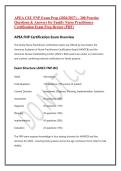
APEA CEU FNP Exam Prep (2026/2027) – 200 Practice
Questions & Answers for Family Nurse Practitioner
Certification Exam Prep Review (PDF)
APEA FNP Certification Exam Overview
The Family Nurse Practitioner certification exams are offered by two bodies: the
American Academy of Nurse Practitioners Certification Board (AANPCB) and the
American Nurses Credentialing Center (ANCC). Both exams are similar in construction
and content, conferring national certification for family practice.
Exam Structure (ANCC FNP-BC)
Detail Information
Total Questions 175 questions (150 scored, 25 pretest)
Content Domains Assessment, Diagnosis, Planning, Implementation, Evaluation
Assessment 29 questions (19%)
Diagnosis 26 questions (17%)
Planning 29 questions (19%)
Implementation 43 questions (29%)
Evaluation 23 questions (15%)
The FNP exam assesses knowledge in four testing domains for AANPCB and five
domains for ANCC, covering body systems across the age continuum from infant to frail
elderly.
,Content Coverage Areas
The exam covers these body systems and drug agents:
Body Systems: Cardiovascular, Endocrine, Gastrointestinal, Genitourinary, HEENT,
Hematopoietic, Immune, Integumentary, Musculoskeletal, Neurological, Psychiatric,
Reproductive, Respiratory.
Drug Agents: Analgesic, Anti-Infective, Cardiovascular, Endocrine, Eye/Ear/Nose/Skin,
Gastrointestinal, Genitourinary, Musculoskeletal, Neurological, Psychiatric, Reproductive,
Respiratory.
Section 1: Cardiovascular Disorders (Questions 1–25)
1. A 60-year-old male with a history of hypertension presents with a new onset of a
"tearing" sensation in his chest radiating to his back. His BP is 180/100 mmHg. What is
the most likely diagnosis?
A. Myocardial Infarction
B. Aortic Dissection
C. Pulmonary Embolism
D. Tension Pneumothorax
Correct Answer: B
Rationale: A "tearing" or "ripping" sensation radiating to the back is a hallmark sign of
aortic dissection, often associated with severe hypertension.
2. Which heart sound is a common finding in an elderly patient with heart failure and
indicates fluid volume overload?
A. S1
B. S2
,C. S3
D. S4
Correct Answer: C
Rationale: An S3 (ventricular gallop) indicates a loss of ventricular compliance and is
often associated with fluid volume overload in heart failure patients.
3. A patient with palpitations has an ECG showing a narrow QRS complex tachycardia at
180 beats per minute. The rhythm is regular. What is the most likely rhythm?
A. Atrial fibrillation
B. SVT (Supraventricular tachycardia)
C. Ventricular tachycardia
D. Atrial flutter with variable block
Correct Answer: B
Rationale: SVT presents with a regular, narrow-complex tachycardia. Atrial fibrillation is
irregularly irregular; ventricular tachycardia is wide-complex; atrial flutter with variable
block is irregular.
4. A patient with hypertension and chronic kidney disease has a blood pressure of
142/90 mmHg on lisinopril 20 mg and hydrochlorothiazide 25 mg. What is the most
appropriate next step?
A. Increase lisinopril to 40 mg
B. Add amlodipine
C. Increase hydrochlorothiazide to 50 mg
D. Add a beta-blocker
Correct Answer: B
Rationale: Adding a calcium channel blocker like amlodipine is appropriate when two
agents are insufficient for blood pressure control in CKD.
5. A 58-year-old male presents with progressive dyspnea on exertion, orthopnea, and
bilateral lower extremity edema. Exam reveals JVD, an S3 gallop, and bibasilar crackles.
, BNP is 850 pg/mL. Which diagnosis is most likely?
A. COPD exacerbation
B. Heart failure with reduced ejection fraction
C. Pulmonary embolism
D. Pneumonia
Correct Answer: B
Rationale: The classic triad of heart failure plus objective findings (JVD, S3 gallop,
crackles, elevated BNP) strongly supports HF.
6. A patient with heart failure has a BNP of 850 pg/mL. What does this indicate?
A. Normal cardiac function
B. Volume overload and heart failure
C. Pulmonary embolism
D. COPD exacerbation
Correct Answer: B
Rationale: BNP >400 pg/mL strongly supports heart failure with volume overload.
7. The compensatory mechanism in early congestive heart failure involves:
A. Decreased preload
B. Increased sympathetic tone
C. Decreased afterload
D. Reduced renin release
Correct Answer: B
Rationale: Early heart failure triggers increased sympathetic tone to maintain cardiac
output, though this eventually becomes maladaptive.
8. A patient with a history of heart failure and hypertension presents with new-onset
dyspnea and bilateral lower extremity edema. Which medication class should be used
with caution?
A. ACE inhibitors
Questions & Answers for Family Nurse Practitioner
Certification Exam Prep Review (PDF)
APEA FNP Certification Exam Overview
The Family Nurse Practitioner certification exams are offered by two bodies: the
American Academy of Nurse Practitioners Certification Board (AANPCB) and the
American Nurses Credentialing Center (ANCC). Both exams are similar in construction
and content, conferring national certification for family practice.
Exam Structure (ANCC FNP-BC)
Detail Information
Total Questions 175 questions (150 scored, 25 pretest)
Content Domains Assessment, Diagnosis, Planning, Implementation, Evaluation
Assessment 29 questions (19%)
Diagnosis 26 questions (17%)
Planning 29 questions (19%)
Implementation 43 questions (29%)
Evaluation 23 questions (15%)
The FNP exam assesses knowledge in four testing domains for AANPCB and five
domains for ANCC, covering body systems across the age continuum from infant to frail
elderly.
,Content Coverage Areas
The exam covers these body systems and drug agents:
Body Systems: Cardiovascular, Endocrine, Gastrointestinal, Genitourinary, HEENT,
Hematopoietic, Immune, Integumentary, Musculoskeletal, Neurological, Psychiatric,
Reproductive, Respiratory.
Drug Agents: Analgesic, Anti-Infective, Cardiovascular, Endocrine, Eye/Ear/Nose/Skin,
Gastrointestinal, Genitourinary, Musculoskeletal, Neurological, Psychiatric, Reproductive,
Respiratory.
Section 1: Cardiovascular Disorders (Questions 1–25)
1. A 60-year-old male with a history of hypertension presents with a new onset of a
"tearing" sensation in his chest radiating to his back. His BP is 180/100 mmHg. What is
the most likely diagnosis?
A. Myocardial Infarction
B. Aortic Dissection
C. Pulmonary Embolism
D. Tension Pneumothorax
Correct Answer: B
Rationale: A "tearing" or "ripping" sensation radiating to the back is a hallmark sign of
aortic dissection, often associated with severe hypertension.
2. Which heart sound is a common finding in an elderly patient with heart failure and
indicates fluid volume overload?
A. S1
B. S2
,C. S3
D. S4
Correct Answer: C
Rationale: An S3 (ventricular gallop) indicates a loss of ventricular compliance and is
often associated with fluid volume overload in heart failure patients.
3. A patient with palpitations has an ECG showing a narrow QRS complex tachycardia at
180 beats per minute. The rhythm is regular. What is the most likely rhythm?
A. Atrial fibrillation
B. SVT (Supraventricular tachycardia)
C. Ventricular tachycardia
D. Atrial flutter with variable block
Correct Answer: B
Rationale: SVT presents with a regular, narrow-complex tachycardia. Atrial fibrillation is
irregularly irregular; ventricular tachycardia is wide-complex; atrial flutter with variable
block is irregular.
4. A patient with hypertension and chronic kidney disease has a blood pressure of
142/90 mmHg on lisinopril 20 mg and hydrochlorothiazide 25 mg. What is the most
appropriate next step?
A. Increase lisinopril to 40 mg
B. Add amlodipine
C. Increase hydrochlorothiazide to 50 mg
D. Add a beta-blocker
Correct Answer: B
Rationale: Adding a calcium channel blocker like amlodipine is appropriate when two
agents are insufficient for blood pressure control in CKD.
5. A 58-year-old male presents with progressive dyspnea on exertion, orthopnea, and
bilateral lower extremity edema. Exam reveals JVD, an S3 gallop, and bibasilar crackles.
, BNP is 850 pg/mL. Which diagnosis is most likely?
A. COPD exacerbation
B. Heart failure with reduced ejection fraction
C. Pulmonary embolism
D. Pneumonia
Correct Answer: B
Rationale: The classic triad of heart failure plus objective findings (JVD, S3 gallop,
crackles, elevated BNP) strongly supports HF.
6. A patient with heart failure has a BNP of 850 pg/mL. What does this indicate?
A. Normal cardiac function
B. Volume overload and heart failure
C. Pulmonary embolism
D. COPD exacerbation
Correct Answer: B
Rationale: BNP >400 pg/mL strongly supports heart failure with volume overload.
7. The compensatory mechanism in early congestive heart failure involves:
A. Decreased preload
B. Increased sympathetic tone
C. Decreased afterload
D. Reduced renin release
Correct Answer: B
Rationale: Early heart failure triggers increased sympathetic tone to maintain cardiac
output, though this eventually becomes maladaptive.
8. A patient with a history of heart failure and hypertension presents with new-onset
dyspnea and bilateral lower extremity edema. Which medication class should be used
with caution?
A. ACE inhibitors


