[STUDY GUIDE] • HIGH-YIELD PRACTICE & REVIEW EDITION
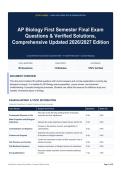
AP Biology First Semester Final Exam
Questions & Verified Solutions,
Comprehensive Updated 2026/2027 Edition
Comprehensive Examination Question Bank • In-Depth Rationales • Concept Mapping
TOTAL QUESTIONS EXAM TOPICS RATIONALES
90 Questions 12 Modules 100% Verified
DOCUMENT OVERVIEW
This document contains 90 verified questions with correct answers and concise explanations covering key
biological concepts. It is suitable for AP Biology exam preparation, course review, and enhanced
understanding of complex biological processes. Students can utilize this resource for effective study and
mastery of essential topics in biology.
EXAM BLUEPRINT & TOPIC DISTRIBUTION
Systematic breakdown of subject domains and exam coverage.
Topic Module Scope & Core Focus Questions Share (%)
This topic covers the basic building blocks of biological
Fundamental Elements of Life molecules and their significance. 8 Qs 8.9%
Water Properties and Biological
Importance Explores the unique properties of water that are vital for life. 8 Qs 8.9%
Focuses on the structure, function, and digestibility of
Carbohydrates and Digestion carbohydrates. 8 Qs 8.9%
Examines the structure and function of proteins and the role
Proteins and Enzymes of enzymes in biological reactions. 8 Qs 8.9%
Covers the components of cells and their respective roles in
Cell Structure and Function cellular processes. 8 Qs 8.9%
Cell Membrane Dynamics Analyzes mechanisms of transport across cell membranes. 8 Qs 8.9%
Discusses cellular respiration and the metabolic pathways
Energy Metabolism involved. 7 Qs 7.8%
Confidential • Student Study Edition • Practice & Review Guide Page 1 of 22
,STUDENT STUDY & MASTERY EDITION PRACTICE & REVIEW GUIDE
Photosynthesis Explores the processes and stages of photosynthesis. 7 Qs 7.8%
Covers the processes of signal transduction and cellular
Cell Signaling Mechanisms communication. 7 Qs 7.8%
Examines the components and mechanisms of the immune
Immune Response system. 7 Qs 7.8%
Focuses on the stages of the cell cycle, including mitosis and
Cell Cycle and Division meiosis. 7 Qs 7.8%
Analyzes the structure of DNA and its roles in genetic
DNA Structure and Function information. 7 Qs 7.8%
Total Exam Coverage 12 Integrated Topic Modules 90 Qs 100.0%
Confidential • Student Study Edition • Practice & Review Guide Page 2 of 22
, STUDENT STUDY & MASTERY EDITION PRACTICE & REVIEW GUIDE
TOPIC 1: FUNDAMENTAL ELEMENTS OF LIFE
8 Questions • 8.9% of Exam • This topic covers the basic building blocks of biological molecules and their significance.
QUESTION 1
Which four elements make up approximately 96% of living matter?
Correct Answer: Carbon, hydrogen, nitrogen, oxygen.
QUESTION 2
What do cohesion, surface tension, and adhesion have in common with reference to
water?
Correct Answer: All properties related to hydrogen bonding.
QUESTION 3
Which property of the carbon atom gives it compatibility with a greater number of
different elements than any other type of atom?
Correct Answer: Is able to form 4 single bonds.
QUESTION 4
What is the ultimate source of carbon that is found in organic molecules?
Correct Answer: The ultimate source of all organic molecules is primary production, in which photosynthetic
organisms take in carbon dioxide gas (or bicarbonate - CO2's water-dissolved form) and, using sunlight as an
energy source, convert it into glucose.
QUESTION 5
The element nitrogen is present in what types of organic molecules?
Correct Answer: Proteins and nucleic acids.
Confidential • Student Study Edition • Practice & Review Guide Page 3 of 22
AP Biology First Semester Final Exam
Questions & Verified Solutions,
Comprehensive Updated 2026/2027 Edition
Comprehensive Examination Question Bank • In-Depth Rationales • Concept Mapping
TOTAL QUESTIONS EXAM TOPICS RATIONALES
90 Questions 12 Modules 100% Verified
DOCUMENT OVERVIEW
This document contains 90 verified questions with correct answers and concise explanations covering key
biological concepts. It is suitable for AP Biology exam preparation, course review, and enhanced
understanding of complex biological processes. Students can utilize this resource for effective study and
mastery of essential topics in biology.
EXAM BLUEPRINT & TOPIC DISTRIBUTION
Systematic breakdown of subject domains and exam coverage.
Topic Module Scope & Core Focus Questions Share (%)
This topic covers the basic building blocks of biological
Fundamental Elements of Life molecules and their significance. 8 Qs 8.9%
Water Properties and Biological
Importance Explores the unique properties of water that are vital for life. 8 Qs 8.9%
Focuses on the structure, function, and digestibility of
Carbohydrates and Digestion carbohydrates. 8 Qs 8.9%
Examines the structure and function of proteins and the role
Proteins and Enzymes of enzymes in biological reactions. 8 Qs 8.9%
Covers the components of cells and their respective roles in
Cell Structure and Function cellular processes. 8 Qs 8.9%
Cell Membrane Dynamics Analyzes mechanisms of transport across cell membranes. 8 Qs 8.9%
Discusses cellular respiration and the metabolic pathways
Energy Metabolism involved. 7 Qs 7.8%
Confidential • Student Study Edition • Practice & Review Guide Page 1 of 22
,STUDENT STUDY & MASTERY EDITION PRACTICE & REVIEW GUIDE
Photosynthesis Explores the processes and stages of photosynthesis. 7 Qs 7.8%
Covers the processes of signal transduction and cellular
Cell Signaling Mechanisms communication. 7 Qs 7.8%
Examines the components and mechanisms of the immune
Immune Response system. 7 Qs 7.8%
Focuses on the stages of the cell cycle, including mitosis and
Cell Cycle and Division meiosis. 7 Qs 7.8%
Analyzes the structure of DNA and its roles in genetic
DNA Structure and Function information. 7 Qs 7.8%
Total Exam Coverage 12 Integrated Topic Modules 90 Qs 100.0%
Confidential • Student Study Edition • Practice & Review Guide Page 2 of 22
, STUDENT STUDY & MASTERY EDITION PRACTICE & REVIEW GUIDE
TOPIC 1: FUNDAMENTAL ELEMENTS OF LIFE
8 Questions • 8.9% of Exam • This topic covers the basic building blocks of biological molecules and their significance.
QUESTION 1
Which four elements make up approximately 96% of living matter?
Correct Answer: Carbon, hydrogen, nitrogen, oxygen.
QUESTION 2
What do cohesion, surface tension, and adhesion have in common with reference to
water?
Correct Answer: All properties related to hydrogen bonding.
QUESTION 3
Which property of the carbon atom gives it compatibility with a greater number of
different elements than any other type of atom?
Correct Answer: Is able to form 4 single bonds.
QUESTION 4
What is the ultimate source of carbon that is found in organic molecules?
Correct Answer: The ultimate source of all organic molecules is primary production, in which photosynthetic
organisms take in carbon dioxide gas (or bicarbonate - CO2's water-dissolved form) and, using sunlight as an
energy source, convert it into glucose.
QUESTION 5
The element nitrogen is present in what types of organic molecules?
Correct Answer: Proteins and nucleic acids.
Confidential • Student Study Edition • Practice & Review Guide Page 3 of 22