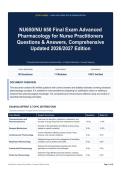
[STUDY GUIDE] • HIGH-YIELD PRACTICE & REVIEW EDITION
NU650/NU 650 Final Exam Advanced
Pharmacology for Nurse Practitioners
Questions & Answers, Comprehensive
Updated 2026/2027 Edition
Comprehensive Examination Question Bank • In-Depth Rationales • Concept Mapping
TOTAL QUESTIONS EXAM TOPICS RATIONALES
86 Questions 11 Modules 100% Verified
DOCUMENT OVERVIEW
This document contains 86 verified questions with correct answers and detailed rationales covering advanced
pharmacology concepts. It is suitable for nurse practitioners preparing for certification exams or seeking to
enhance their pharmacological knowledge. The comprehensive format ensures effective study and review of
essential pharmacology principles.
EXAM BLUEPRINT & TOPIC DISTRIBUTION
Systematic breakdown of subject domains and exam coverage.
Topic Module Scope & Core Focus Questions Share (%)
Pharmacokinetics and Examines the absorption, distribution, metabolism, and
Pharmacodynamics excretion of drugs along with their mechanisms of action. 10 Qs 11.6%
Focuses on the interactions and effects of various drug
Receptor Mechanisms classes on specific receptors. 9 Qs 10.5%
Covers medications affecting cardiac function, blood
Cardiovascular Pharmacology pressure, and vascular resistance. 8 Qs 9.3%
Addresses drugs used in the management of respiratory
Respiratory Pharmacology conditions such as asthma and COPD. 8 Qs 9.3%
Explores the pharmacological properties and clinical
Antimicrobial Pharmacology applications of antibiotics and antifungals. 8 Qs 9.3%
Examines drugs affecting hormonal systems, including
Endocrine Pharmacology antithyroid medications and hormone replacement therapies. 8 Qs 9.3%
Confidential • Student Study Edition • Practice & Review Guide Page 1 of 45
,STUDENT STUDY & MASTERY EDITION PRACTICE & REVIEW GUIDE
Focuses on medications used to treat psychiatric disorders
Psychopharmacology and their mechanisms. 7 Qs 8.1%
Covers drugs used to treat gastrointestinal disorders,
Gastrointestinal Pharmacology including acid suppression and motility agents. 7 Qs 8.1%
Explores the impact of genetic variation on drug metabolism
Pharmacogenomics and response. 7 Qs 8.1%
Special Populations and Addresses pharmacological considerations in unique patient
Considerations populations, including geriatrics and those with comorbidities. 7 Qs 8.1%
Covers the effects and management of drug-drug
Drug Interactions interactions. 7 Qs 8.1%
Total Exam Coverage 11 Integrated Topic Modules 86 Qs 100.0%
Confidential • Student Study Edition • Practice & Review Guide Page 2 of 45
,STUDENT STUDY & MASTERY EDITION PRACTICE & REVIEW GUIDE
TOPIC 1: PHARMACOKINETICS AND PHARMACODYNAMICS
10 Questions • 11.6% of Exam • Examines the absorption, distribution, metabolism, and excretion of drugs along with their
mechanisms of action.
QUESTION 1
A drug exhibits nonlinear (capacity-limited) elimination characterized by
Michaelis-Menten kinetics. Which of the following statements best describes the effect
of increasing the dose from a low to a high level on the drug's clearance?
[A] Clearance remains constant because clearance is dose-independent.
[B] Clearance decreases as dose increases due to saturation of metabolic pathways.
[C] Clearance increases proportionally with dose because more drug is available for metabolism.
[D] Clearance first decreases then increases as dose surpasses the Km value.
Correct Answer: Clearance decreases as dose increases due to saturation of metabolic pathways.
Rationale: In Michaelis-Menten (capacity-limited) elimination, clearance (CL = Vmax/(Km + C)) declines as plasma
concentrations approach Vmax, reflecting saturation of the metabolizing enzymes.
QUESTION 2
A new antibiotic demonstrates time-dependent killing. Which PK/PD index is most
predictive of its clinical efficacy?
[A] Cmax/MIC
[B] AUC/MIC
[C] Time above MIC (T>MIC)
[D] Peak concentration to MIC ratio
Correct Answer: Time above MIC (T>MIC)
Rationale: Time-dependent antibiotics (e.g., β-lactams) exert maximal effect when plasma concentrations remain above the
MIC for a sufficient portion of the dosing interval; thus T>MIC is the key PK/PD index.
Confidential • Student Study Edition • Practice & Review Guide Page 3 of 45
, STUDENT STUDY & MASTERY EDITION PRACTICE & REVIEW GUIDE
QUESTION 3
A drug with a half-life of 8 hours is administered intravenously as a continuous
infusion. After how many hours will the plasma concentration reach approximately 95%
of the steady-state concentration?
[A] 16 hours
[B] 24 hours
[C] 32 hours
[D] 40 hours
Correct Answer: 32 Hours.
Rationale: Steady state is generally achieved after ~4-5 half-lives. Four half-lives (4 × 8 h = 32 h) yields ~94% of steady
state; five half-lives (40 h) would be >95%, but 32 h is the closest answer.
QUESTION 4
When a prodrug undergoes extensive first-pass metabolism, which parameter is most
directly reduced, and how does this affect the drug's apparent clearance (CL/F)?
[A] Bioavailability (F) is reduced, causing an apparent increase in CL/F.
[B] Volume of distribution (Vd) is reduced, causing a decrease in CL/F.
[C] Intrinsic clearance (CLint) is reduced, causing a decrease in CL/F.
[D] Elimination half-life is reduced, causing an apparent increase in CL/F.
Correct Answer: Bioavailability (F) is reduced, causing an apparent increase in CL/F.
Rationale: First-pass metabolism lowers the fraction of dose reaching systemic circulation (F). Because CL/F =
Dose/(AUC), a lower F inflates the apparent clearance when calculated using oral data.
Autonomic & Cardiovascular Pharmacology (16 Questions)
Confidential • Student Study Edition • Practice & Review Guide Page 4 of 45
NU650/NU 650 Final Exam Advanced
Pharmacology for Nurse Practitioners
Questions & Answers, Comprehensive
Updated 2026/2027 Edition
Comprehensive Examination Question Bank • In-Depth Rationales • Concept Mapping
TOTAL QUESTIONS EXAM TOPICS RATIONALES
86 Questions 11 Modules 100% Verified
DOCUMENT OVERVIEW
This document contains 86 verified questions with correct answers and detailed rationales covering advanced
pharmacology concepts. It is suitable for nurse practitioners preparing for certification exams or seeking to
enhance their pharmacological knowledge. The comprehensive format ensures effective study and review of
essential pharmacology principles.
EXAM BLUEPRINT & TOPIC DISTRIBUTION
Systematic breakdown of subject domains and exam coverage.
Topic Module Scope & Core Focus Questions Share (%)
Pharmacokinetics and Examines the absorption, distribution, metabolism, and
Pharmacodynamics excretion of drugs along with their mechanisms of action. 10 Qs 11.6%
Focuses on the interactions and effects of various drug
Receptor Mechanisms classes on specific receptors. 9 Qs 10.5%
Covers medications affecting cardiac function, blood
Cardiovascular Pharmacology pressure, and vascular resistance. 8 Qs 9.3%
Addresses drugs used in the management of respiratory
Respiratory Pharmacology conditions such as asthma and COPD. 8 Qs 9.3%
Explores the pharmacological properties and clinical
Antimicrobial Pharmacology applications of antibiotics and antifungals. 8 Qs 9.3%
Examines drugs affecting hormonal systems, including
Endocrine Pharmacology antithyroid medications and hormone replacement therapies. 8 Qs 9.3%
Confidential • Student Study Edition • Practice & Review Guide Page 1 of 45
,STUDENT STUDY & MASTERY EDITION PRACTICE & REVIEW GUIDE
Focuses on medications used to treat psychiatric disorders
Psychopharmacology and their mechanisms. 7 Qs 8.1%
Covers drugs used to treat gastrointestinal disorders,
Gastrointestinal Pharmacology including acid suppression and motility agents. 7 Qs 8.1%
Explores the impact of genetic variation on drug metabolism
Pharmacogenomics and response. 7 Qs 8.1%
Special Populations and Addresses pharmacological considerations in unique patient
Considerations populations, including geriatrics and those with comorbidities. 7 Qs 8.1%
Covers the effects and management of drug-drug
Drug Interactions interactions. 7 Qs 8.1%
Total Exam Coverage 11 Integrated Topic Modules 86 Qs 100.0%
Confidential • Student Study Edition • Practice & Review Guide Page 2 of 45
,STUDENT STUDY & MASTERY EDITION PRACTICE & REVIEW GUIDE
TOPIC 1: PHARMACOKINETICS AND PHARMACODYNAMICS
10 Questions • 11.6% of Exam • Examines the absorption, distribution, metabolism, and excretion of drugs along with their
mechanisms of action.
QUESTION 1
A drug exhibits nonlinear (capacity-limited) elimination characterized by
Michaelis-Menten kinetics. Which of the following statements best describes the effect
of increasing the dose from a low to a high level on the drug's clearance?
[A] Clearance remains constant because clearance is dose-independent.
[B] Clearance decreases as dose increases due to saturation of metabolic pathways.
[C] Clearance increases proportionally with dose because more drug is available for metabolism.
[D] Clearance first decreases then increases as dose surpasses the Km value.
Correct Answer: Clearance decreases as dose increases due to saturation of metabolic pathways.
Rationale: In Michaelis-Menten (capacity-limited) elimination, clearance (CL = Vmax/(Km + C)) declines as plasma
concentrations approach Vmax, reflecting saturation of the metabolizing enzymes.
QUESTION 2
A new antibiotic demonstrates time-dependent killing. Which PK/PD index is most
predictive of its clinical efficacy?
[A] Cmax/MIC
[B] AUC/MIC
[C] Time above MIC (T>MIC)
[D] Peak concentration to MIC ratio
Correct Answer: Time above MIC (T>MIC)
Rationale: Time-dependent antibiotics (e.g., β-lactams) exert maximal effect when plasma concentrations remain above the
MIC for a sufficient portion of the dosing interval; thus T>MIC is the key PK/PD index.
Confidential • Student Study Edition • Practice & Review Guide Page 3 of 45
, STUDENT STUDY & MASTERY EDITION PRACTICE & REVIEW GUIDE
QUESTION 3
A drug with a half-life of 8 hours is administered intravenously as a continuous
infusion. After how many hours will the plasma concentration reach approximately 95%
of the steady-state concentration?
[A] 16 hours
[B] 24 hours
[C] 32 hours
[D] 40 hours
Correct Answer: 32 Hours.
Rationale: Steady state is generally achieved after ~4-5 half-lives. Four half-lives (4 × 8 h = 32 h) yields ~94% of steady
state; five half-lives (40 h) would be >95%, but 32 h is the closest answer.
QUESTION 4
When a prodrug undergoes extensive first-pass metabolism, which parameter is most
directly reduced, and how does this affect the drug's apparent clearance (CL/F)?
[A] Bioavailability (F) is reduced, causing an apparent increase in CL/F.
[B] Volume of distribution (Vd) is reduced, causing a decrease in CL/F.
[C] Intrinsic clearance (CLint) is reduced, causing a decrease in CL/F.
[D] Elimination half-life is reduced, causing an apparent increase in CL/F.
Correct Answer: Bioavailability (F) is reduced, causing an apparent increase in CL/F.
Rationale: First-pass metabolism lowers the fraction of dose reaching systemic circulation (F). Because CL/F =
Dose/(AUC), a lower F inflates the apparent clearance when calculated using oral data.
Autonomic & Cardiovascular Pharmacology (16 Questions)
Confidential • Student Study Edition • Practice & Review Guide Page 4 of 45