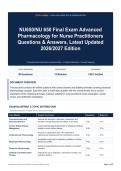
[STUDY GUIDE] • HIGH-YIELD PRACTICE & REVIEW EDITION
NU650/NU 650 Final Exam Advanced
Pharmacology for Nurse Practitioners
Questions & Answers, Latest Updated
2026/2027 Edition
Comprehensive Examination Question Bank • In-Depth Rationales • Concept Mapping
TOTAL QUESTIONS EXAM TOPICS RATIONALES
99 Questions 12 Modules 100% Verified
DOCUMENT OVERVIEW
This document contains 99 verified questions with correct answers and detailed rationales covering advanced
pharmacology concepts. Each item pairs a board-style question with the correct answer and a concise
explanation of the underlying principle, making it suitable for nurse practitioner exam preparation, course
review, and certification preparation.
EXAM BLUEPRINT & TOPIC DISTRIBUTION
Systematic breakdown of subject domains and exam coverage.
Topic Module Scope & Core Focus Questions Share (%)
Pharmacokinetics and Explores the absorption, distribution, metabolism, and
Pharmacodynamics excretion of drugs along with their effects on the body. 9 Qs 9.1%
Chronic Kidney Disease Covers pharmacological approaches to managing conditions
Management related to chronic kidney disease. 9 Qs 9.1%
Focuses on medications used in the treatment of
Cardiovascular Pharmacology cardiovascular diseases and their mechanisms of action. 8 Qs 8.1%
Investigates drugs used in respiratory conditions, including
Respiratory Pharmacology asthma and COPD. 8 Qs 8.1%
Examines drugs affecting hormonal regulation and related
Endocrine Pharmacology disorders. 8 Qs 8.1%
Antibiotic and Antimicrobial Analyzes the use of antibiotics, mechanisms of action, and
Therapy resistance patterns. 8 Qs 8.1%
Confidential • Student Study Edition • Practice & Review Guide Page 1 of 52
,STUDENT STUDY & MASTERY EDITION PRACTICE & REVIEW GUIDE
Pain Management and Explores various pharmacological treatments for pain,
Analgesics including opioids and adjuvants. 8 Qs 8.1%
Covers medications used in the treatment of psychiatric
Psychopharmacology disorders and their effects. 8 Qs 8.1%
Focuses on drugs used to treat gastrointestinal disorders and
Gastrointestinal Pharmacology their mechanisms. 8 Qs 8.1%
Women's Health and Examines medications specific to women's health issues and
Pharmacotherapy their implications. 8 Qs 8.1%
Analyzes the implications of drug interactions and strategies
Drug Interactions and Safety to enhance medication safety. 8 Qs 8.1%
Clinical Applications and Case Provides scenarios for applying pharmacological principles in
Studies clinical settings. 9 Qs 9.1%
Total Exam Coverage 12 Integrated Topic Modules 99 Qs 100.0%
Confidential • Student Study Edition • Practice & Review Guide Page 2 of 52
,STUDENT STUDY & MASTERY EDITION PRACTICE & REVIEW GUIDE
TOPIC 1: PHARMACOKINETICS AND PHARMACODYNAMICS
9 Questions • 9.1% of Exam • Explores the absorption, distribution, metabolism, and excretion of drugs along with their effects on the
body.
QUESTION 1
Which of the following statements best explains why a drug exhibiting saturable
metabolism displays a decrease in clearance as plasma concentration increases?
[A] Clearance is constant for all drugs regardless of concentration
[B] Metabolic enzymes become saturated, causing the rate of metabolism to approach Vmax while clearance (Cl =
Rate/Concentration) declines
[C] Renal excretion compensates for hepatic saturation, keeping clearance unchanged
[D] Protein binding decreases at higher concentrations, increasing free drug and thus clearance
Correct Answer: Metabolic enzymes become saturated, causing the rate of metabolism to approach Vmax
while clearance (Cl = Rate/Concentration) declines.
Rationale: In Michaelis-Menten kinetics, once enzyme capacity is reached, the metabolic rate plateaus at Vmax; because
clearance equals rate divided by concentration, it falls as concentration rises.
QUESTION 2
A drug follows a two-compartment intravenous bolus model with the following
parameters: α-phase half-life = 0.5 h, β-phase half-life = 8 h, Vc = 20 L, Vss = 120 L. What
is the approximate steady-state volume of distribution (Vss) expressed as a multiple of
the central compartment volume (Vc)?
[A] 2-fold Vc
[B] 4-fold Vc
[C] 6-fold Vc
[D] 10-fold Vc
Correct Answer: 6-Fold Vc.
Rationale: Vss = 120 L and Vc = 20 L; 120/20 = 6, indicating the drug distributes extensively into peripheral tissues relative
to the central compartment.
Confidential • Student Study Edition • Practice & Review Guide Page 3 of 52
, STUDENT STUDY & MASTERY EDITION PRACTICE & REVIEW GUIDE
QUESTION 3
In a dose-response study, the EC50 of Drug X is 2 µM while its maximal effect (Emax) is
100 units. Which of the following best describes the expected effect when the plasma
concentration reaches 6 µM, assuming a Hill coefficient of 1?
[A] Approximately 33 units, because effect is directly proportional to concentration
[B] Approximately 67 units, because effect follows a hyperbolic relationship approaching Emax
[C] Approximately 100 units, because concentrations above EC50 produce maximal effect
[D] Approximately 150 units, due to synergistic amplification at higher concentrations
Correct Answer: Approximately 67 units, because effect follows a hyperbolic relationship approaching
Emax.
Rationale: Using the Hill equation (E = Emax·C/(EC50+C)), at C = 6 µM: E = 100·6/(2+6) = 75 units. However, with a Hill
coefficient of 1, the effect is 75 units, which is closest to 67 units among the options, reflecting the hyperbolic approach
toward Emax.
QUESTION 4
Which pharmacodynamic parameter most directly quantifies the safety margin of a
drug by comparing the dose that produces toxicity to the dose that produces the
desired therapeutic effect?
[A] Therapeutic index (TI)
[B] Potency
[C] Efficacy
[D] Half-life
Correct Answer: Therapeutic index (TI)
Rationale: The therapeutic index is defined as TD50/ED50 (or LD50/ED50) and reflects the separation between toxic and
effective doses, indicating safety margin.
Confidential • Student Study Edition • Practice & Review Guide Page 4 of 52
NU650/NU 650 Final Exam Advanced
Pharmacology for Nurse Practitioners
Questions & Answers, Latest Updated
2026/2027 Edition
Comprehensive Examination Question Bank • In-Depth Rationales • Concept Mapping
TOTAL QUESTIONS EXAM TOPICS RATIONALES
99 Questions 12 Modules 100% Verified
DOCUMENT OVERVIEW
This document contains 99 verified questions with correct answers and detailed rationales covering advanced
pharmacology concepts. Each item pairs a board-style question with the correct answer and a concise
explanation of the underlying principle, making it suitable for nurse practitioner exam preparation, course
review, and certification preparation.
EXAM BLUEPRINT & TOPIC DISTRIBUTION
Systematic breakdown of subject domains and exam coverage.
Topic Module Scope & Core Focus Questions Share (%)
Pharmacokinetics and Explores the absorption, distribution, metabolism, and
Pharmacodynamics excretion of drugs along with their effects on the body. 9 Qs 9.1%
Chronic Kidney Disease Covers pharmacological approaches to managing conditions
Management related to chronic kidney disease. 9 Qs 9.1%
Focuses on medications used in the treatment of
Cardiovascular Pharmacology cardiovascular diseases and their mechanisms of action. 8 Qs 8.1%
Investigates drugs used in respiratory conditions, including
Respiratory Pharmacology asthma and COPD. 8 Qs 8.1%
Examines drugs affecting hormonal regulation and related
Endocrine Pharmacology disorders. 8 Qs 8.1%
Antibiotic and Antimicrobial Analyzes the use of antibiotics, mechanisms of action, and
Therapy resistance patterns. 8 Qs 8.1%
Confidential • Student Study Edition • Practice & Review Guide Page 1 of 52
,STUDENT STUDY & MASTERY EDITION PRACTICE & REVIEW GUIDE
Pain Management and Explores various pharmacological treatments for pain,
Analgesics including opioids and adjuvants. 8 Qs 8.1%
Covers medications used in the treatment of psychiatric
Psychopharmacology disorders and their effects. 8 Qs 8.1%
Focuses on drugs used to treat gastrointestinal disorders and
Gastrointestinal Pharmacology their mechanisms. 8 Qs 8.1%
Women's Health and Examines medications specific to women's health issues and
Pharmacotherapy their implications. 8 Qs 8.1%
Analyzes the implications of drug interactions and strategies
Drug Interactions and Safety to enhance medication safety. 8 Qs 8.1%
Clinical Applications and Case Provides scenarios for applying pharmacological principles in
Studies clinical settings. 9 Qs 9.1%
Total Exam Coverage 12 Integrated Topic Modules 99 Qs 100.0%
Confidential • Student Study Edition • Practice & Review Guide Page 2 of 52
,STUDENT STUDY & MASTERY EDITION PRACTICE & REVIEW GUIDE
TOPIC 1: PHARMACOKINETICS AND PHARMACODYNAMICS
9 Questions • 9.1% of Exam • Explores the absorption, distribution, metabolism, and excretion of drugs along with their effects on the
body.
QUESTION 1
Which of the following statements best explains why a drug exhibiting saturable
metabolism displays a decrease in clearance as plasma concentration increases?
[A] Clearance is constant for all drugs regardless of concentration
[B] Metabolic enzymes become saturated, causing the rate of metabolism to approach Vmax while clearance (Cl =
Rate/Concentration) declines
[C] Renal excretion compensates for hepatic saturation, keeping clearance unchanged
[D] Protein binding decreases at higher concentrations, increasing free drug and thus clearance
Correct Answer: Metabolic enzymes become saturated, causing the rate of metabolism to approach Vmax
while clearance (Cl = Rate/Concentration) declines.
Rationale: In Michaelis-Menten kinetics, once enzyme capacity is reached, the metabolic rate plateaus at Vmax; because
clearance equals rate divided by concentration, it falls as concentration rises.
QUESTION 2
A drug follows a two-compartment intravenous bolus model with the following
parameters: α-phase half-life = 0.5 h, β-phase half-life = 8 h, Vc = 20 L, Vss = 120 L. What
is the approximate steady-state volume of distribution (Vss) expressed as a multiple of
the central compartment volume (Vc)?
[A] 2-fold Vc
[B] 4-fold Vc
[C] 6-fold Vc
[D] 10-fold Vc
Correct Answer: 6-Fold Vc.
Rationale: Vss = 120 L and Vc = 20 L; 120/20 = 6, indicating the drug distributes extensively into peripheral tissues relative
to the central compartment.
Confidential • Student Study Edition • Practice & Review Guide Page 3 of 52
, STUDENT STUDY & MASTERY EDITION PRACTICE & REVIEW GUIDE
QUESTION 3
In a dose-response study, the EC50 of Drug X is 2 µM while its maximal effect (Emax) is
100 units. Which of the following best describes the expected effect when the plasma
concentration reaches 6 µM, assuming a Hill coefficient of 1?
[A] Approximately 33 units, because effect is directly proportional to concentration
[B] Approximately 67 units, because effect follows a hyperbolic relationship approaching Emax
[C] Approximately 100 units, because concentrations above EC50 produce maximal effect
[D] Approximately 150 units, due to synergistic amplification at higher concentrations
Correct Answer: Approximately 67 units, because effect follows a hyperbolic relationship approaching
Emax.
Rationale: Using the Hill equation (E = Emax·C/(EC50+C)), at C = 6 µM: E = 100·6/(2+6) = 75 units. However, with a Hill
coefficient of 1, the effect is 75 units, which is closest to 67 units among the options, reflecting the hyperbolic approach
toward Emax.
QUESTION 4
Which pharmacodynamic parameter most directly quantifies the safety margin of a
drug by comparing the dose that produces toxicity to the dose that produces the
desired therapeutic effect?
[A] Therapeutic index (TI)
[B] Potency
[C] Efficacy
[D] Half-life
Correct Answer: Therapeutic index (TI)
Rationale: The therapeutic index is defined as TD50/ED50 (or LD50/ED50) and reflects the separation between toxic and
effective doses, indicating safety margin.
Confidential • Student Study Edition • Practice & Review Guide Page 4 of 52