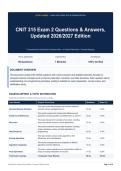
[STUDY GUIDE] • HIGH-YIELD PRACTICE & REVIEW EDITION
CNIT 315 Exam 2 Questions & Answers,
Updated 2026/2027 Edition
Comprehensive Examination Question Bank • In-Depth Rationales • Concept Mapping
TOTAL QUESTIONS EXAM TOPICS RATIONALES
86 Questions 7 Modules 100% Verified
DOCUMENT OVERVIEW
This document contains 86 verified questions with correct answers and detailed rationales focused on
computer science concepts such as memory allocation, recursion, and data structures. Each question aids in
understanding core programming principles, making it suitable for exam preparation, course review, and
certification study.
EXAM BLUEPRINT & TOPIC DISTRIBUTION
Systematic breakdown of subject domains and exam coverage.
Topic Module Scope & Core Focus Questions Share (%)
This topic covers the principles and functions related to
Dynamic Memory Allocation dynamic memory management in C. 12 Qs 14.0%
This section explores the fundamental differences and
Pointers and References operations involving pointers and references in C and C++. 12 Qs 14.0%
This topic discusses the concepts of recursion, including
Recursion direct and indirect recursion, and its applications. 12 Qs 14.0%
This section examines various data structures, including
arrays, structures, unions, and their applications in
Data Structures programming. 15 Qs 17.4%
This topic reviews various sorting algorithms, their
Sorting Algorithms efficiencies, and characteristics. 12 Qs 14.0%
This section assesses the time complexity of different
Algorithm Complexity algorithms and their efficiency. 12 Qs 14.0%
This topic involves operations and manipulations related to
Array Operations arrays, including initialization and access. 11 Qs 12.8%
Total Exam Coverage 7 Integrated Topic Modules 86 Qs 100.0%
Confidential • Student Study Edition • Practice & Review Guide Page 1 of 34
,STUDENT STUDY & MASTERY EDITION PRACTICE & REVIEW GUIDE
TOPIC 1: DYNAMIC MEMORY ALLOCATION
12 Questions • 14.0% of Exam • This topic covers the principles and functions related to dynamic memory management in C.
QUESTION 1
A pointer is a variable that holds the memory address of another variable. What is the
correct way to declare a pointer in C?
[A] int x;
[B] int *x;
[C] int *x = NULL;
[D] int x = NULL;
Correct Answer: B) int *x;
Rationale: When declaring a pointer, it's essential to use the asterisk symbol (*) to denote that the variable will hold a
memory address.
QUESTION 2
When using dynamic memory allocation, what function is used to allocate memory for
an array?
[A] malloc()
[B] calloc()
[C] realloc()
[D] free()
Correct Answer: B) calloc()
Rationale: Calloc() is used to allocate memory for an array and initialize its elements to zero.
Confidential • Student Study Edition • Practice & Review Guide Page 2 of 34
,STUDENT STUDY & MASTERY EDITION PRACTICE & REVIEW GUIDE
QUESTION 3
In C, how do you properly deallocate memory allocated using malloc()?
[A] free()
[B] malloc()
[C] calloc()
[D] realloc()
Correct Answer: A) free()
Rationale: The free() function is used to deallocate memory allocated using malloc().
QUESTION 4
In C, what is the purpose of the malloc function?
[A] To dynamically allocate memory for a variable.
[B] To dynamically deallocate memory for a variable.
[C] To copy the value of one variable to another variable.
[D] To convert the size of a variable in bytes to a type.
Correct Answer: A. To dynamically allocate memory for a variable.
Rationale: The malloc function dynamically allocates memory for a variable, returning a pointer to the allocated memory.
QUESTION 5
What is the difference between a static and dynamic memory allocation in C?
[A] Static memory allocation is used for automatic variables, while dynamic memory allocation is used for pointers.
[B] Static memory allocation is used for pointers, while dynamic memory allocation is used for automatic variables.
[C] Static memory allocation is used for variables with a fixed size, while dynamic memory allocation is used for variables
with a variable size.
[D] Static memory allocation is used for variables allocated on the stack, while dynamic memory allocation is used for
variables allocated on the heap.
Correct Answer: D. Static memory allocation is used for variables allocated on the stack, while dynamic
memory allocation is used for variables allocated on the heap.
Rationale: Static memory allocation is used for variables allocated on the stack, while dynamic memory allocation is used
for variables allocated on the heap.
Confidential • Student Study Edition • Practice & Review Guide Page 3 of 34
, STUDENT STUDY & MASTERY EDITION PRACTICE & REVIEW GUIDE
QUESTION 6
How do you free dynamically allocated memory in C?
[A] By using the malloc function.
[B] By using the free function.
[C] By using the sizeof operator and assigning it to a pointer.
[D] By using the NULL pointer.
Correct Answer: B. By using the free function.
Rationale: You can free dynamically allocated memory in C by using the free function.
QUESTION 7
How is memory allocated for an array in a program?
[A] On the heap
[B] On the stack
[C] At compile-time
[D] At runtime
Correct Answer: On the heap.
Rationale: Arrays are allocated memory on the heap, allowing for dynamic memory management.
QUESTION 8
A developer is tasked with analyzing the memory usage of a C program containing a
large structure. Which of the following methods is most efficient for determining the
memory usage of the structure?
[A] Using the sizeof operator to calculate the size of the structure
[B] Analyzing the structure's member variables individually using offsetof()
[C] Using a memory profiler to track memory allocations and deallocations
[D] Implementing a custom memory usage function within the program
Correct Answer: A. Using the sizeof operator to calculate the size of the structure.
Rationale: The sizeof operator is the most efficient method for determining the memory usage of a structure, as it provides
a direct size value without the need for manual analysis.
Confidential • Student Study Edition • Practice & Review Guide Page 4 of 34
CNIT 315 Exam 2 Questions & Answers,
Updated 2026/2027 Edition
Comprehensive Examination Question Bank • In-Depth Rationales • Concept Mapping
TOTAL QUESTIONS EXAM TOPICS RATIONALES
86 Questions 7 Modules 100% Verified
DOCUMENT OVERVIEW
This document contains 86 verified questions with correct answers and detailed rationales focused on
computer science concepts such as memory allocation, recursion, and data structures. Each question aids in
understanding core programming principles, making it suitable for exam preparation, course review, and
certification study.
EXAM BLUEPRINT & TOPIC DISTRIBUTION
Systematic breakdown of subject domains and exam coverage.
Topic Module Scope & Core Focus Questions Share (%)
This topic covers the principles and functions related to
Dynamic Memory Allocation dynamic memory management in C. 12 Qs 14.0%
This section explores the fundamental differences and
Pointers and References operations involving pointers and references in C and C++. 12 Qs 14.0%
This topic discusses the concepts of recursion, including
Recursion direct and indirect recursion, and its applications. 12 Qs 14.0%
This section examines various data structures, including
arrays, structures, unions, and their applications in
Data Structures programming. 15 Qs 17.4%
This topic reviews various sorting algorithms, their
Sorting Algorithms efficiencies, and characteristics. 12 Qs 14.0%
This section assesses the time complexity of different
Algorithm Complexity algorithms and their efficiency. 12 Qs 14.0%
This topic involves operations and manipulations related to
Array Operations arrays, including initialization and access. 11 Qs 12.8%
Total Exam Coverage 7 Integrated Topic Modules 86 Qs 100.0%
Confidential • Student Study Edition • Practice & Review Guide Page 1 of 34
,STUDENT STUDY & MASTERY EDITION PRACTICE & REVIEW GUIDE
TOPIC 1: DYNAMIC MEMORY ALLOCATION
12 Questions • 14.0% of Exam • This topic covers the principles and functions related to dynamic memory management in C.
QUESTION 1
A pointer is a variable that holds the memory address of another variable. What is the
correct way to declare a pointer in C?
[A] int x;
[B] int *x;
[C] int *x = NULL;
[D] int x = NULL;
Correct Answer: B) int *x;
Rationale: When declaring a pointer, it's essential to use the asterisk symbol (*) to denote that the variable will hold a
memory address.
QUESTION 2
When using dynamic memory allocation, what function is used to allocate memory for
an array?
[A] malloc()
[B] calloc()
[C] realloc()
[D] free()
Correct Answer: B) calloc()
Rationale: Calloc() is used to allocate memory for an array and initialize its elements to zero.
Confidential • Student Study Edition • Practice & Review Guide Page 2 of 34
,STUDENT STUDY & MASTERY EDITION PRACTICE & REVIEW GUIDE
QUESTION 3
In C, how do you properly deallocate memory allocated using malloc()?
[A] free()
[B] malloc()
[C] calloc()
[D] realloc()
Correct Answer: A) free()
Rationale: The free() function is used to deallocate memory allocated using malloc().
QUESTION 4
In C, what is the purpose of the malloc function?
[A] To dynamically allocate memory for a variable.
[B] To dynamically deallocate memory for a variable.
[C] To copy the value of one variable to another variable.
[D] To convert the size of a variable in bytes to a type.
Correct Answer: A. To dynamically allocate memory for a variable.
Rationale: The malloc function dynamically allocates memory for a variable, returning a pointer to the allocated memory.
QUESTION 5
What is the difference between a static and dynamic memory allocation in C?
[A] Static memory allocation is used for automatic variables, while dynamic memory allocation is used for pointers.
[B] Static memory allocation is used for pointers, while dynamic memory allocation is used for automatic variables.
[C] Static memory allocation is used for variables with a fixed size, while dynamic memory allocation is used for variables
with a variable size.
[D] Static memory allocation is used for variables allocated on the stack, while dynamic memory allocation is used for
variables allocated on the heap.
Correct Answer: D. Static memory allocation is used for variables allocated on the stack, while dynamic
memory allocation is used for variables allocated on the heap.
Rationale: Static memory allocation is used for variables allocated on the stack, while dynamic memory allocation is used
for variables allocated on the heap.
Confidential • Student Study Edition • Practice & Review Guide Page 3 of 34
, STUDENT STUDY & MASTERY EDITION PRACTICE & REVIEW GUIDE
QUESTION 6
How do you free dynamically allocated memory in C?
[A] By using the malloc function.
[B] By using the free function.
[C] By using the sizeof operator and assigning it to a pointer.
[D] By using the NULL pointer.
Correct Answer: B. By using the free function.
Rationale: You can free dynamically allocated memory in C by using the free function.
QUESTION 7
How is memory allocated for an array in a program?
[A] On the heap
[B] On the stack
[C] At compile-time
[D] At runtime
Correct Answer: On the heap.
Rationale: Arrays are allocated memory on the heap, allowing for dynamic memory management.
QUESTION 8
A developer is tasked with analyzing the memory usage of a C program containing a
large structure. Which of the following methods is most efficient for determining the
memory usage of the structure?
[A] Using the sizeof operator to calculate the size of the structure
[B] Analyzing the structure's member variables individually using offsetof()
[C] Using a memory profiler to track memory allocations and deallocations
[D] Implementing a custom memory usage function within the program
Correct Answer: A. Using the sizeof operator to calculate the size of the structure.
Rationale: The sizeof operator is the most efficient method for determining the memory usage of a structure, as it provides
a direct size value without the need for manual analysis.
Confidential • Student Study Edition • Practice & Review Guide Page 4 of 34