[STUDY GUIDE] • HIGH-YIELD PRACTICE & REVIEW EDITION
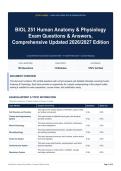
BIOL 251 Human Anatomy & Physiology
Exam Questions & Answers,
Comprehensive Updated 2026/2027 Edition
Comprehensive Examination Question Bank • In-Depth Rationales • Concept Mapping
TOTAL QUESTIONS EXAM TOPICS RATIONALES
100 Questions 12 Modules 100% Verified
DOCUMENT OVERVIEW
This document contains 100 verified questions with correct answers and detailed rationales covering Human
Anatomy & Physiology. Each item provides an opportunity for in-depth understanding of the subject matter,
making it suitable for exam preparation, course review, and certification study.
EXAM BLUEPRINT & TOPIC DISTRIBUTION
Systematic breakdown of subject domains and exam coverage.
Topic Module Scope & Core Focus Questions Share (%)
This topic covers various aspects of cell theory, types of cells,
Cell Structure and Function and cellular components. 9 Qs 9.0%
Tissues and Integumentary This topic focuses on different tissue types, skin structure,
System and their functions. 9 Qs 9.0%
This topic examines muscle types, contraction mechanisms,
Muscle Physiology and muscle adaptations. 9 Qs 9.0%
This topic explores neuronal function, synaptic transmission,
Neurophysiology and sensory processing. 9 Qs 9.0%
This topic discusses hormones, their functions, and the body's
Endocrine System hormonal regulation. 8 Qs 8.0%
This topic covers heart function, hemodynamics, and blood
Cardiovascular System pressure regulation. 8 Qs 8.0%
This topic focuses on lung function, ventilation, and gas
Respiratory System exchange mechanisms. 8 Qs 8.0%
Confidential • Student Study Edition • Practice & Review Guide Page 1 of 51
,STUDENT STUDY & MASTERY EDITION PRACTICE & REVIEW GUIDE
This topic examines kidney function, urine formation, and fluid
Renal Physiology balance. 8 Qs 8.0%
This topic discusses male and female reproductive anatomy
Reproductive System and hormonal cycles. 8 Qs 8.0%
This topic explores digestive processes, nutrient absorption,
Gastrointestinal System and gastrointestinal hormones. 8 Qs 8.0%
This topic covers lymphatic function, immune responses, and
Lymphatic and Immune System related disorders. 8 Qs 8.0%
This topic examines disease mechanisms and their effects on
Pathophysiology body systems. 8 Qs 8.0%
Total Exam Coverage 12 Integrated Topic Modules 100 Qs 100.0%
Confidential • Student Study Edition • Practice & Review Guide Page 2 of 51
,STUDENT STUDY & MASTERY EDITION PRACTICE & REVIEW GUIDE
TOPIC 1: CELL STRUCTURE AND FUNCTION
9 Questions • 9.0% of Exam • This topic covers various aspects of cell theory, types of cells, and cellular components.
QUESTION 1
Which statement best summarizes the three tenets of the modern cell theory?
[A] All living things are composed of cells; cells are the basic unit of life; all cells arise from pre-existing cells
[B] All living things are composed of tissues; tissues are the basic unit of life; tissues arise from pre-existing tissues
[C] All living things are composed of organelles; organelles are the basic unit of life; organelles arise de novo
[D] All living things are composed of atoms; atoms are the basic unit of life; atoms arise from pre-existing atoms
Correct Answer: All living things are composed of cells; cells are the basic unit of life; all cells arise from
pre-existing cells.
Rationale: The modern cell theory states that (1) all organisms are made of cells, (2) the cell is the structural and functional
unit of life, and (3) all cells originate from existing cells.
QUESTION 2
Which of the following membrane transport processes requires direct expenditure of
cellular ATP?
[A] Simple diffusion
[B] Facilitated diffusion
[C] Osmosis
[D] Primary active transport
Correct Answer: Primary active transport.
Rationale: Primary active transport moves solutes against their concentration gradient using energy from ATP hydrolysis,
unlike passive processes such as diffusion and osmosis.
Confidential • Student Study Edition • Practice & Review Guide Page 3 of 51
, STUDENT STUDY & MASTERY EDITION PRACTICE & REVIEW GUIDE
QUESTION 3
The principal function of mitochondria in most human cells is to:
[A] Synthesize proteins
[B] Produce ATP through oxidative phosphorylation
[C] Store calcium ions
[D] Detoxify ammonia
Correct Answer: Produce ATP through oxidative phosphorylation.
Rationale: Mitochondria are the powerhouses of the cell, generating the majority of ATP via the electron transport chain and
oxidative phosphorylation.
QUESTION 4
In a standard hematoxylin and eosin (H&E) stain, which component of the cell nucleus
is primarily visualized by hematoxylin?
[A] Cytoplasmic proteins
[B] DNA-rich chromatin
[C] Mitochondrial membranes
[D] Lipid droplets
Correct Answer: DNA-rich chromatin.
Rationale: Hematoxylin is a basic dye that binds to acidic structures such as nucleic acids, staining chromatin a deep
blue-purple.
Integumentary System (10 Questions)
Confidential • Student Study Edition • Practice & Review Guide Page 4 of 51
BIOL 251 Human Anatomy & Physiology
Exam Questions & Answers,
Comprehensive Updated 2026/2027 Edition
Comprehensive Examination Question Bank • In-Depth Rationales • Concept Mapping
TOTAL QUESTIONS EXAM TOPICS RATIONALES
100 Questions 12 Modules 100% Verified
DOCUMENT OVERVIEW
This document contains 100 verified questions with correct answers and detailed rationales covering Human
Anatomy & Physiology. Each item provides an opportunity for in-depth understanding of the subject matter,
making it suitable for exam preparation, course review, and certification study.
EXAM BLUEPRINT & TOPIC DISTRIBUTION
Systematic breakdown of subject domains and exam coverage.
Topic Module Scope & Core Focus Questions Share (%)
This topic covers various aspects of cell theory, types of cells,
Cell Structure and Function and cellular components. 9 Qs 9.0%
Tissues and Integumentary This topic focuses on different tissue types, skin structure,
System and their functions. 9 Qs 9.0%
This topic examines muscle types, contraction mechanisms,
Muscle Physiology and muscle adaptations. 9 Qs 9.0%
This topic explores neuronal function, synaptic transmission,
Neurophysiology and sensory processing. 9 Qs 9.0%
This topic discusses hormones, their functions, and the body's
Endocrine System hormonal regulation. 8 Qs 8.0%
This topic covers heart function, hemodynamics, and blood
Cardiovascular System pressure regulation. 8 Qs 8.0%
This topic focuses on lung function, ventilation, and gas
Respiratory System exchange mechanisms. 8 Qs 8.0%
Confidential • Student Study Edition • Practice & Review Guide Page 1 of 51
,STUDENT STUDY & MASTERY EDITION PRACTICE & REVIEW GUIDE
This topic examines kidney function, urine formation, and fluid
Renal Physiology balance. 8 Qs 8.0%
This topic discusses male and female reproductive anatomy
Reproductive System and hormonal cycles. 8 Qs 8.0%
This topic explores digestive processes, nutrient absorption,
Gastrointestinal System and gastrointestinal hormones. 8 Qs 8.0%
This topic covers lymphatic function, immune responses, and
Lymphatic and Immune System related disorders. 8 Qs 8.0%
This topic examines disease mechanisms and their effects on
Pathophysiology body systems. 8 Qs 8.0%
Total Exam Coverage 12 Integrated Topic Modules 100 Qs 100.0%
Confidential • Student Study Edition • Practice & Review Guide Page 2 of 51
,STUDENT STUDY & MASTERY EDITION PRACTICE & REVIEW GUIDE
TOPIC 1: CELL STRUCTURE AND FUNCTION
9 Questions • 9.0% of Exam • This topic covers various aspects of cell theory, types of cells, and cellular components.
QUESTION 1
Which statement best summarizes the three tenets of the modern cell theory?
[A] All living things are composed of cells; cells are the basic unit of life; all cells arise from pre-existing cells
[B] All living things are composed of tissues; tissues are the basic unit of life; tissues arise from pre-existing tissues
[C] All living things are composed of organelles; organelles are the basic unit of life; organelles arise de novo
[D] All living things are composed of atoms; atoms are the basic unit of life; atoms arise from pre-existing atoms
Correct Answer: All living things are composed of cells; cells are the basic unit of life; all cells arise from
pre-existing cells.
Rationale: The modern cell theory states that (1) all organisms are made of cells, (2) the cell is the structural and functional
unit of life, and (3) all cells originate from existing cells.
QUESTION 2
Which of the following membrane transport processes requires direct expenditure of
cellular ATP?
[A] Simple diffusion
[B] Facilitated diffusion
[C] Osmosis
[D] Primary active transport
Correct Answer: Primary active transport.
Rationale: Primary active transport moves solutes against their concentration gradient using energy from ATP hydrolysis,
unlike passive processes such as diffusion and osmosis.
Confidential • Student Study Edition • Practice & Review Guide Page 3 of 51
, STUDENT STUDY & MASTERY EDITION PRACTICE & REVIEW GUIDE
QUESTION 3
The principal function of mitochondria in most human cells is to:
[A] Synthesize proteins
[B] Produce ATP through oxidative phosphorylation
[C] Store calcium ions
[D] Detoxify ammonia
Correct Answer: Produce ATP through oxidative phosphorylation.
Rationale: Mitochondria are the powerhouses of the cell, generating the majority of ATP via the electron transport chain and
oxidative phosphorylation.
QUESTION 4
In a standard hematoxylin and eosin (H&E) stain, which component of the cell nucleus
is primarily visualized by hematoxylin?
[A] Cytoplasmic proteins
[B] DNA-rich chromatin
[C] Mitochondrial membranes
[D] Lipid droplets
Correct Answer: DNA-rich chromatin.
Rationale: Hematoxylin is a basic dye that binds to acidic structures such as nucleic acids, staining chromatin a deep
blue-purple.
Integumentary System (10 Questions)
Confidential • Student Study Edition • Practice & Review Guide Page 4 of 51