[STUDY GUIDE] • HIGH-YIELD PRACTICE & REVIEW EDITION
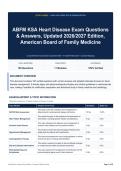
ABFM KSA Heart Disease Exam Questions
& Answers, Updated 2026/2027 Edition,
American Board of Family Medicine
Comprehensive Examination Question Bank • In-Depth Rationales • Concept Mapping
TOTAL QUESTIONS EXAM TOPICS RATIONALES
100 Questions 11 Modules 100% Verified
DOCUMENT OVERVIEW
This document contains 100 verified questions with correct answers and detailed rationales focused on heart
disease management. It directly aligns with pharmacological principles and clinical guidelines in cardiovascular
care, making it suitable for certification preparation and advanced study in family medicine and cardiology.
EXAM BLUEPRINT & TOPIC DISTRIBUTION
Systematic breakdown of subject domains and exam coverage.
Topic Module Scope & Core Focus Questions Share (%)
This topic covers the evaluation and management of
ASCVD Risk Assessment atherosclerotic cardiovascular disease risk factors. 10 Qs 10.0%
This section focuses on the treatment and assessment of
Heart Failure Management heart failure, including ejection fraction considerations. 9 Qs 9.0%
This topic addresses the diagnosis and management of
Ischemic Heart Disease ischemic heart disease and myocardial infarction. 9 Qs 9.0%
This section involves the pharmacological treatment and
Hypertension Management target goals for patients with hypertension. 9 Qs 9.0%
This topic encompasses the use of anticoagulants in various
Anticoagulation Therapy clinical scenarios, including atrial fibrillation. 9 Qs 9.0%
This section reviews the impact of diet and lifestyle changes
Diet and Lifestyle Interventions on cardiovascular health and disease prevention. 9 Qs 9.0%
Electrophysiology and This topic explores the management of arrhythmias and the
Arrhythmias pharmacological agents used in their treatment. 9 Qs 9.0%
Confidential • Student Study Edition • Practice & Review Guide Page 1 of 52
,STUDENT STUDY & MASTERY EDITION PRACTICE & REVIEW GUIDE
Cardiovascular Imaging and This section covers diagnostic tools and imaging techniques
Diagnostics used in the assessment of cardiovascular conditions. 9 Qs 9.0%
This topic addresses the management and surgical
Heart Valve Disease considerations for patients with valvular heart disease. 9 Qs 9.0%
Chronic Kidney Disease and This section focuses on the interplay between chronic kidney
Cardiovascular Risk disease and cardiovascular risk factors. 9 Qs 9.0%
This topic reviews the management strategies for patients
Congenital Heart Disease with congenital heart conditions. 9 Qs 9.0%
Total Exam Coverage 11 Integrated Topic Modules 100 Qs 100.0%
Confidential • Student Study Edition • Practice & Review Guide Page 2 of 52
,STUDENT STUDY & MASTERY EDITION PRACTICE & REVIEW GUIDE
TOPIC 1: ASCVD RISK ASSESSMENT
10 Questions • 10.0% of Exam • This topic covers the evaluation and management of atherosclerotic cardiovascular disease risk
factors.
QUESTION 1
A 55-year-old African-American male smoker has a total cholesterol of 240 mg/dL,
HDL-C 38 mg/dL, systolic blood pressure 148 mmHg (untreated), and no diabetes.
Using the ACC/AHA Pooled Cohort equations, his 10-year ASCVD risk is calculated at
12%. According to current primary-prevention guidelines, which of the following is the
most appropriate next step?
[A] Begin lifestyle modification alone and re-assess risk in 5 years
[B] Start a moderate-intensity statin
[C] Start a high-intensity statin
[D] Prescribe low-dose aspirin without a statin
Correct Answer: Start a high-intensity statin.
Rationale: A 10-year ASCVD risk >10% warrants initiation of a high-intensity statin regardless of age or race. Lifestyle
changes are still recommended but do not replace statin therapy in this risk category.
QUESTION 2
In a 68-year-old woman with hypertension and stage 3 chronic kidney disease (eGFR 45
mL/min/1.73 m²), what is the target blood pressure for optimal cardiovascular risk
reduction according to the latest ACC/AHA guideline?
[A] Less than 140/90 mmHg
[B] Less than 130/80 mmHg
[C] Less than 120/70 mmHg
[D] Less than 150/90 mmHg
Correct Answer: Less than 130/80 mmHg.
Rationale: For patients with hypertension and CKD, the guideline recommends a target of <130/80 mmHg to reduce the risk
of myocardial infarction, stroke, and heart failure.
Confidential • Student Study Edition • Practice & Review Guide Page 3 of 52
, STUDENT STUDY & MASTERY EDITION PRACTICE & REVIEW GUIDE
QUESTION 3
A 48-year-old African-American man with a systolic blood pressure of 138 mmHg, total
cholesterol 210 mg/dL, HDL-C 38 mg/dL, non-smoker, no diabetes, and a father who
had an MI at age 55 is evaluated for primary prevention. Using the pooled cohort
ASCVD risk calculator, his 10-year risk is approximately 7.5%. According to current
ABFM recommendations, what is the most appropriate next step regarding
lipid-lowering therapy?
[A] Initiate high-intensity statin therapy immediately
[B] Begin moderate-intensity statin therapy
[C] Defer statin therapy and repeat risk assessment in 5 years
[D] Prescribe a bile-acid sequestrant instead of a statin
Correct Answer: Begin moderate-intensity statin therapy.
Rationale: A 10-year ASCVD risk of 7.5% places the patient in the intermediate-risk category. Current guidelines
recommend initiating moderate-intensity statin therapy for primary prevention in patients with a 10-year risk of 7.5%-19.9%,
after discussing potential benefits and harms.
QUESTION 4
Which of the following lifestyle interventions has been shown to produce the greatest
absolute reduction in 10-year ASCVD risk when added to standard medical therapy in
adults with elevated baseline risk?
[A] Mediterranean diet rich in nuts and olive oil
[B] Structured aerobic exercise program achieving ≥150 min/week moderate intensity
[C] Smoking cessation counseling with nicotine replacement therapy
[D] Weight loss achieving ≥10% reduction in body weight
Correct Answer: Smoking cessation counseling with nicotine replacement therapy.
Rationale: Smoking cessation yields the largest absolute risk reduction (~2-3% per decade) in ASCVD risk compared with
other individual lifestyle changes, especially in high-risk populations.
Confidential • Student Study Edition • Practice & Review Guide Page 4 of 52
ABFM KSA Heart Disease Exam Questions
& Answers, Updated 2026/2027 Edition,
American Board of Family Medicine
Comprehensive Examination Question Bank • In-Depth Rationales • Concept Mapping
TOTAL QUESTIONS EXAM TOPICS RATIONALES
100 Questions 11 Modules 100% Verified
DOCUMENT OVERVIEW
This document contains 100 verified questions with correct answers and detailed rationales focused on heart
disease management. It directly aligns with pharmacological principles and clinical guidelines in cardiovascular
care, making it suitable for certification preparation and advanced study in family medicine and cardiology.
EXAM BLUEPRINT & TOPIC DISTRIBUTION
Systematic breakdown of subject domains and exam coverage.
Topic Module Scope & Core Focus Questions Share (%)
This topic covers the evaluation and management of
ASCVD Risk Assessment atherosclerotic cardiovascular disease risk factors. 10 Qs 10.0%
This section focuses on the treatment and assessment of
Heart Failure Management heart failure, including ejection fraction considerations. 9 Qs 9.0%
This topic addresses the diagnosis and management of
Ischemic Heart Disease ischemic heart disease and myocardial infarction. 9 Qs 9.0%
This section involves the pharmacological treatment and
Hypertension Management target goals for patients with hypertension. 9 Qs 9.0%
This topic encompasses the use of anticoagulants in various
Anticoagulation Therapy clinical scenarios, including atrial fibrillation. 9 Qs 9.0%
This section reviews the impact of diet and lifestyle changes
Diet and Lifestyle Interventions on cardiovascular health and disease prevention. 9 Qs 9.0%
Electrophysiology and This topic explores the management of arrhythmias and the
Arrhythmias pharmacological agents used in their treatment. 9 Qs 9.0%
Confidential • Student Study Edition • Practice & Review Guide Page 1 of 52
,STUDENT STUDY & MASTERY EDITION PRACTICE & REVIEW GUIDE
Cardiovascular Imaging and This section covers diagnostic tools and imaging techniques
Diagnostics used in the assessment of cardiovascular conditions. 9 Qs 9.0%
This topic addresses the management and surgical
Heart Valve Disease considerations for patients with valvular heart disease. 9 Qs 9.0%
Chronic Kidney Disease and This section focuses on the interplay between chronic kidney
Cardiovascular Risk disease and cardiovascular risk factors. 9 Qs 9.0%
This topic reviews the management strategies for patients
Congenital Heart Disease with congenital heart conditions. 9 Qs 9.0%
Total Exam Coverage 11 Integrated Topic Modules 100 Qs 100.0%
Confidential • Student Study Edition • Practice & Review Guide Page 2 of 52
,STUDENT STUDY & MASTERY EDITION PRACTICE & REVIEW GUIDE
TOPIC 1: ASCVD RISK ASSESSMENT
10 Questions • 10.0% of Exam • This topic covers the evaluation and management of atherosclerotic cardiovascular disease risk
factors.
QUESTION 1
A 55-year-old African-American male smoker has a total cholesterol of 240 mg/dL,
HDL-C 38 mg/dL, systolic blood pressure 148 mmHg (untreated), and no diabetes.
Using the ACC/AHA Pooled Cohort equations, his 10-year ASCVD risk is calculated at
12%. According to current primary-prevention guidelines, which of the following is the
most appropriate next step?
[A] Begin lifestyle modification alone and re-assess risk in 5 years
[B] Start a moderate-intensity statin
[C] Start a high-intensity statin
[D] Prescribe low-dose aspirin without a statin
Correct Answer: Start a high-intensity statin.
Rationale: A 10-year ASCVD risk >10% warrants initiation of a high-intensity statin regardless of age or race. Lifestyle
changes are still recommended but do not replace statin therapy in this risk category.
QUESTION 2
In a 68-year-old woman with hypertension and stage 3 chronic kidney disease (eGFR 45
mL/min/1.73 m²), what is the target blood pressure for optimal cardiovascular risk
reduction according to the latest ACC/AHA guideline?
[A] Less than 140/90 mmHg
[B] Less than 130/80 mmHg
[C] Less than 120/70 mmHg
[D] Less than 150/90 mmHg
Correct Answer: Less than 130/80 mmHg.
Rationale: For patients with hypertension and CKD, the guideline recommends a target of <130/80 mmHg to reduce the risk
of myocardial infarction, stroke, and heart failure.
Confidential • Student Study Edition • Practice & Review Guide Page 3 of 52
, STUDENT STUDY & MASTERY EDITION PRACTICE & REVIEW GUIDE
QUESTION 3
A 48-year-old African-American man with a systolic blood pressure of 138 mmHg, total
cholesterol 210 mg/dL, HDL-C 38 mg/dL, non-smoker, no diabetes, and a father who
had an MI at age 55 is evaluated for primary prevention. Using the pooled cohort
ASCVD risk calculator, his 10-year risk is approximately 7.5%. According to current
ABFM recommendations, what is the most appropriate next step regarding
lipid-lowering therapy?
[A] Initiate high-intensity statin therapy immediately
[B] Begin moderate-intensity statin therapy
[C] Defer statin therapy and repeat risk assessment in 5 years
[D] Prescribe a bile-acid sequestrant instead of a statin
Correct Answer: Begin moderate-intensity statin therapy.
Rationale: A 10-year ASCVD risk of 7.5% places the patient in the intermediate-risk category. Current guidelines
recommend initiating moderate-intensity statin therapy for primary prevention in patients with a 10-year risk of 7.5%-19.9%,
after discussing potential benefits and harms.
QUESTION 4
Which of the following lifestyle interventions has been shown to produce the greatest
absolute reduction in 10-year ASCVD risk when added to standard medical therapy in
adults with elevated baseline risk?
[A] Mediterranean diet rich in nuts and olive oil
[B] Structured aerobic exercise program achieving ≥150 min/week moderate intensity
[C] Smoking cessation counseling with nicotine replacement therapy
[D] Weight loss achieving ≥10% reduction in body weight
Correct Answer: Smoking cessation counseling with nicotine replacement therapy.
Rationale: Smoking cessation yields the largest absolute risk reduction (~2-3% per decade) in ASCVD risk compared with
other individual lifestyle changes, especially in high-risk populations.
Confidential • Student Study Edition • Practice & Review Guide Page 4 of 52