[STUDY GUIDE] • HIGH-YIELD PRACTICE & REVIEW EDITION
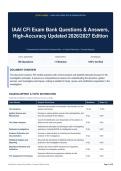
IAAI CFI Exam Bank Questions & Answers,
High-Accuracy Updated 2026/2027 Edition
Comprehensive Examination Question Bank • In-Depth Rationales • Concept Mapping
TOTAL QUESTIONS EXAM TOPICS RATIONALES
100 Questions 11 Modules 100% Verified
DOCUMENT OVERVIEW
This document contains 100 verified questions with correct answers and detailed rationales focused on fire
investigation principles. It serves as a comprehensive resource for understanding fire dynamics, ignition
sources, and investigative techniques, making it suitable for study, review, and certification preparation in fire
investigation.
EXAM BLUEPRINT & TOPIC DISTRIBUTION
Systematic breakdown of subject domains and exam coverage.
Topic Module Scope & Core Focus Questions Share (%)
Examines the principles of combustion, heat transfer, and fire
Fire Dynamics spread mechanisms. 10 Qs 10.0%
Ignition Sources and Focuses on various ignition sources, their characteristics, and
Mechanisms how they contribute to fire initiation. 9 Qs 9.0%
Covers the identification and interpretation of fire patterns to
Fire Pattern Analysis determine fire origin and spread. 9 Qs 9.0%
Addresses the principles and techniques used in investigating
Explosion Investigations explosions, including BLEVE and deflagration events. 9 Qs 9.0%
Evidence Collection and Focuses on best practices for collecting and documenting
Documentation evidence in fire investigations. 9 Qs 9.0%
Statistical Analysis and Discusses the importance of statistical methods and reporting
Reporting protocols in fire investigation outcomes. 9 Qs 9.0%
Regulatory Standards and Explores the relevant NFPA standards and regulations
Guidelines impacting fire investigation practices. 9 Qs 9.0%
Examines effective fire suppression methods and the
Fire Suppression Techniques principles guiding their application. 9 Qs 9.0%
Confidential • Student Study Edition • Practice & Review Guide Page 1 of 52
,STUDENT STUDY & MASTERY EDITION PRACTICE & REVIEW GUIDE
Chemical Analysis in Fire Focuses on the role of chemical analysis techniques in
Investigation identifying accelerants and residues. 9 Qs 9.0%
Covers the systematic approaches and methodologies used
Investigative Techniques in fire investigation. 9 Qs 9.0%
Analyzes thermal dynamics and the characteristics of fire
Thermal Effects and Fire Growth growth in various environments. 9 Qs 9.0%
Total Exam Coverage 11 Integrated Topic Modules 100 Qs 100.0%
Confidential • Student Study Edition • Practice & Review Guide Page 2 of 52
,STUDENT STUDY & MASTERY EDITION PRACTICE & REVIEW GUIDE
TOPIC 1: FIRE DYNAMICS
10 Questions • 10.0% of Exam • Examines the principles of combustion, heat transfer, and fire spread mechanisms.
QUESTION 1
In fire dynamics, a combustion wave traveling at a speed greater than the local speed of
sound is classified as which of the following?
[A] Deflagration
[B] Detonation
[C] Flame spread
[D] Flashover
Correct Answer: Detonation.
Rationale: Detonation is defined by a supersonic combustion front that generates a shock wave, whereas deflagration
propagates sub-sonically.
QUESTION 2
During a compartment fire, which heat transfer mechanism becomes dominant in the
late stage and most significantly contributes to flashover?
[A] Conduction through walls
[B] Convection currents within the hot layer
[C] Radiant heat exchange from the fire plume
[D] Evaporative cooling from water streams
Correct Answer: Radiant heat exchange from the fire plume.
Rationale: Radiation from the hot fire plume and burning surfaces raises the temperature of all interior surfaces, leading to
simultaneous ignition (flashover).
Confidential • Student Study Edition • Practice & Review Guide Page 3 of 52
, STUDENT STUDY & MASTERY EDITION PRACTICE & REVIEW GUIDE
QUESTION 3
A pressurized liquid storage tank fails explosively when its internal pressure exceeds
the design pressure and the liquid undergoes rapid phase change. Which phenomenon
best describes this event?
[A] Boiling Liquid Expanding Vapor Explosion (BLEVE)
[B] Deflagration
[C] Thermal runaway
[D] Detonation
Correct Answer: Boiling Liquid Expanding Vapor Explosion (BLEVE)
Rationale: BLEVE occurs when a vessel containing a pressurized liquid ruptures, causing rapid vaporization and explosive
pressure release.
QUESTION 4
Which of the following best explains why smoke tends to stratify in a high-rise building
fire?
[A] Higher temperature gases become less dense and rise, forming a hot upper layer beneath the ceiling.
[B] Cold air from the HVAC system forces smoke downward.
[C] Gravity pulls smoke particles toward the floor.
[D] Ventilation fans mix smoke uniformly throughout the space.
Correct Answer: Higher temperature gases become less dense and rise, forming a hot upper layer beneath
the ceiling.
Rationale: Thermal buoyancy causes hot, less dense smoke to rise and accumulate near the ceiling, creating a distinct
upper layer.
Confidential • Student Study Edition • Practice & Review Guide Page 4 of 52
IAAI CFI Exam Bank Questions & Answers,
High-Accuracy Updated 2026/2027 Edition
Comprehensive Examination Question Bank • In-Depth Rationales • Concept Mapping
TOTAL QUESTIONS EXAM TOPICS RATIONALES
100 Questions 11 Modules 100% Verified
DOCUMENT OVERVIEW
This document contains 100 verified questions with correct answers and detailed rationales focused on fire
investigation principles. It serves as a comprehensive resource for understanding fire dynamics, ignition
sources, and investigative techniques, making it suitable for study, review, and certification preparation in fire
investigation.
EXAM BLUEPRINT & TOPIC DISTRIBUTION
Systematic breakdown of subject domains and exam coverage.
Topic Module Scope & Core Focus Questions Share (%)
Examines the principles of combustion, heat transfer, and fire
Fire Dynamics spread mechanisms. 10 Qs 10.0%
Ignition Sources and Focuses on various ignition sources, their characteristics, and
Mechanisms how they contribute to fire initiation. 9 Qs 9.0%
Covers the identification and interpretation of fire patterns to
Fire Pattern Analysis determine fire origin and spread. 9 Qs 9.0%
Addresses the principles and techniques used in investigating
Explosion Investigations explosions, including BLEVE and deflagration events. 9 Qs 9.0%
Evidence Collection and Focuses on best practices for collecting and documenting
Documentation evidence in fire investigations. 9 Qs 9.0%
Statistical Analysis and Discusses the importance of statistical methods and reporting
Reporting protocols in fire investigation outcomes. 9 Qs 9.0%
Regulatory Standards and Explores the relevant NFPA standards and regulations
Guidelines impacting fire investigation practices. 9 Qs 9.0%
Examines effective fire suppression methods and the
Fire Suppression Techniques principles guiding their application. 9 Qs 9.0%
Confidential • Student Study Edition • Practice & Review Guide Page 1 of 52
,STUDENT STUDY & MASTERY EDITION PRACTICE & REVIEW GUIDE
Chemical Analysis in Fire Focuses on the role of chemical analysis techniques in
Investigation identifying accelerants and residues. 9 Qs 9.0%
Covers the systematic approaches and methodologies used
Investigative Techniques in fire investigation. 9 Qs 9.0%
Analyzes thermal dynamics and the characteristics of fire
Thermal Effects and Fire Growth growth in various environments. 9 Qs 9.0%
Total Exam Coverage 11 Integrated Topic Modules 100 Qs 100.0%
Confidential • Student Study Edition • Practice & Review Guide Page 2 of 52
,STUDENT STUDY & MASTERY EDITION PRACTICE & REVIEW GUIDE
TOPIC 1: FIRE DYNAMICS
10 Questions • 10.0% of Exam • Examines the principles of combustion, heat transfer, and fire spread mechanisms.
QUESTION 1
In fire dynamics, a combustion wave traveling at a speed greater than the local speed of
sound is classified as which of the following?
[A] Deflagration
[B] Detonation
[C] Flame spread
[D] Flashover
Correct Answer: Detonation.
Rationale: Detonation is defined by a supersonic combustion front that generates a shock wave, whereas deflagration
propagates sub-sonically.
QUESTION 2
During a compartment fire, which heat transfer mechanism becomes dominant in the
late stage and most significantly contributes to flashover?
[A] Conduction through walls
[B] Convection currents within the hot layer
[C] Radiant heat exchange from the fire plume
[D] Evaporative cooling from water streams
Correct Answer: Radiant heat exchange from the fire plume.
Rationale: Radiation from the hot fire plume and burning surfaces raises the temperature of all interior surfaces, leading to
simultaneous ignition (flashover).
Confidential • Student Study Edition • Practice & Review Guide Page 3 of 52
, STUDENT STUDY & MASTERY EDITION PRACTICE & REVIEW GUIDE
QUESTION 3
A pressurized liquid storage tank fails explosively when its internal pressure exceeds
the design pressure and the liquid undergoes rapid phase change. Which phenomenon
best describes this event?
[A] Boiling Liquid Expanding Vapor Explosion (BLEVE)
[B] Deflagration
[C] Thermal runaway
[D] Detonation
Correct Answer: Boiling Liquid Expanding Vapor Explosion (BLEVE)
Rationale: BLEVE occurs when a vessel containing a pressurized liquid ruptures, causing rapid vaporization and explosive
pressure release.
QUESTION 4
Which of the following best explains why smoke tends to stratify in a high-rise building
fire?
[A] Higher temperature gases become less dense and rise, forming a hot upper layer beneath the ceiling.
[B] Cold air from the HVAC system forces smoke downward.
[C] Gravity pulls smoke particles toward the floor.
[D] Ventilation fans mix smoke uniformly throughout the space.
Correct Answer: Higher temperature gases become less dense and rise, forming a hot upper layer beneath
the ceiling.
Rationale: Thermal buoyancy causes hot, less dense smoke to rise and accumulate near the ceiling, creating a distinct
upper layer.
Confidential • Student Study Edition • Practice & Review Guide Page 4 of 52