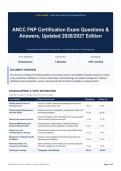
[STUDY GUIDE] • HIGH-YIELD PRACTICE & REVIEW EDITION
ANCC FNP Certification Exam Questions &
Answers, Updated 2026/2027 Edition
Comprehensive Examination Question Bank • In-Depth Rationales • Concept Mapping
TOTAL QUESTIONS EXAM TOPICS RATIONALES
84 Questions 7 Modules 100% Verified
DOCUMENT OVERVIEW
This document contains 84 verified questions with correct answers and detailed rationales focusing on family
nurse practitioner certification. It covers critical areas of pharmacology and patient management, making it
suitable for exam preparation, review, and enhancement of clinical knowledge in nursing practice.
EXAM BLUEPRINT & TOPIC DISTRIBUTION
Systematic breakdown of subject domains and exam coverage.
Topic Module Scope & Core Focus Questions Share (%)
Routine Health Visits and Focuses on health maintenance strategies and preventive
Preventive Care measures during routine visits. 12 Qs 14.3%
Pharmacological Management Explores medication management, potential side effects, and
and Side Effects monitoring parameters. 17 Qs 20.2%
Examines strategies and methodologies for improving patient
Quality Improvement Projects care and reducing adverse outcomes. 11 Qs 13.1%
Research Methodology and Covers research methodologies, including randomized
Evidence-Based Practice controlled trials and their application in clinical practice. 11 Qs 13.1%
Ethical and Legal Addresses ethical dilemmas and legal responsibilities faced
Considerations in Nursing by nurse practitioners. 11 Qs 13.1%
Management of Specific Health Focuses on the management and treatment protocols for
Conditions various chronic conditions. 11 Qs 13.1%
Patient Education and Explores effective communication and counseling strategies
Counseling Techniques for patient engagement and education. 11 Qs 13.1%
Total Exam Coverage 7 Integrated Topic Modules 84 Qs 100.0%
Confidential • Student Study Edition • Practice & Review Guide Page 1 of 41
,STUDENT STUDY & MASTERY EDITION PRACTICE & REVIEW GUIDE
TOPIC 1: ROUTINE HEALTH VISITS AND PREVENTIVE CARE
12 Questions • 14.3% of Exam • Focuses on health maintenance strategies and preventive measures during routine visits.
QUESTION 1
A 25-year-old woman presents for a routine health visit. She is sexually active and uses
condoms inconsistently. Which of the following is the most appropriate
recommendation for cervical cancer screening and prevention?
[A] Initiate Pap smear screening at age 30
[B] Administer Gardasil vaccine
[C] Recommend consistent condom use and HPV vaccination if not already vaccinated
[D] Perform HPV testing now
Correct Answer: Recommend consistent condom use and HPV vaccination if not already vaccinated.
Rationale: The patient is at risk for HPV infection due to inconsistent condom use. HPV vaccination is recommended for
adults up to age 26, and consistent condom use can reduce the risk of HPV transmission. Current guidelines recommend
starting Pap smear screening at age 21.
QUESTION 2
A 50-year-old male patient with a history of smoking presents for a health maintenance
visit. Which of the following is the most appropriate recommendation for lung cancer
screening?
[A] Annual low-dose CT scan
[B] Annual chest X-ray
[C] Spirometry testing
[D] No screening recommended
Correct Answer: Annual low-dose CT scan.
Rationale: The US Preventive Services Task Force recommends annual lung cancer screening with low-dose CT for adults
aged 50-74 who have a 20 pack-year smoking history and currently smoke or have quit within the past 15 years.
Confidential • Student Study Edition • Practice & Review Guide Page 2 of 41
,STUDENT STUDY & MASTERY EDITION PRACTICE & REVIEW GUIDE
QUESTION 3
A 30-year-old woman with a family history of breast cancer presents for a routine health
visit. Which of the following is the most appropriate recommendation for breast cancer
screening?
[A] Annual mammography starting at age 40
[B] Biennial mammography starting at age 50
[C] Risk assessment and consideration of earlier screening
[D] No screening recommended until age 50
Correct Answer: Risk assessment and consideration of earlier screening.
Rationale: The patient's family history of breast cancer is a risk factor. Current guidelines recommend assessing breast
cancer risk and considering earlier screening for women with a significant family history.
QUESTION 4
A 20-year-old woman presents for a routine health visit. She is a college student and
reports binge drinking on weekends. Which of the following is the most appropriate
recommendation for alcohol misuse prevention?
[A] Counseling on safe drinking limits
[B] Referral to a substance abuse program
[C] Prescription for naltrexone
[D] No intervention recommended
Correct Answer: Counseling on safe drinking limits.
Rationale: The patient is engaging in risky drinking behavior. Brief counseling on safe drinking limits is a recommended
intervention for alcohol misuse prevention.
Confidential • Student Study Edition • Practice & Review Guide Page 3 of 41
, STUDENT STUDY & MASTERY EDITION PRACTICE & REVIEW GUIDE
QUESTION 5
A 40-year-old male patient with a history of diabetes presents for a health maintenance
visit. Which of the following is the most appropriate recommendation for
diabetes-related complication prevention?
[A] Annual dilated eye exam
[B] Biennial foot exam
[C] Quarterly hemoglobin A1c testing
[D] Annual urine microalbumin testing
Correct Answer: Annual dilated eye exam.
Rationale: Diabetic retinopathy is a common complication of diabetes. Annual dilated eye exams are recommended to
detect retinopathy early.
QUESTION 6
A 55-year-old postmenopausal woman presents for a routine health visit. Which of the
following is the most appropriate recommendation for osteoporosis prevention?
[A] Calcium and vitamin D supplementation
[B] Bisphosphonate therapy
[C] Dual-energy X-ray absorptiometry (DXA) scan
[D] Hormone replacement therapy (HRT)
Correct Answer: Calcium and vitamin D supplementation.
Rationale: Calcium and vitamin D supplementation is recommended for osteoporosis prevention in postmenopausal
women.
Confidential • Student Study Edition • Practice & Review Guide Page 4 of 41
ANCC FNP Certification Exam Questions &
Answers, Updated 2026/2027 Edition
Comprehensive Examination Question Bank • In-Depth Rationales • Concept Mapping
TOTAL QUESTIONS EXAM TOPICS RATIONALES
84 Questions 7 Modules 100% Verified
DOCUMENT OVERVIEW
This document contains 84 verified questions with correct answers and detailed rationales focusing on family
nurse practitioner certification. It covers critical areas of pharmacology and patient management, making it
suitable for exam preparation, review, and enhancement of clinical knowledge in nursing practice.
EXAM BLUEPRINT & TOPIC DISTRIBUTION
Systematic breakdown of subject domains and exam coverage.
Topic Module Scope & Core Focus Questions Share (%)
Routine Health Visits and Focuses on health maintenance strategies and preventive
Preventive Care measures during routine visits. 12 Qs 14.3%
Pharmacological Management Explores medication management, potential side effects, and
and Side Effects monitoring parameters. 17 Qs 20.2%
Examines strategies and methodologies for improving patient
Quality Improvement Projects care and reducing adverse outcomes. 11 Qs 13.1%
Research Methodology and Covers research methodologies, including randomized
Evidence-Based Practice controlled trials and their application in clinical practice. 11 Qs 13.1%
Ethical and Legal Addresses ethical dilemmas and legal responsibilities faced
Considerations in Nursing by nurse practitioners. 11 Qs 13.1%
Management of Specific Health Focuses on the management and treatment protocols for
Conditions various chronic conditions. 11 Qs 13.1%
Patient Education and Explores effective communication and counseling strategies
Counseling Techniques for patient engagement and education. 11 Qs 13.1%
Total Exam Coverage 7 Integrated Topic Modules 84 Qs 100.0%
Confidential • Student Study Edition • Practice & Review Guide Page 1 of 41
,STUDENT STUDY & MASTERY EDITION PRACTICE & REVIEW GUIDE
TOPIC 1: ROUTINE HEALTH VISITS AND PREVENTIVE CARE
12 Questions • 14.3% of Exam • Focuses on health maintenance strategies and preventive measures during routine visits.
QUESTION 1
A 25-year-old woman presents for a routine health visit. She is sexually active and uses
condoms inconsistently. Which of the following is the most appropriate
recommendation for cervical cancer screening and prevention?
[A] Initiate Pap smear screening at age 30
[B] Administer Gardasil vaccine
[C] Recommend consistent condom use and HPV vaccination if not already vaccinated
[D] Perform HPV testing now
Correct Answer: Recommend consistent condom use and HPV vaccination if not already vaccinated.
Rationale: The patient is at risk for HPV infection due to inconsistent condom use. HPV vaccination is recommended for
adults up to age 26, and consistent condom use can reduce the risk of HPV transmission. Current guidelines recommend
starting Pap smear screening at age 21.
QUESTION 2
A 50-year-old male patient with a history of smoking presents for a health maintenance
visit. Which of the following is the most appropriate recommendation for lung cancer
screening?
[A] Annual low-dose CT scan
[B] Annual chest X-ray
[C] Spirometry testing
[D] No screening recommended
Correct Answer: Annual low-dose CT scan.
Rationale: The US Preventive Services Task Force recommends annual lung cancer screening with low-dose CT for adults
aged 50-74 who have a 20 pack-year smoking history and currently smoke or have quit within the past 15 years.
Confidential • Student Study Edition • Practice & Review Guide Page 2 of 41
,STUDENT STUDY & MASTERY EDITION PRACTICE & REVIEW GUIDE
QUESTION 3
A 30-year-old woman with a family history of breast cancer presents for a routine health
visit. Which of the following is the most appropriate recommendation for breast cancer
screening?
[A] Annual mammography starting at age 40
[B] Biennial mammography starting at age 50
[C] Risk assessment and consideration of earlier screening
[D] No screening recommended until age 50
Correct Answer: Risk assessment and consideration of earlier screening.
Rationale: The patient's family history of breast cancer is a risk factor. Current guidelines recommend assessing breast
cancer risk and considering earlier screening for women with a significant family history.
QUESTION 4
A 20-year-old woman presents for a routine health visit. She is a college student and
reports binge drinking on weekends. Which of the following is the most appropriate
recommendation for alcohol misuse prevention?
[A] Counseling on safe drinking limits
[B] Referral to a substance abuse program
[C] Prescription for naltrexone
[D] No intervention recommended
Correct Answer: Counseling on safe drinking limits.
Rationale: The patient is engaging in risky drinking behavior. Brief counseling on safe drinking limits is a recommended
intervention for alcohol misuse prevention.
Confidential • Student Study Edition • Practice & Review Guide Page 3 of 41
, STUDENT STUDY & MASTERY EDITION PRACTICE & REVIEW GUIDE
QUESTION 5
A 40-year-old male patient with a history of diabetes presents for a health maintenance
visit. Which of the following is the most appropriate recommendation for
diabetes-related complication prevention?
[A] Annual dilated eye exam
[B] Biennial foot exam
[C] Quarterly hemoglobin A1c testing
[D] Annual urine microalbumin testing
Correct Answer: Annual dilated eye exam.
Rationale: Diabetic retinopathy is a common complication of diabetes. Annual dilated eye exams are recommended to
detect retinopathy early.
QUESTION 6
A 55-year-old postmenopausal woman presents for a routine health visit. Which of the
following is the most appropriate recommendation for osteoporosis prevention?
[A] Calcium and vitamin D supplementation
[B] Bisphosphonate therapy
[C] Dual-energy X-ray absorptiometry (DXA) scan
[D] Hormone replacement therapy (HRT)
Correct Answer: Calcium and vitamin D supplementation.
Rationale: Calcium and vitamin D supplementation is recommended for osteoporosis prevention in postmenopausal
women.
Confidential • Student Study Edition • Practice & Review Guide Page 4 of 41