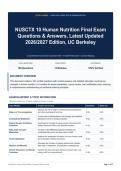
[STUDY GUIDE] • HIGH-YIELD PRACTICE & REVIEW EDITION
NUSCTX 10 Human Nutrition Final Exam
Questions & Answers, Latest Updated
2026/2027 Edition, UC Berkeley
Comprehensive Examination Question Bank • In-Depth Rationales • Concept Mapping
TOTAL QUESTIONS EXAM TOPICS RATIONALES
100 Questions 12 Modules 100% Verified
DOCUMENT OVERVIEW
This document contains 100 verified questions with correct answers and detailed rationales covering key
concepts in human nutrition. It is suitable for exam preparation, course review, and certification prep, ensuring
a comprehensive understanding of nutritional science principles.
EXAM BLUEPRINT & TOPIC DISTRIBUTION
Systematic breakdown of subject domains and exam coverage.
Topic Module Scope & Core Focus Questions Share (%)
Explores the role of water in maintaining body temperature
Water and Thermoregulation and other physiological functions. 9 Qs 9.0%
Covers types of carbohydrates, their storage, and metabolic
Carbohydrate Metabolism pathways involved in energy production. 9 Qs 9.0%
Nutrient Density and Dietary Examines the concepts of energy density, Recommended
Guidelines Dietary Allowance (RDA), and essential nutrients. 9 Qs 9.0%
Fatty Acids and Lipid Focuses on the differences between saturated and
Metabolism unsaturated fatty acids, and their roles in health. 9 Qs 9.0%
Analyzes the breakdown of proteins, the role of amino acids,
Protein Metabolism and associated metabolic processes. 8 Qs 8.0%
Discusses the functions of various vitamins and minerals,
Vitamins and Minerals their roles in metabolism, and deficiency consequences. 8 Qs 8.0%
Cellular Respiration and Energy Explores the citric acid cycle, electron transport chain, and
Production energy yield from macronutrients. 8 Qs 8.0%
Confidential • Student Study Edition • Practice & Review Guide Page 1 of 37
,STUDENT STUDY & MASTERY EDITION PRACTICE & REVIEW GUIDE
Covers essential food safety protocols, Hazard Analysis and
Food Safety Practices Critical Control Points (HACCP), and sanitation methods. 8 Qs 8.0%
Explores the application of nutrition principles across different
Lifecycle Nutrition Principles life stages and individual dietary needs. 8 Qs 8.0%
Disease and Nutritional Examines the relationships between nutrition and various
Interventions health conditions, including metabolic diseases. 8 Qs 8.0%
Behavioral and Lifestyle Factors Analyzes the impact of lifestyle choices on nutrition and health
in Nutrition outcomes. 8 Qs 8.0%
Discusses the role of probiotics in digestive health and related
Probiotics and Gut Health nutritional therapies. 8 Qs 8.0%
Total Exam Coverage 12 Integrated Topic Modules 100 Qs 100.0%
Confidential • Student Study Edition • Practice & Review Guide Page 2 of 37
,STUDENT STUDY & MASTERY EDITION PRACTICE & REVIEW GUIDE
TOPIC 1: WATER AND THERMOREGULATION
9 Questions • 9.0% of Exam • Explores the role of water in maintaining body temperature and other physiological functions.
QUESTION 1
What is the primary function of water in the human body during thermoregulation?
[A] To produce energy for metabolic processes
[B] To regulate body temperature
[C] To maintain pH balance in the body
[D] To provide structural support to cells and tissues
Correct Answer: To regulate body temperature.
Rationale: Water plays a crucial role in thermoregulation by facilitating heat exchange between the body and the
environment.
QUESTION 2
What is the term for the process by which the body adapts to changes in nutrient intake
or energy expenditure over time?
[A] Metabolic adaptation
[B] Hormonal response
[C] Adaptation to energy balance
[D] Nutrient regulation
Correct Answer: C) Adaptation to energy balance.
Rationale: Adaptation to energy balance refers to the body's adjustment to changes in nutrient intake or energy
expenditure.
QUESTION 3
What is the primary role of enzymes in the human digestive system?
Correct Answer: Enzymes break down large molecules of food into smaller molecules that can be absorbed
and utilized by the body.
Rationale: Enzymes play a crucial role in facilitating chemical reactions during digestion, enabling the breakdown of
complex nutrients.
Confidential • Student Study Edition • Practice & Review Guide Page 3 of 37
, STUDENT STUDY & MASTERY EDITION PRACTICE & REVIEW GUIDE
QUESTION 4
Which of the following is an example of a negative feedback mechanism in nutrition?
[A] Increased insulin levels leading to increased glucose uptake in cells
[B] Decreased thyroid hormone levels leading to decreased metabolic rate
[C] Increased ghrelin levels leading to increased food intake
[D] Decreased leptin levels leading to increased food intake
Correct Answer: B.
Rationale: Decreased thyroid hormone levels leading to decreased metabolic rate is an example of a negative feedback
mechanism in nutrition, where a decrease in thyroid hormone levels triggers a response to decrease metabolic rate.
QUESTION 5
A person consuming a high-protein diet requires more of which essential nutrient?
[A] Vitamin C
[B] Vitamin E
[C] Calcium
[D] Folic acid
Correct Answer: C.
Rationale: A high-protein diet requires more calcium to help neutralize the acidity produced by the metabolism of protein.
QUESTION 6
Is the process of glycolysis an anaerobic or aerobic process?
Correct Answer: False.
Rationale: Glycolysis is an anaerobic process, meaning it does not require oxygen to produce energy in the form of ATP.
However, it can be aerobic in the presence of oxygen, generating more ATP through the electron transport chain.
Confidential • Student Study Edition • Practice & Review Guide Page 4 of 37
NUSCTX 10 Human Nutrition Final Exam
Questions & Answers, Latest Updated
2026/2027 Edition, UC Berkeley
Comprehensive Examination Question Bank • In-Depth Rationales • Concept Mapping
TOTAL QUESTIONS EXAM TOPICS RATIONALES
100 Questions 12 Modules 100% Verified
DOCUMENT OVERVIEW
This document contains 100 verified questions with correct answers and detailed rationales covering key
concepts in human nutrition. It is suitable for exam preparation, course review, and certification prep, ensuring
a comprehensive understanding of nutritional science principles.
EXAM BLUEPRINT & TOPIC DISTRIBUTION
Systematic breakdown of subject domains and exam coverage.
Topic Module Scope & Core Focus Questions Share (%)
Explores the role of water in maintaining body temperature
Water and Thermoregulation and other physiological functions. 9 Qs 9.0%
Covers types of carbohydrates, their storage, and metabolic
Carbohydrate Metabolism pathways involved in energy production. 9 Qs 9.0%
Nutrient Density and Dietary Examines the concepts of energy density, Recommended
Guidelines Dietary Allowance (RDA), and essential nutrients. 9 Qs 9.0%
Fatty Acids and Lipid Focuses on the differences between saturated and
Metabolism unsaturated fatty acids, and their roles in health. 9 Qs 9.0%
Analyzes the breakdown of proteins, the role of amino acids,
Protein Metabolism and associated metabolic processes. 8 Qs 8.0%
Discusses the functions of various vitamins and minerals,
Vitamins and Minerals their roles in metabolism, and deficiency consequences. 8 Qs 8.0%
Cellular Respiration and Energy Explores the citric acid cycle, electron transport chain, and
Production energy yield from macronutrients. 8 Qs 8.0%
Confidential • Student Study Edition • Practice & Review Guide Page 1 of 37
,STUDENT STUDY & MASTERY EDITION PRACTICE & REVIEW GUIDE
Covers essential food safety protocols, Hazard Analysis and
Food Safety Practices Critical Control Points (HACCP), and sanitation methods. 8 Qs 8.0%
Explores the application of nutrition principles across different
Lifecycle Nutrition Principles life stages and individual dietary needs. 8 Qs 8.0%
Disease and Nutritional Examines the relationships between nutrition and various
Interventions health conditions, including metabolic diseases. 8 Qs 8.0%
Behavioral and Lifestyle Factors Analyzes the impact of lifestyle choices on nutrition and health
in Nutrition outcomes. 8 Qs 8.0%
Discusses the role of probiotics in digestive health and related
Probiotics and Gut Health nutritional therapies. 8 Qs 8.0%
Total Exam Coverage 12 Integrated Topic Modules 100 Qs 100.0%
Confidential • Student Study Edition • Practice & Review Guide Page 2 of 37
,STUDENT STUDY & MASTERY EDITION PRACTICE & REVIEW GUIDE
TOPIC 1: WATER AND THERMOREGULATION
9 Questions • 9.0% of Exam • Explores the role of water in maintaining body temperature and other physiological functions.
QUESTION 1
What is the primary function of water in the human body during thermoregulation?
[A] To produce energy for metabolic processes
[B] To regulate body temperature
[C] To maintain pH balance in the body
[D] To provide structural support to cells and tissues
Correct Answer: To regulate body temperature.
Rationale: Water plays a crucial role in thermoregulation by facilitating heat exchange between the body and the
environment.
QUESTION 2
What is the term for the process by which the body adapts to changes in nutrient intake
or energy expenditure over time?
[A] Metabolic adaptation
[B] Hormonal response
[C] Adaptation to energy balance
[D] Nutrient regulation
Correct Answer: C) Adaptation to energy balance.
Rationale: Adaptation to energy balance refers to the body's adjustment to changes in nutrient intake or energy
expenditure.
QUESTION 3
What is the primary role of enzymes in the human digestive system?
Correct Answer: Enzymes break down large molecules of food into smaller molecules that can be absorbed
and utilized by the body.
Rationale: Enzymes play a crucial role in facilitating chemical reactions during digestion, enabling the breakdown of
complex nutrients.
Confidential • Student Study Edition • Practice & Review Guide Page 3 of 37
, STUDENT STUDY & MASTERY EDITION PRACTICE & REVIEW GUIDE
QUESTION 4
Which of the following is an example of a negative feedback mechanism in nutrition?
[A] Increased insulin levels leading to increased glucose uptake in cells
[B] Decreased thyroid hormone levels leading to decreased metabolic rate
[C] Increased ghrelin levels leading to increased food intake
[D] Decreased leptin levels leading to increased food intake
Correct Answer: B.
Rationale: Decreased thyroid hormone levels leading to decreased metabolic rate is an example of a negative feedback
mechanism in nutrition, where a decrease in thyroid hormone levels triggers a response to decrease metabolic rate.
QUESTION 5
A person consuming a high-protein diet requires more of which essential nutrient?
[A] Vitamin C
[B] Vitamin E
[C] Calcium
[D] Folic acid
Correct Answer: C.
Rationale: A high-protein diet requires more calcium to help neutralize the acidity produced by the metabolism of protein.
QUESTION 6
Is the process of glycolysis an anaerobic or aerobic process?
Correct Answer: False.
Rationale: Glycolysis is an anaerobic process, meaning it does not require oxygen to produce energy in the form of ATP.
However, it can be aerobic in the presence of oxygen, generating more ATP through the electron transport chain.
Confidential • Student Study Edition • Practice & Review Guide Page 4 of 37