[STUDY GUIDE] • HIGH-YIELD PRACTICE & REVIEW EDITION
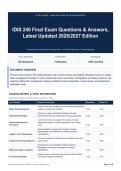
IDIS 240 Final Exam Questions & Answers,
Latest Updated 2026/2027 Edition
Comprehensive Examination Question Bank • In-Depth Rationales • Concept Mapping
TOTAL QUESTIONS EXAM TOPICS RATIONALES
100 Questions 13 Modules 100% Verified
DOCUMENT OVERVIEW
This document contains 100 verified questions with correct answers and detailed rationales focused on supply
chain management concepts. It covers critical topics such as inventory management, purchasing systems, and
customer relationship management, making it suitable for exam preparation, course review, and professional
certification study.
EXAM BLUEPRINT & TOPIC DISTRIBUTION
Systematic breakdown of subject domains and exam coverage.
Topic Module Scope & Core Focus Questions Share (%)
Examines the role and objectives of master data management
Master Data Management systems in supply chain contexts. 8 Qs 8.0%
Focuses on various distribution strategies, including
Distribution Strategies market-partnership and collaborative sourcing approaches. 8 Qs 8.0%
Covers key inventory management concepts, including
Inventory Management warehouse allocation, inventory optimization, and holding
Techniques costs. 8 Qs 8.0%
Explores logistics management principles, including
transportation mode selection and warehouse layout
Logistics and Transportation considerations. 8 Qs 8.0%
Discusses strategies for identifying and mitigating risks within
Supply Chain Risk Management supply chains. 8 Qs 8.0%
Examines the use and benefits of Radio Frequency
Identification technology in tracking and inventory
RFID Technology in Logistics management. 8 Qs 8.0%
Analyzes various purchasing approaches including strategic
Purchasing Strategies sourcing and supplier qualification. 8 Qs 8.0%
Confidential • Student Study Edition • Practice & Review Guide Page 1 of 48
,STUDENT STUDY & MASTERY EDITION PRACTICE & REVIEW GUIDE
Focuses on the principles and practices of customer
Customer Relationship relationship management and its impact on customer
Management satisfaction. 8 Qs 8.0%
Covers the role of data analytics and technology in enhancing
Data Analytics in Distribution distribution operations and decision-making. 8 Qs 8.0%
Discusses different inventory control models including
Inventory Control Models Economic Order Quantity and Just-in-Time systems. 7 Qs 7.0%
Explores various pricing strategies including dynamic pricing
Pricing Strategies and price discrimination. 7 Qs 7.0%
Supplier Relationship Examines the importance of managing supplier relationships
Management and conducting supplier evaluations. 7 Qs 7.0%
Technology and Automation in Discusses the impact of technology and automation on supply
Supply Chain chain processes and efficiency. 7 Qs 7.0%
Total Exam Coverage 13 Integrated Topic Modules 100 Qs 100.0%
Confidential • Student Study Edition • Practice & Review Guide Page 2 of 48
,STUDENT STUDY & MASTERY EDITION PRACTICE & REVIEW GUIDE
TOPIC 1: MASTER DATA MANAGEMENT
8 Questions • 8.0% of Exam • Examines the role and objectives of master data management systems in supply chain contexts.
QUESTION 1
What is the primary objective of a master data management system in industrial
distribution supply chains?
[A] To optimize warehouse capacity
[B] To streamline product classification and categorization
[C] To reduce transportation costs
[D] To increase sales revenue
Correct Answer: To streamline product classification and categorization.
Rationale: Master data management systems help ensure consistent and accurate product information across the supply
chain, enabling better decision-making and more efficient operations.
QUESTION 2
Which of the following industrial distribution metrics measures the percentage of
on-time deliveries to customers
[A] On-Time Delivery Rate
[B] Inventory Turns
[C] Order Fulfillment Rate
[D] Lead Time
Correct Answer: On-Time Delivery Rate.
Rationale: The on-time delivery rate measures the percentage of orders that are delivered to customers on the
agreed-upon date, providing a key indicator of supply chain reliability and customer satisfaction.
Confidential • Student Study Edition • Practice & Review Guide Page 3 of 48
, STUDENT STUDY & MASTERY EDITION PRACTICE & REVIEW GUIDE
QUESTION 3
What is the term for the process of managing and controlling the flow of goods,
services, and information from raw materials to end customers?
[A] Supply Chain Management
[B] Distribution Management
[C] Inventory Management
[D] Transportation Management
Correct Answer: Supply Chain Management.
Rationale: Supply chain management involves coordinating and controlling all activities involved in producing and delivering
a product or service, from raw materials to end customers.
QUESTION 4
Which of the following is a key factor in determining inventory turnover in a logistics
system?
[A] Inventory levels
[B] Product demand
[C] Lead time
[D] All of the above
Correct Answer: D. All of the above.
Rationale: Inventory turnover is influenced by inventory levels, product demand, and lead time. A higher inventory turnover
rate typically indicates a more efficient logistics system.
Confidential • Student Study Edition • Practice & Review Guide Page 4 of 48
IDIS 240 Final Exam Questions & Answers,
Latest Updated 2026/2027 Edition
Comprehensive Examination Question Bank • In-Depth Rationales • Concept Mapping
TOTAL QUESTIONS EXAM TOPICS RATIONALES
100 Questions 13 Modules 100% Verified
DOCUMENT OVERVIEW
This document contains 100 verified questions with correct answers and detailed rationales focused on supply
chain management concepts. It covers critical topics such as inventory management, purchasing systems, and
customer relationship management, making it suitable for exam preparation, course review, and professional
certification study.
EXAM BLUEPRINT & TOPIC DISTRIBUTION
Systematic breakdown of subject domains and exam coverage.
Topic Module Scope & Core Focus Questions Share (%)
Examines the role and objectives of master data management
Master Data Management systems in supply chain contexts. 8 Qs 8.0%
Focuses on various distribution strategies, including
Distribution Strategies market-partnership and collaborative sourcing approaches. 8 Qs 8.0%
Covers key inventory management concepts, including
Inventory Management warehouse allocation, inventory optimization, and holding
Techniques costs. 8 Qs 8.0%
Explores logistics management principles, including
transportation mode selection and warehouse layout
Logistics and Transportation considerations. 8 Qs 8.0%
Discusses strategies for identifying and mitigating risks within
Supply Chain Risk Management supply chains. 8 Qs 8.0%
Examines the use and benefits of Radio Frequency
Identification technology in tracking and inventory
RFID Technology in Logistics management. 8 Qs 8.0%
Analyzes various purchasing approaches including strategic
Purchasing Strategies sourcing and supplier qualification. 8 Qs 8.0%
Confidential • Student Study Edition • Practice & Review Guide Page 1 of 48
,STUDENT STUDY & MASTERY EDITION PRACTICE & REVIEW GUIDE
Focuses on the principles and practices of customer
Customer Relationship relationship management and its impact on customer
Management satisfaction. 8 Qs 8.0%
Covers the role of data analytics and technology in enhancing
Data Analytics in Distribution distribution operations and decision-making. 8 Qs 8.0%
Discusses different inventory control models including
Inventory Control Models Economic Order Quantity and Just-in-Time systems. 7 Qs 7.0%
Explores various pricing strategies including dynamic pricing
Pricing Strategies and price discrimination. 7 Qs 7.0%
Supplier Relationship Examines the importance of managing supplier relationships
Management and conducting supplier evaluations. 7 Qs 7.0%
Technology and Automation in Discusses the impact of technology and automation on supply
Supply Chain chain processes and efficiency. 7 Qs 7.0%
Total Exam Coverage 13 Integrated Topic Modules 100 Qs 100.0%
Confidential • Student Study Edition • Practice & Review Guide Page 2 of 48
,STUDENT STUDY & MASTERY EDITION PRACTICE & REVIEW GUIDE
TOPIC 1: MASTER DATA MANAGEMENT
8 Questions • 8.0% of Exam • Examines the role and objectives of master data management systems in supply chain contexts.
QUESTION 1
What is the primary objective of a master data management system in industrial
distribution supply chains?
[A] To optimize warehouse capacity
[B] To streamline product classification and categorization
[C] To reduce transportation costs
[D] To increase sales revenue
Correct Answer: To streamline product classification and categorization.
Rationale: Master data management systems help ensure consistent and accurate product information across the supply
chain, enabling better decision-making and more efficient operations.
QUESTION 2
Which of the following industrial distribution metrics measures the percentage of
on-time deliveries to customers
[A] On-Time Delivery Rate
[B] Inventory Turns
[C] Order Fulfillment Rate
[D] Lead Time
Correct Answer: On-Time Delivery Rate.
Rationale: The on-time delivery rate measures the percentage of orders that are delivered to customers on the
agreed-upon date, providing a key indicator of supply chain reliability and customer satisfaction.
Confidential • Student Study Edition • Practice & Review Guide Page 3 of 48
, STUDENT STUDY & MASTERY EDITION PRACTICE & REVIEW GUIDE
QUESTION 3
What is the term for the process of managing and controlling the flow of goods,
services, and information from raw materials to end customers?
[A] Supply Chain Management
[B] Distribution Management
[C] Inventory Management
[D] Transportation Management
Correct Answer: Supply Chain Management.
Rationale: Supply chain management involves coordinating and controlling all activities involved in producing and delivering
a product or service, from raw materials to end customers.
QUESTION 4
Which of the following is a key factor in determining inventory turnover in a logistics
system?
[A] Inventory levels
[B] Product demand
[C] Lead time
[D] All of the above
Correct Answer: D. All of the above.
Rationale: Inventory turnover is influenced by inventory levels, product demand, and lead time. A higher inventory turnover
rate typically indicates a more efficient logistics system.
Confidential • Student Study Edition • Practice & Review Guide Page 4 of 48