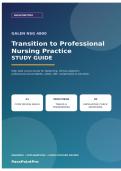
PASSPOINTPRO
GALEN NSG 4800
Transition to Professional
Nursing Practice
STUDY GUIDE
High-yield course review for leadership, clinical judgment,
professional accountability, safety, EBP, collaboration & transition.
11 HIGH-YIELD 30
CORE REVIEW AREAS TABLES & KNOWLEDGE CHECK
FRAMEWORKS QUESTIONS
ANSWERS EXPLANATIONS• EXAM-FOCUSED REVIEW
PassPointPro
,PASSPOINTPRO | GALEN NSG 4800 STUDY GUIDE
How to Use This Study Guide
COURSE FOCUS
NSG 4800 emphasizes synthesis and application: leadership and management, clinical reasoning and
judgment, advocacy, collaboration, coordination, and evidence-based care across healthcare settings.
Use this guide to connect concepts rather than memorize isolated facts. The strongest answers in transition-to-practice
questions usually combine patient safety, scope of practice, prioritization, communication, accountability, and
evidence-based decision-making.
Study Method What to Do Why It Helps
1. Preview Read the chapter summary and high- Creates a mental framework before
yield takeaways first. details.
2. Compare Use the tables to distinguish concepts Improves discrimination between
that are easily confused. answer choices.
3. Apply For every scenario, ask: What is the Moves review from recall to clinical
immediate risk? Who can do what? judgment.
What must be communicated?
4. Retrieve Complete the knowledge check without Strengthens recall and identifies weak
notes, then review explanations. areas.
5. Revisit Repeat the weak chapters using the Targets study time efficiently.
end-of-chapter takeaways.
Core Decision Rule
THINK: SAFETY -> SCOPE -> PRIORITY -> COMMUNICATION -> REASSESS
When two answers seem reasonable, prefer the option that protects immediate safety, stays within scope,
addresses the highest-priority need, communicates/escalates appropriately, and includes reassessment of
the response.
Transition to Professional Nursing Practice
Page 2
, PASSPOINTPRO | GALEN NSG 4800 STUDY GUIDE
1 Transition to Professional Nursing Practice
Integrating knowledge, accountability, and clinical judgment into the RN role
Role Transition: From Student to Accountable RN
The transition to professional practice requires a shift from completing assigned learning activities to accepting
responsibility for patient outcomes within the RN scope of practice.
New graduate nurses are expected to recognize limits, seek assistance early, use policies and evidence, communicate
changes in condition, and evaluate the results of nursing actions.
Professional confidence should grow with competence. Confidence without verification can increase risk; appropriate
consultation is a sign of safe practice rather than weakness.
Professional Socialization
Professional identity develops through repeated practice of nursing values: accountability, advocacy, integrity,
respect, collaboration, and commitment to learning.
Mentors, preceptors, unit culture, professional organizations, reflection, and feedback all shape professional
socialization.
When unit habits conflict with standards or policy, the nurse follows the safer evidence-based standard and uses the
chain of command as needed.
Benner-Style Progression in Practice
Novice and advanced-beginner clinicians depend more heavily on rules and structured guidance. Experience
gradually improves pattern recognition and prioritization.
A new nurse should use checklists, protocols, decision aids, preceptor consultation, and deliberate reflection while
experience accumulates.
Expertise does not eliminate the need for standards, verification, or speaking up when conditions are unsafe.
HIGH-YIELD TAKEAWAYS
Transition questions often test judgment and accountability, not memorized tasks.
Safe professional behavior includes recognizing limits and seeking help early.
Professional identity is demonstrated through consistent actions, not job title alone.
2 Professional Identity & Accountability
Scope, standards, boundaries, resilience, and lifelong professional growth
Accountability vs. Responsibility
Responsibility is the obligation to perform a task; accountability means being answerable for decisions, actions,
omissions, and follow-up.
An RN who delegates retains accountability for the delegation decision, appropriate supervision, and evaluation of the
outcome even when another team member performs the task.
Documentation supports continuity and demonstrates the nursing process. It should be timely, objective, accurate,
complete, and focused on patient care.
Transition to Professional Nursing Practice
Page 3
GALEN NSG 4800
Transition to Professional
Nursing Practice
STUDY GUIDE
High-yield course review for leadership, clinical judgment,
professional accountability, safety, EBP, collaboration & transition.
11 HIGH-YIELD 30
CORE REVIEW AREAS TABLES & KNOWLEDGE CHECK
FRAMEWORKS QUESTIONS
ANSWERS EXPLANATIONS• EXAM-FOCUSED REVIEW
PassPointPro
,PASSPOINTPRO | GALEN NSG 4800 STUDY GUIDE
How to Use This Study Guide
COURSE FOCUS
NSG 4800 emphasizes synthesis and application: leadership and management, clinical reasoning and
judgment, advocacy, collaboration, coordination, and evidence-based care across healthcare settings.
Use this guide to connect concepts rather than memorize isolated facts. The strongest answers in transition-to-practice
questions usually combine patient safety, scope of practice, prioritization, communication, accountability, and
evidence-based decision-making.
Study Method What to Do Why It Helps
1. Preview Read the chapter summary and high- Creates a mental framework before
yield takeaways first. details.
2. Compare Use the tables to distinguish concepts Improves discrimination between
that are easily confused. answer choices.
3. Apply For every scenario, ask: What is the Moves review from recall to clinical
immediate risk? Who can do what? judgment.
What must be communicated?
4. Retrieve Complete the knowledge check without Strengthens recall and identifies weak
notes, then review explanations. areas.
5. Revisit Repeat the weak chapters using the Targets study time efficiently.
end-of-chapter takeaways.
Core Decision Rule
THINK: SAFETY -> SCOPE -> PRIORITY -> COMMUNICATION -> REASSESS
When two answers seem reasonable, prefer the option that protects immediate safety, stays within scope,
addresses the highest-priority need, communicates/escalates appropriately, and includes reassessment of
the response.
Transition to Professional Nursing Practice
Page 2
, PASSPOINTPRO | GALEN NSG 4800 STUDY GUIDE
1 Transition to Professional Nursing Practice
Integrating knowledge, accountability, and clinical judgment into the RN role
Role Transition: From Student to Accountable RN
The transition to professional practice requires a shift from completing assigned learning activities to accepting
responsibility for patient outcomes within the RN scope of practice.
New graduate nurses are expected to recognize limits, seek assistance early, use policies and evidence, communicate
changes in condition, and evaluate the results of nursing actions.
Professional confidence should grow with competence. Confidence without verification can increase risk; appropriate
consultation is a sign of safe practice rather than weakness.
Professional Socialization
Professional identity develops through repeated practice of nursing values: accountability, advocacy, integrity,
respect, collaboration, and commitment to learning.
Mentors, preceptors, unit culture, professional organizations, reflection, and feedback all shape professional
socialization.
When unit habits conflict with standards or policy, the nurse follows the safer evidence-based standard and uses the
chain of command as needed.
Benner-Style Progression in Practice
Novice and advanced-beginner clinicians depend more heavily on rules and structured guidance. Experience
gradually improves pattern recognition and prioritization.
A new nurse should use checklists, protocols, decision aids, preceptor consultation, and deliberate reflection while
experience accumulates.
Expertise does not eliminate the need for standards, verification, or speaking up when conditions are unsafe.
HIGH-YIELD TAKEAWAYS
Transition questions often test judgment and accountability, not memorized tasks.
Safe professional behavior includes recognizing limits and seeking help early.
Professional identity is demonstrated through consistent actions, not job title alone.
2 Professional Identity & Accountability
Scope, standards, boundaries, resilience, and lifelong professional growth
Accountability vs. Responsibility
Responsibility is the obligation to perform a task; accountability means being answerable for decisions, actions,
omissions, and follow-up.
An RN who delegates retains accountability for the delegation decision, appropriate supervision, and evaluation of the
outcome even when another team member performs the task.
Documentation supports continuity and demonstrates the nursing process. It should be timely, objective, accurate,
complete, and focused on patient care.
Transition to Professional Nursing Practice
Page 3