
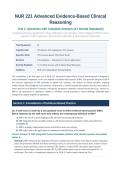
NUR 221 Advanced Evidence-Based Clinical
Reasoning
Test 1: Questions with Complete Answers (A+ Scored Standards)
Foundations of Evidence-Based Practice | Research Methods | Levels of Evidence | Clinical Judgment | PICOT | Critical
Appraisal | Evidence Application | Research Ethics | Informatics & Interprofessional Collaboration
Total Questions 90
Cognitive Mix 35% Recall | 45% Application | 20% Analysis
Question Style 70% Scenario-Based | 30% Direct Recall
Sections 9 (Foundations -> Informatics & Clinical Application)
Scoring Standard A+ Verified Answers with Evidence-Based Rationales
Audience NUR 221 Undergraduate Nursing Students
This examination is the first major test in NUR 221 Advanced Evidence-Based Clinical Reasoning and is designed to
assess foundational competence in the core domains of evidence-based practice (EBP). The questions integrate recall of
key concepts, application of EBP principles to patient care scenarios, and analysis of clinical situations requiring
evidence-based clinical judgment. Each question is followed by a verified rationale that explains why the correct option is
correct and why each distractor is incorrect, with specific attention to commonly confused concept pairs (e.g., research vs.
EBP vs. QI, quantitative vs. qualitative, validity vs. reliability, clinical reasoning vs. critical thinking). Embedded study
strategy notes support targeted test preparation.
Section 1: Foundations of Evidence-Based Practice
Q1: A staff nurse is asked by a new graduate nurse to define evidence-based practice (EBP).
Which statement by the staff nurse best reflects the contemporary definition of EBP?
A. EBP is the use of research findings as the sole basis for nursing interventions.
B. EBP integrates the best available evidence with clinical expertise and patient values and preferences.
[CORRECT]
C. EBP is a quality improvement process restricted to acute care settings.
D. EBP refers only to the application of randomized controlled trials at the bedside.
Correct Answer: B. EBP integrates the best available evidence with clinical expertise and patient
values a...
Rationale: EBP is defined as the integration of the best available research evidence with clinical expertise and patient
values and preferences (Melnyk & Fineout-Overholt). Option A is incorrect because research alone, without clinician
expertise or patient preference, does not constitute EBP. Option C confuses EBP with quality improvement (a
commonly confused pair). Option D overstates RCTs; EBP includes many levels of evidence beyond RCTs. A+
verification: This triad is a foundational competency for NUR 221 and is tested verbatim on Test 1.
,Q2: Which component is NOT one of the three core elements of evidence-based practice?
A. Best available research evidence
B. Clinician's clinical expertise
C. Healthcare organization's financial margin [CORRECT]
D. Patient values and preferences
Correct Answer: C. Healthcare organization's financial margin
Rationale: The three components of EBP are (1) best available evidence, (2) clinical expertise, and (3) patient values
and preferences. Financial margin is a consideration for healthcare leadership but is not a pillar of EBP. Option A, B,
and D are the verbatim elements described in Melnyk's ARCC model. A+ verification: Mastering this triad is essential
for distinguishing EBP from research and QI. Study tip: memorize 'Evidence + Expertise + Patient.'
Q3: A hospital is seeking Magnet designation. The CNO explains that EBP is significant for
healthcare quality primarily because it:
A. Guarantees that all patients receive identical care regardless of condition.
B. Reduces cost by eliminating the need for nursing research departments.
C. Promotes care that is current, safe, effective, and patient-centered, improving outcomes. [CORRECT]
D. Allows nurses to delegate clinical decision-making to physicians.
Correct Answer: C. Promotes care that is current, safe, effective, and patient-centered, improving
outcomes.
Rationale: EBP enhances healthcare quality by ensuring care reflects current best evidence, leading to safer, more
effective, patient-centered practice and improved outcomes. Magnet designation specifically requires EBP integration.
Option A is wrong: EBP individualizes care rather than standardizes it. Option B is incorrect: EBP does not eliminate
nursing research. Option D is incorrect: EBP empowers nurses to lead clinical decisions. A+ verification: Aligns with
ANCC Magnet standards and QSEN competencies.
Q4: Which of the following is an EBP competency expected of a bedside practicing nurse?
A. Conducting independent randomized controlled trials as primary investigator.
B. Appraising evidence critically and applying findings to practice with patient input. [CORRECT]
C. Funding large-scale multi-site clinical research.
D. Serving as editor of a peer-reviewed nursing journal.
Correct Answer: B. Appraising evidence critically and applying findings to practice with patient
input.
Rationale: Practicing nurses are expected to formulate PICOT questions, search literature, critically appraise evidence,
and integrate findings with patient preferences. Options A, C, and D describe roles of nurse scientists and academics,
not bedside EBP competencies. A+ verification: AACN Essentials and QSEN emphasize the bedside nurse's role in
evidence application, not evidence generation. Study tip: distinguish 'user of evidence' (bedside) from 'generator of
evidence' (researcher).
, Q5: A new nurse states, 'EBP and research are basically the same thing.' What is the best
response?
A. 'You are correct; both require IRB approval and informed consent.'
B. 'EBP uses research evidence but also integrates clinical expertise and patient preferences, whereas research
generates new knowledge.' [CORRECT]
C. 'EBP is broader than research because it includes only qualitative studies.'
D. 'Research is a subset of EBP used only in academic medical centers.'
Correct Answer: B. 'EBP uses research evidence but also integrates clinical expertise and patient
preferen...
Rationale: Research is the systematic generation of new knowledge through scientific inquiry, while EBP applies
existing best evidence alongside clinical expertise and patient values. This is one of the most commonly confused
concept pairs in NUR 221. Option A is wrong: EBP does not require IRB approval. Option C is wrong: EBP includes
many types of evidence. Option D is wrong: research is not a subset of EBP. A+ verification: distinguishing research
vs EBP is a Test 1 anchor concept.
Q6: Which scenario best represents quality improvement (QI) rather than EBP or research?
A. A nurse tests a hypothesis about a new wound dressing across 200 patients in a randomized design.
B. A unit team tracks falls over 6 months after implementing a new hourly rounding protocol to reduce fall
rates. [CORRECT]
C. A nurse conducts a phenomenological study exploring lived experiences of caregivers.
D. A nurse searches CINAHL to answer a question about medication adherence and applies findings to one
patient.
Correct Answer: B. A unit team tracks falls over 6 months after implementing a new hourly
rounding protoco...
Rationale: QI is a local, systematic process used within a unit/organization to improve care delivery and outcomes
(e.g., tracking falls after a practice change). Option A describes research (RCT design generating new generalizable
knowledge). Option C describes qualitative research. Option D describes EBP. A+ verification: Research vs EBP vs QI
is a high-yield Test 1 distinction. QI is internal, cyclical, and immediate; research generalizes; EBP applies.
Q7: The term 'evidence-based medicine' was first introduced in the 1990s by which pioneer?
A. Florence Nightingale
B. David Sackett and the McMaster group [CORRECT]
C. Hildegard Peplau
D. Madeleine Leininger
Correct Answer: B. David Sackett and the McMaster group
Rationale: David Sackett and colleagues at McMaster University coined 'evidence-based medicine' in 1992, defining
it as integrating individual clinical expertise with the best available external clinical evidence. Nightingale pioneered
nursing statistics (Option A), but predated EBP terminology. Peplau and Leininger (Options C, D) are nursing
theorists, not EBP originators. A+ verification: Sackett's definition remains the contemporary foundation for EBP in
nursing.
Reasoning
Test 1: Questions with Complete Answers (A+ Scored Standards)
Foundations of Evidence-Based Practice | Research Methods | Levels of Evidence | Clinical Judgment | PICOT | Critical
Appraisal | Evidence Application | Research Ethics | Informatics & Interprofessional Collaboration
Total Questions 90
Cognitive Mix 35% Recall | 45% Application | 20% Analysis
Question Style 70% Scenario-Based | 30% Direct Recall
Sections 9 (Foundations -> Informatics & Clinical Application)
Scoring Standard A+ Verified Answers with Evidence-Based Rationales
Audience NUR 221 Undergraduate Nursing Students
This examination is the first major test in NUR 221 Advanced Evidence-Based Clinical Reasoning and is designed to
assess foundational competence in the core domains of evidence-based practice (EBP). The questions integrate recall of
key concepts, application of EBP principles to patient care scenarios, and analysis of clinical situations requiring
evidence-based clinical judgment. Each question is followed by a verified rationale that explains why the correct option is
correct and why each distractor is incorrect, with specific attention to commonly confused concept pairs (e.g., research vs.
EBP vs. QI, quantitative vs. qualitative, validity vs. reliability, clinical reasoning vs. critical thinking). Embedded study
strategy notes support targeted test preparation.
Section 1: Foundations of Evidence-Based Practice
Q1: A staff nurse is asked by a new graduate nurse to define evidence-based practice (EBP).
Which statement by the staff nurse best reflects the contemporary definition of EBP?
A. EBP is the use of research findings as the sole basis for nursing interventions.
B. EBP integrates the best available evidence with clinical expertise and patient values and preferences.
[CORRECT]
C. EBP is a quality improvement process restricted to acute care settings.
D. EBP refers only to the application of randomized controlled trials at the bedside.
Correct Answer: B. EBP integrates the best available evidence with clinical expertise and patient
values a...
Rationale: EBP is defined as the integration of the best available research evidence with clinical expertise and patient
values and preferences (Melnyk & Fineout-Overholt). Option A is incorrect because research alone, without clinician
expertise or patient preference, does not constitute EBP. Option C confuses EBP with quality improvement (a
commonly confused pair). Option D overstates RCTs; EBP includes many levels of evidence beyond RCTs. A+
verification: This triad is a foundational competency for NUR 221 and is tested verbatim on Test 1.
,Q2: Which component is NOT one of the three core elements of evidence-based practice?
A. Best available research evidence
B. Clinician's clinical expertise
C. Healthcare organization's financial margin [CORRECT]
D. Patient values and preferences
Correct Answer: C. Healthcare organization's financial margin
Rationale: The three components of EBP are (1) best available evidence, (2) clinical expertise, and (3) patient values
and preferences. Financial margin is a consideration for healthcare leadership but is not a pillar of EBP. Option A, B,
and D are the verbatim elements described in Melnyk's ARCC model. A+ verification: Mastering this triad is essential
for distinguishing EBP from research and QI. Study tip: memorize 'Evidence + Expertise + Patient.'
Q3: A hospital is seeking Magnet designation. The CNO explains that EBP is significant for
healthcare quality primarily because it:
A. Guarantees that all patients receive identical care regardless of condition.
B. Reduces cost by eliminating the need for nursing research departments.
C. Promotes care that is current, safe, effective, and patient-centered, improving outcomes. [CORRECT]
D. Allows nurses to delegate clinical decision-making to physicians.
Correct Answer: C. Promotes care that is current, safe, effective, and patient-centered, improving
outcomes.
Rationale: EBP enhances healthcare quality by ensuring care reflects current best evidence, leading to safer, more
effective, patient-centered practice and improved outcomes. Magnet designation specifically requires EBP integration.
Option A is wrong: EBP individualizes care rather than standardizes it. Option B is incorrect: EBP does not eliminate
nursing research. Option D is incorrect: EBP empowers nurses to lead clinical decisions. A+ verification: Aligns with
ANCC Magnet standards and QSEN competencies.
Q4: Which of the following is an EBP competency expected of a bedside practicing nurse?
A. Conducting independent randomized controlled trials as primary investigator.
B. Appraising evidence critically and applying findings to practice with patient input. [CORRECT]
C. Funding large-scale multi-site clinical research.
D. Serving as editor of a peer-reviewed nursing journal.
Correct Answer: B. Appraising evidence critically and applying findings to practice with patient
input.
Rationale: Practicing nurses are expected to formulate PICOT questions, search literature, critically appraise evidence,
and integrate findings with patient preferences. Options A, C, and D describe roles of nurse scientists and academics,
not bedside EBP competencies. A+ verification: AACN Essentials and QSEN emphasize the bedside nurse's role in
evidence application, not evidence generation. Study tip: distinguish 'user of evidence' (bedside) from 'generator of
evidence' (researcher).
, Q5: A new nurse states, 'EBP and research are basically the same thing.' What is the best
response?
A. 'You are correct; both require IRB approval and informed consent.'
B. 'EBP uses research evidence but also integrates clinical expertise and patient preferences, whereas research
generates new knowledge.' [CORRECT]
C. 'EBP is broader than research because it includes only qualitative studies.'
D. 'Research is a subset of EBP used only in academic medical centers.'
Correct Answer: B. 'EBP uses research evidence but also integrates clinical expertise and patient
preferen...
Rationale: Research is the systematic generation of new knowledge through scientific inquiry, while EBP applies
existing best evidence alongside clinical expertise and patient values. This is one of the most commonly confused
concept pairs in NUR 221. Option A is wrong: EBP does not require IRB approval. Option C is wrong: EBP includes
many types of evidence. Option D is wrong: research is not a subset of EBP. A+ verification: distinguishing research
vs EBP is a Test 1 anchor concept.
Q6: Which scenario best represents quality improvement (QI) rather than EBP or research?
A. A nurse tests a hypothesis about a new wound dressing across 200 patients in a randomized design.
B. A unit team tracks falls over 6 months after implementing a new hourly rounding protocol to reduce fall
rates. [CORRECT]
C. A nurse conducts a phenomenological study exploring lived experiences of caregivers.
D. A nurse searches CINAHL to answer a question about medication adherence and applies findings to one
patient.
Correct Answer: B. A unit team tracks falls over 6 months after implementing a new hourly
rounding protoco...
Rationale: QI is a local, systematic process used within a unit/organization to improve care delivery and outcomes
(e.g., tracking falls after a practice change). Option A describes research (RCT design generating new generalizable
knowledge). Option C describes qualitative research. Option D describes EBP. A+ verification: Research vs EBP vs QI
is a high-yield Test 1 distinction. QI is internal, cyclical, and immediate; research generalizes; EBP applies.
Q7: The term 'evidence-based medicine' was first introduced in the 1990s by which pioneer?
A. Florence Nightingale
B. David Sackett and the McMaster group [CORRECT]
C. Hildegard Peplau
D. Madeleine Leininger
Correct Answer: B. David Sackett and the McMaster group
Rationale: David Sackett and colleagues at McMaster University coined 'evidence-based medicine' in 1992, defining
it as integrating individual clinical expertise with the best available external clinical evidence. Nightingale pioneered
nursing statistics (Option A), but predated EBP terminology. Peplau and Leininger (Options C, D) are nursing
theorists, not EBP originators. A+ verification: Sackett's definition remains the contemporary foundation for EBP in
nursing.


