
___________________________________________________________________
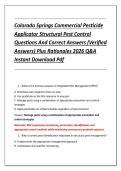
Colorado Springs Commercial Pesticide
Applicator Structural Pest Control
Questions And Correct Answers (Verified
Answers) Plus Rationales 2026 Q&A
Instant Download Pdf
___________________________________________________________________
1. What is the primary purpose of Integrated Pest Management (IPM)?
A. Eliminate every organism from an area
B. Use pesticides as the first response to any pest
C. Manage pests using a combination of appropriate prevention and control
strategies
D. Apply pesticides on a fixed schedule regardless of pest presence
Answer: Manage pests using a combination of appropriate prevention and
control strategies
Rationale: IPM emphasizes monitoring, prevention, identification, and
appropriate control methods while minimizing unnecessary pesticide exposure.
2. Why is correct pest identification important in structural pest management?
A. It determines the appropriate management approach
B. It eliminates the need for monitoring
,C. It guarantees that pesticides will be necessary
D. It replaces the need to inspect the structure
Answer: It determines the appropriate management approach
Rationale: Different pests have different biology, habitats, and vulnerabilities, so
accurate identification is fundamental to effective management.
3. Which condition commonly contributes to structural pest problems?
A. Proper sanitation
B. Elimination of standing water
C. Sealing entry points
D. Accessible food, water, or shelter
Answer: Accessible food, water, or shelter
Rationale: Pests are more likely to establish where they can obtain food,
moisture, shelter, or access into a structure.
4. What is monitoring in an IPM program?
A. Applying pesticide every month
B. Observing and assessing pest activity over time
C. Removing all vegetation around a building
D. Treating every room regardless of pest activity
Answer: Observing and assessing pest activity over time
Rationale: Monitoring provides information about pest presence, population
trends, and whether management actions are needed.
5. Which practice is an example of structural exclusion?
A. Sealing cracks and openings that allow pests to enter
B. Increasing available food sources
C. Leaving doors open
D. Increasing moisture around foundations
Answer: Sealing cracks and openings that allow pests to enter
,Rationale: Exclusion reduces pest access to structures and can prevent
infestations without relying solely on pesticides.
6. Which pest group includes ants, bees, and wasps?
A. Arachnids
B. Mollusks
C. Insects
D. Rodents
Answer: Insects
Rationale: Ants, bees, and wasps are insects and share the basic insect body
plan of head, thorax, and abdomen with six legs.
7. Which characteristic distinguishes spiders from insects?
A. Spiders have six legs
B. Spiders have eight legs
C. Spiders have wings
D. Spiders have antennae
Answer: Spiders have eight legs
Rationale: Spiders are arachnids and normally have eight legs, whereas adult
insects have six legs.
8. Why should pest-management decisions consider the pest's life cycle?
A. Pest susceptibility and behavior can vary by life stage
B. All life stages respond identically
C. Life cycles are unrelated to management
D. It prevents the need for pest identification
Answer: Pest susceptibility and behavior can vary by life stage
Rationale: Understanding development helps determine when prevention,
monitoring, or other control measures are most appropriate.
9. Which environmental factor frequently favors many indoor pests?
, A. Completely dry conditions
B. Availability of moisture
C. Complete absence of shelter
D. Continuous exposure to sunlight
Answer: Availability of moisture
Rationale: Many structural pests depend on moisture for survival or are
attracted to damp areas where food and shelter may also be available.
10.What is the purpose of sanitation in structural pest management?
A. Increase pest food sources
B. Reduce food and shelter available to pests
C. Eliminate the need for inspection
D. Make pests resistant to control methods
Answer: Reduce food and shelter available to pests
Rationale: Good sanitation reduces conditions that allow pests to survive and
reproduce.
11.Which observation would be most useful when investigating a suspected
pest infestation?
A. The building's paint color
B. Evidence of pest activity and possible entry points
C. The age of nearby vehicles
D. The number of windows alone
Answer: Evidence of pest activity and possible entry points
Rationale: Pest evidence and access points help establish where pests are active
and how they may be entering or moving through the structure.
12.What does a pesticide label primarily communicate?
A. Advertising information only
B. Legally enforceable directions and safety information
Colorado Springs Commercial Pesticide
Applicator Structural Pest Control
Questions And Correct Answers (Verified
Answers) Plus Rationales 2026 Q&A
Instant Download Pdf
___________________________________________________________________
1. What is the primary purpose of Integrated Pest Management (IPM)?
A. Eliminate every organism from an area
B. Use pesticides as the first response to any pest
C. Manage pests using a combination of appropriate prevention and control
strategies
D. Apply pesticides on a fixed schedule regardless of pest presence
Answer: Manage pests using a combination of appropriate prevention and
control strategies
Rationale: IPM emphasizes monitoring, prevention, identification, and
appropriate control methods while minimizing unnecessary pesticide exposure.
2. Why is correct pest identification important in structural pest management?
A. It determines the appropriate management approach
B. It eliminates the need for monitoring
,C. It guarantees that pesticides will be necessary
D. It replaces the need to inspect the structure
Answer: It determines the appropriate management approach
Rationale: Different pests have different biology, habitats, and vulnerabilities, so
accurate identification is fundamental to effective management.
3. Which condition commonly contributes to structural pest problems?
A. Proper sanitation
B. Elimination of standing water
C. Sealing entry points
D. Accessible food, water, or shelter
Answer: Accessible food, water, or shelter
Rationale: Pests are more likely to establish where they can obtain food,
moisture, shelter, or access into a structure.
4. What is monitoring in an IPM program?
A. Applying pesticide every month
B. Observing and assessing pest activity over time
C. Removing all vegetation around a building
D. Treating every room regardless of pest activity
Answer: Observing and assessing pest activity over time
Rationale: Monitoring provides information about pest presence, population
trends, and whether management actions are needed.
5. Which practice is an example of structural exclusion?
A. Sealing cracks and openings that allow pests to enter
B. Increasing available food sources
C. Leaving doors open
D. Increasing moisture around foundations
Answer: Sealing cracks and openings that allow pests to enter
,Rationale: Exclusion reduces pest access to structures and can prevent
infestations without relying solely on pesticides.
6. Which pest group includes ants, bees, and wasps?
A. Arachnids
B. Mollusks
C. Insects
D. Rodents
Answer: Insects
Rationale: Ants, bees, and wasps are insects and share the basic insect body
plan of head, thorax, and abdomen with six legs.
7. Which characteristic distinguishes spiders from insects?
A. Spiders have six legs
B. Spiders have eight legs
C. Spiders have wings
D. Spiders have antennae
Answer: Spiders have eight legs
Rationale: Spiders are arachnids and normally have eight legs, whereas adult
insects have six legs.
8. Why should pest-management decisions consider the pest's life cycle?
A. Pest susceptibility and behavior can vary by life stage
B. All life stages respond identically
C. Life cycles are unrelated to management
D. It prevents the need for pest identification
Answer: Pest susceptibility and behavior can vary by life stage
Rationale: Understanding development helps determine when prevention,
monitoring, or other control measures are most appropriate.
9. Which environmental factor frequently favors many indoor pests?
, A. Completely dry conditions
B. Availability of moisture
C. Complete absence of shelter
D. Continuous exposure to sunlight
Answer: Availability of moisture
Rationale: Many structural pests depend on moisture for survival or are
attracted to damp areas where food and shelter may also be available.
10.What is the purpose of sanitation in structural pest management?
A. Increase pest food sources
B. Reduce food and shelter available to pests
C. Eliminate the need for inspection
D. Make pests resistant to control methods
Answer: Reduce food and shelter available to pests
Rationale: Good sanitation reduces conditions that allow pests to survive and
reproduce.
11.Which observation would be most useful when investigating a suspected
pest infestation?
A. The building's paint color
B. Evidence of pest activity and possible entry points
C. The age of nearby vehicles
D. The number of windows alone
Answer: Evidence of pest activity and possible entry points
Rationale: Pest evidence and access points help establish where pests are active
and how they may be entering or moving through the structure.
12.What does a pesticide label primarily communicate?
A. Advertising information only
B. Legally enforceable directions and safety information


