
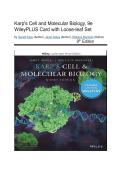
Karp's Cell and Molecular Biology, 9e
WileyPLUS Card with Loose-leaf Set
by Gerald Karp (Author), Janet Iwasa (Author), Wallace Marshall (Author)
9th Edition
,TABLE OF CONTENTS
CHAPTER 1: Introduction to the Study of Cell and Molecular Biology
CHAPTER 2: The Chemical Basis of Life
CHAPTER 3: Bioenergetics, Enzymes, and Metabolism
CHAPTER 4: The Structure and Function of the Plasma Membrane
CHAPTER 6: Photosynthesis and the Chloroplast
CHAPTER 7: Interactions Between Cells and Their Environment
CHAPTER 8: Cytoplasmic Membrane Systems: Structure, Function, and Membrane Traff...
CHAPTER 9: The Cytoskeleton and Cell Motility
CHAPTER 10: The Nature of the Gene and the Genome
CHAPTER 11: The Central Dogma: DNA to RNA to Protein
CHAPTER 12: Control of Gene Expression
CHAPTER 13: DNA Replication and Repair
CHAPTER 14: Cell Division
CHAPTER 15: Cell Signaling and Signal Transduction: Communication between Cells
CHAPTER 16: Cancer
CHAPTER 17: The Immune Response
CHAPTER 18: Techniques in Cell and Molecular Biology
,Test Bank: Karp's Cell and Molecular Biology, 9th
Edition
Chapters 1–18
CHAPTER 1: Introduction to the Study of Cell and
Molecular Biology
Multiple Choice Questions
1. Which of the following is NOT a property shared by all living cells?
a) Ability to undergo mitosis
b) Possession of genetic material
c) Ability to reproduce
d) Capacity for energy metabolism
Answer: a
Rationale: Not all cells undergo mitosis; some cells (e.g., prokaryotes) divide by binary fission, and some
eukaryotic cells are terminally differentiated and do not divide. All cells possess genetic material,
reproduce (at some level), and carry out metabolism.
2. The cell theory was first proposed by:
a) Robert Hooke and Anton van Leeuwenhoek
b) Matthias Schleiden and Theodor Schwann
c) Charles Darwin and Alfred Wallace
d) James Watson and Francis Crick
Answer: b
Rationale: Schleiden and Schwann proposed the cell theory in 1838-1839, stating that all organisms are
composed of cells.
3. Which of the following best describes the relationship between genotype and phenotype?
a) They are always identical
b) Genotype refers to the physical characteristics; phenotype refers to genetic composition
c) Genotype is the genetic makeup; phenotype is the observable characteristics
d) Phenotype is inherited; genotype is acquired
Answer: c
Rationale: Genotype refers to the specific genetic constitution of an organism, while phenotype refers to
the observable structural and functional properties.
4. Which model organism is a unicellular eukaryote commonly used to study cell cycle regulation?
a) Escherichia coli
, b) Drosophila melanogaster
c) Saccharomyces cerevisiae
d) Caenorhabditis elegans
Answer: c
Rationale: S. cerevisiae (budding yeast) is a unicellular eukaryote widely used for studying cell cycle
regulation, genetics, and molecular biology.
5. Which of the following distinguishes eukaryotic cells from prokaryotic cells?
a) Presence of DNA
b) Presence of ribosomes
c) Presence of a membrane-bound nucleus
d) Presence of a plasma membrane
Answer: c
Rationale: The defining feature of eukaryotic cells is the presence of a membrane-bound nucleus. Both
prokaryotes and eukaryotes have DNA, ribosomes, and plasma membranes.
6. The resolution of a light microscope is limited to approximately:
a) 0.1 nm
b) 0.2 μm
c) 0.2 mm
d) 2.0 μm
Answer: b
Rationale: The resolving power of a light microscope is approximately 0.2 μm (200 nm), limited by the
wavelength of visible light.
7. Which of the following techniques would be most appropriate for studying the three-dimensional
surface structure of a cell?
a) Transmission electron microscopy (TEM)
b) Scanning electron microscopy (SEM)
c) Phase-contrast microscopy
d) Bright-field microscopy
Answer: b
Rationale: SEM provides detailed images of surface topography and three-dimensional structure of
specimens.
8. Green fluorescent protein (GFP) is used in cell biology to:
a) Stain DNA in fixed cells
b) Track protein localization in living cells
c) Measure pH changes in the cytoplasm
d) Kill specific cell types
Answer: b
Rationale: GFP can be fused to proteins of interest using recombinant DNA technology, allowing
researchers to track protein localization and movement in living cells.
9. Which of the following is an example of in vitro experimentation?
a) Studying behavior of mice in a maze
b) Observing cell division in a living organism
WileyPLUS Card with Loose-leaf Set
by Gerald Karp (Author), Janet Iwasa (Author), Wallace Marshall (Author)
9th Edition
,TABLE OF CONTENTS
CHAPTER 1: Introduction to the Study of Cell and Molecular Biology
CHAPTER 2: The Chemical Basis of Life
CHAPTER 3: Bioenergetics, Enzymes, and Metabolism
CHAPTER 4: The Structure and Function of the Plasma Membrane
CHAPTER 6: Photosynthesis and the Chloroplast
CHAPTER 7: Interactions Between Cells and Their Environment
CHAPTER 8: Cytoplasmic Membrane Systems: Structure, Function, and Membrane Traff...
CHAPTER 9: The Cytoskeleton and Cell Motility
CHAPTER 10: The Nature of the Gene and the Genome
CHAPTER 11: The Central Dogma: DNA to RNA to Protein
CHAPTER 12: Control of Gene Expression
CHAPTER 13: DNA Replication and Repair
CHAPTER 14: Cell Division
CHAPTER 15: Cell Signaling and Signal Transduction: Communication between Cells
CHAPTER 16: Cancer
CHAPTER 17: The Immune Response
CHAPTER 18: Techniques in Cell and Molecular Biology
,Test Bank: Karp's Cell and Molecular Biology, 9th
Edition
Chapters 1–18
CHAPTER 1: Introduction to the Study of Cell and
Molecular Biology
Multiple Choice Questions
1. Which of the following is NOT a property shared by all living cells?
a) Ability to undergo mitosis
b) Possession of genetic material
c) Ability to reproduce
d) Capacity for energy metabolism
Answer: a
Rationale: Not all cells undergo mitosis; some cells (e.g., prokaryotes) divide by binary fission, and some
eukaryotic cells are terminally differentiated and do not divide. All cells possess genetic material,
reproduce (at some level), and carry out metabolism.
2. The cell theory was first proposed by:
a) Robert Hooke and Anton van Leeuwenhoek
b) Matthias Schleiden and Theodor Schwann
c) Charles Darwin and Alfred Wallace
d) James Watson and Francis Crick
Answer: b
Rationale: Schleiden and Schwann proposed the cell theory in 1838-1839, stating that all organisms are
composed of cells.
3. Which of the following best describes the relationship between genotype and phenotype?
a) They are always identical
b) Genotype refers to the physical characteristics; phenotype refers to genetic composition
c) Genotype is the genetic makeup; phenotype is the observable characteristics
d) Phenotype is inherited; genotype is acquired
Answer: c
Rationale: Genotype refers to the specific genetic constitution of an organism, while phenotype refers to
the observable structural and functional properties.
4. Which model organism is a unicellular eukaryote commonly used to study cell cycle regulation?
a) Escherichia coli
, b) Drosophila melanogaster
c) Saccharomyces cerevisiae
d) Caenorhabditis elegans
Answer: c
Rationale: S. cerevisiae (budding yeast) is a unicellular eukaryote widely used for studying cell cycle
regulation, genetics, and molecular biology.
5. Which of the following distinguishes eukaryotic cells from prokaryotic cells?
a) Presence of DNA
b) Presence of ribosomes
c) Presence of a membrane-bound nucleus
d) Presence of a plasma membrane
Answer: c
Rationale: The defining feature of eukaryotic cells is the presence of a membrane-bound nucleus. Both
prokaryotes and eukaryotes have DNA, ribosomes, and plasma membranes.
6. The resolution of a light microscope is limited to approximately:
a) 0.1 nm
b) 0.2 μm
c) 0.2 mm
d) 2.0 μm
Answer: b
Rationale: The resolving power of a light microscope is approximately 0.2 μm (200 nm), limited by the
wavelength of visible light.
7. Which of the following techniques would be most appropriate for studying the three-dimensional
surface structure of a cell?
a) Transmission electron microscopy (TEM)
b) Scanning electron microscopy (SEM)
c) Phase-contrast microscopy
d) Bright-field microscopy
Answer: b
Rationale: SEM provides detailed images of surface topography and three-dimensional structure of
specimens.
8. Green fluorescent protein (GFP) is used in cell biology to:
a) Stain DNA in fixed cells
b) Track protein localization in living cells
c) Measure pH changes in the cytoplasm
d) Kill specific cell types
Answer: b
Rationale: GFP can be fused to proteins of interest using recombinant DNA technology, allowing
researchers to track protein localization and movement in living cells.
9. Which of the following is an example of in vitro experimentation?
a) Studying behavior of mice in a maze
b) Observing cell division in a living organism


