

Written by students who passed Immediately available after payment Read online or as PDF Wrong document? Swap it for free 4.6 TrustPilot
logo-home
Document preview thumbnail
Preview 2 out of 13 pages
Exam (elaborations)

PSYCH 351 Exam 3 Final 2026/2027 – 60+ Questions & Answers | Neurocognitive Disorders, Dementia, TBI, Alzheimer’s & Sleep-Wake Disorders

Document preview thumbnail
Preview 2 out of 13 pages

This PSYCH 351 Exam 3 Final study guide for the 2026/2027 academic year is a 13-page exam-preparation resource containing 60+ questions, answers, definitions, clinical examples, and applied scenarios. The document concentrates primarily on neurocognitive disorders and sleep-wake disorders, including major and mild neurocognitive disorder, delirium, dementia, traumatic brain injury (TBI), Alzheimer’s disease, dementia with Lewy bodies, Parkinson’s disease, Huntington’s disease, chronic traumatic encephalopathy (CTE), insomnia-related concepts, hypersomnolence, dyssomnias, and parasomnias. The university is not identified in the uploaded material, so an institution cannot be accurately included in the title. The first major section provides detailed preparation for neurocognitive disorders. It distinguishes major neurocognitive disorder, mild neurocognitive disorder, and delirium while examining cognitive domains such as complex attention, executive ability, learning and memory, language, visual-perceptual ability, and social cognition. The material emphasizes the relationship between the severity of cognitive decline and an individual’s capacity for independent daily functioning. It also discusses biological, psychological, social, and sociocultural dimensions associated with neurocognitive dysfunction, including brain pathology, aging, neurochemical and structural changes, resilience, depression and anxiety, social support, stigma, healthcare access, and attitudes toward aging. A substantial portion addresses traumatic brain injury and neurological damage. Students review concussion, contusion, cerebral laceration, neurological assessment, symptoms following head trauma, and chronic traumatic encephalopathy. Applied exam scenarios require students to distinguish types of head injury and understand the association between repeated head trauma and CTE. The material additionally discusses rehabilitation, medication, deep-brain stimulation, and cognitive behavioral therapy as treatment approaches presented for neurocognitive dysfunction. The guide also provides focused coverage of neurodegenerative conditions, particularly Alzheimer’s disease. It reviews progressive memory and cognitive impairment and behavioral changes associated with Alzheimer’s, alongside dementia with Lewy bodies, frontotemporal lobar degeneration, Parkinson’s disease, and Huntington’s disease. Students encounter both direct definition questions and clinical scenarios testing recognition of symptoms, cognitive impairment, motor disturbances, dementia, and disease progression. The final portion concentrates on sleep and sleep-wake disorders. Topics include REM and non-REM sleep, age-related sleep requirements, healthy sleep functions, dyssomnias, parasomnias, hypersomnolence disorder, sleep terrors, nightmares, insomnia-related symptoms, excessive daytime sleepiness, and sleep hygiene. Scenario-based questions ask students to apply these concepts to children, adolescents, shift workers, and individuals experiencing persistent daytime sleepiness or abnormal behaviors during sleep. Relevant students: This document is especially relevant to students enrolled in PSYCH 351 who are preparing for Exam 3, a final examination, or a cumulative assessment covering neurocognitive and sleep-wake disorders. It may also support students taking Abnormal Psychology, Clinical Psychology, Psychopathology, Neuropsychology, Behavioral Neuroscience, Mental Health, or related psychology courses that include dementia, delirium, traumatic brain injury, neurodegenerative disease, and sleep disorders. Students should note that a few questions near the end of the uploaded document have blank answers, so the material should be used alongside the official course textbook, lectures, and instructor guidance. Keywords: PSYCH 351 exam 3, PSYCH 351 final exam, PSYCH 351 questions and answers, PSYCH , psychology exam 3, psychology final exam questions, neurocognitive disorders, major neurocognitive disorder, mild neurocognitive disorder, delirium, dementia, traumatic brain injury, TBI, concussion, cerebral contusion, cerebral laceration, chronic traumatic encephalopathy, CTE, Alzheimer disease, dementia with Lewy bodies, frontotemporal lobar degeneration, Parkinson disease, Huntington disease, neurodegenerative disorders, cognitive impairment, mental status exam, neuroimaging, sleep wake disorders, REM sleep, non REM sleep, dyssomnia, parasomnia, insomnia, hypersomnolence disorder, sleep terrors, nightmares, excessive daytime sleepiness, sleep hygiene, abnormal psychology exam, clinical psychology study guide, psychology exam preparation

Content preview

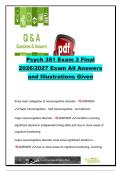
Psych 351 Exam 3 Final
2026/2027 Exam All Answers
and Illustrations Given


three main categories of neurocognitive disorder - ANSWER

✔✔major neurocognitive , mild neurocognitive , and delirium


major neurocognitive disorder - ANSWER ✔✔condition involving

significant decline in independent living skills and one or more areas of

cognitive functioning

major neurocognitive disorder must show significant decline in -

ANSWER ✔✔one or more areas of cognitive functioning, involving

, attention and focus, decision making and judgment language learning

and memory visual perception or social understanding

the ability to independently meet the demands of daily living(this can

involve more complex skills such as managing bills or meds


dementia - ANSWER ✔✔decline in mental functioning and self help

skills that result from a major neurocognitive disorder , age is the

strongest risk factor


areas of possible neurocognitive dysfunction - ANSWER ✔✔complex

attention executive ability learnig and memory language visual

perceptual ability and social cognition


mild neurocognitive disorder - ANSWER ✔✔demonstrate a modest

decline in at least one major cognitive area

mores subtle , , intermediate stage between normal aging and major

neurocognitive disorder or dementia


delirium - ANSWER ✔✔acute state of confusion characterized by

disorientation and impaired attentional skills , underlying medical

condition such as exposure to a toxin or med or from alcohol or drug

intoxication or withdrawl

Document information

Uploaded on
September 17, 2026
Number of pages
13
Written in
2026/2027
Type
Exam (elaborations)
Contains
Questions & answers
$18.99

Wrong document? Swap it for free Within 14 days of purchase and before downloading, you can choose a different document. You can simply spend the amount again.
Written by students who passed
Immediately available after payment
Read online or as PDF

Seller avatar
Reputation scores are based on the amount of documents a seller has sold for a fee and the reviews they have received for those documents. There are three levels: Bronze, Silver and Gold. The better the reputation, the more your can rely on the quality of the sellers work.
NinjaNerd
3.4
(78)
Sold
419
Followers
6
Items
15918
Last sold
1 day ago


Why students choose Stuvia

Created by fellow students, verified by reviews

Quality you can trust: written by students who passed their tests and reviewed by others who've used these notes.

Didn't get what you expected? Choose another document

No worries! You can instantly pick a different document that better fits what you're looking for.

Pay as you like, start learning right away

No subscription, no commitments. Pay the way you're used to via credit card and download your PDF document instantly.

Student with book image

“Bought, downloaded, and aced it. It really can be that simple.”

Alisha Student

Working on your references?

Create accurate citations in APA, MLA and Harvard with our free citation generator.

Working on your references?

Frequently asked questions

