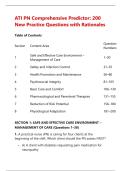
ATI PN Comprehensive Predictor: 200
New Practice Questions with Rationales
Table of Contents
Question
Section Content Area
Numbers
Safe and Effective Care Environment –
1 1–30
Management of Care
2 Safety and Infection Control 31–55
3 Health Promotion and Maintenance 56–80
4 Psychosocial Integrity 81–105
5 Basic Care and Comfort 106–130
6 Pharmacological and Parenteral Therapies 131–155
7 Reduction of Risk Potential 156–180
8 Physiological Adaptation 181–200
SECTION 1: SAFE AND EFFECTIVE CARE ENVIRONMENT –
MANAGEMENT OF CARE (Questions 1–30)
1. A practical nurse (PN) is caring for four clients at the
beginning of the shift. Which client should the PN assess FIRST?
• A) A client with diabetes requesting pain medication for
neuropathy
, • B) A client with COPD who has a new cough producing
green sputum
• C) A client who is postoperative day 1 with new-onset
confusion and blood pressure 88/50
• D) A client with a fractured tibia requesting assistance to
the bathroom
Rationale: New-onset confusion accompanied by hypotension
suggests possible sepsis, hemorrhage, or shock—an unstable,
life-threatening priority. Airway, breathing, and circulation
always precede stable complaints. The other clients have stable
conditions that can be addressed after the unstable client is
assessed.
2. A charge nurse is assigning staff for the shift. Which client
should be assigned to an RN rather than a PN?
• A) A client with stable CHF receiving daily furosemide
• B) A client requiring a blood transfusion for symptomatic
anemia
• C) A client with a new diagnosis of diabetes needing
insulin instruction
• D) A client with a PEG tube requiring intermittent feedings
Rationale: Blood transfusions require complex assessment and
monitoring that is typically within the RN scope of practice. The
PN can administer stable medications, reinforce teaching, and
perform routine monitoring.
,3. A PN is delegating tasks to assistive personnel (AP). Which
task is appropriate to delegate?
• A) Assessing a client's capillary refill
• B) Teaching a client how to keep a cast dry
• C) Assisting a client with ambulation to the bathroom
• D) Evaluating a client's pain level
Rationale: Assisting with ambulation is a standard, stable task
that falls within the scope of AP practice. The PN cannot
delegate assessment, evaluation, or teaching, as these require
professional nursing judgment.
4. A client is placed on airborne precautions for active
tuberculosis. Which action is required?
• A) Place the client in a room with positive pressure
• B) Wear a surgical mask when entering the room
• C) Place the client in a negative pressure room
• D) Keep the door open for ventilation
Rationale: TB is an airborne pathogen spread via droplet nuclei
that remain suspended in the air. Airborne precautions require
a negative pressure room and the use of an N95 respirator by
healthcare providers.
5. A client with dementia has a physician's order for bilateral
soft wrist restraints. Which action is required?
• A) Secure the restraint ties to the side rails
, • B) Apply the restraint snugly against the skin
• C) Obtain a written prescription for the restraint application
• D) Observe the client every 60 minutes after application
Rationale: Restraints require a physician's written order
specifying duration and reason. Ties must never be secured to
side rails because they can cause injury if the rails are lowered.
The restraint should allow for two fingers of width to prevent
circulation impairment. Observations must be made every 15–
30 minutes, not hourly.
6. A client is postoperative day 1 following a total knee
replacement. The client reports pain of 7/10 and is due for
hydromorphone 2 mg IV PRN. What is the PN's priority action?
• A) Administer the medication immediately without
checking vital signs
• B) Assess the client's respiratory rate and sedation level
before administering
• C) Withhold the medication because the client had a dose
2 hours ago
• D) Administer the medication and document the response
Rationale: Opioids can cause respiratory depression. The PN
must assess respiratory rate and sedation level before
administering IV hydromorphone. If the respiratory rate is
below 12/min or the client is overly sedated, the PN should
withhold the medication and notify the provider.
New Practice Questions with Rationales
Table of Contents
Question
Section Content Area
Numbers
Safe and Effective Care Environment –
1 1–30
Management of Care
2 Safety and Infection Control 31–55
3 Health Promotion and Maintenance 56–80
4 Psychosocial Integrity 81–105
5 Basic Care and Comfort 106–130
6 Pharmacological and Parenteral Therapies 131–155
7 Reduction of Risk Potential 156–180
8 Physiological Adaptation 181–200
SECTION 1: SAFE AND EFFECTIVE CARE ENVIRONMENT –
MANAGEMENT OF CARE (Questions 1–30)
1. A practical nurse (PN) is caring for four clients at the
beginning of the shift. Which client should the PN assess FIRST?
• A) A client with diabetes requesting pain medication for
neuropathy
, • B) A client with COPD who has a new cough producing
green sputum
• C) A client who is postoperative day 1 with new-onset
confusion and blood pressure 88/50
• D) A client with a fractured tibia requesting assistance to
the bathroom
Rationale: New-onset confusion accompanied by hypotension
suggests possible sepsis, hemorrhage, or shock—an unstable,
life-threatening priority. Airway, breathing, and circulation
always precede stable complaints. The other clients have stable
conditions that can be addressed after the unstable client is
assessed.
2. A charge nurse is assigning staff for the shift. Which client
should be assigned to an RN rather than a PN?
• A) A client with stable CHF receiving daily furosemide
• B) A client requiring a blood transfusion for symptomatic
anemia
• C) A client with a new diagnosis of diabetes needing
insulin instruction
• D) A client with a PEG tube requiring intermittent feedings
Rationale: Blood transfusions require complex assessment and
monitoring that is typically within the RN scope of practice. The
PN can administer stable medications, reinforce teaching, and
perform routine monitoring.
,3. A PN is delegating tasks to assistive personnel (AP). Which
task is appropriate to delegate?
• A) Assessing a client's capillary refill
• B) Teaching a client how to keep a cast dry
• C) Assisting a client with ambulation to the bathroom
• D) Evaluating a client's pain level
Rationale: Assisting with ambulation is a standard, stable task
that falls within the scope of AP practice. The PN cannot
delegate assessment, evaluation, or teaching, as these require
professional nursing judgment.
4. A client is placed on airborne precautions for active
tuberculosis. Which action is required?
• A) Place the client in a room with positive pressure
• B) Wear a surgical mask when entering the room
• C) Place the client in a negative pressure room
• D) Keep the door open for ventilation
Rationale: TB is an airborne pathogen spread via droplet nuclei
that remain suspended in the air. Airborne precautions require
a negative pressure room and the use of an N95 respirator by
healthcare providers.
5. A client with dementia has a physician's order for bilateral
soft wrist restraints. Which action is required?
• A) Secure the restraint ties to the side rails
, • B) Apply the restraint snugly against the skin
• C) Obtain a written prescription for the restraint application
• D) Observe the client every 60 minutes after application
Rationale: Restraints require a physician's written order
specifying duration and reason. Ties must never be secured to
side rails because they can cause injury if the rails are lowered.
The restraint should allow for two fingers of width to prevent
circulation impairment. Observations must be made every 15–
30 minutes, not hourly.
6. A client is postoperative day 1 following a total knee
replacement. The client reports pain of 7/10 and is due for
hydromorphone 2 mg IV PRN. What is the PN's priority action?
• A) Administer the medication immediately without
checking vital signs
• B) Assess the client's respiratory rate and sedation level
before administering
• C) Withhold the medication because the client had a dose
2 hours ago
• D) Administer the medication and document the response
Rationale: Opioids can cause respiratory depression. The PN
must assess respiratory rate and sedation level before
administering IV hydromorphone. If the respiratory rate is
below 12/min or the client is overly sedated, the PN should
withhold the medication and notify the provider.