
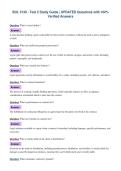
BUL 3130 - Test 2 Study Guide | UPDATED Questions with 100%
Verified Answers
Question: What is strict liability?
Answer:
A legal doctrine holding a party responsible for their actions or products without the need to prove negligence
or fault.
Question: What are intellectual property protections?
Answer:
Legal rights that grant creators control over the use of their inventions, designs, and artistic works, including
patents, copyrights, and trademarks.
Question: What are criminal law defenses?
Answer:
Legal arguments used by defendants to avoid liability for a crime, including insanity, self- defense, and duress.
Question: What is contract formation?
Answer:
The process of creating a legally binding agreement, which typically requires an offer, acceptance,
consideration, and mutual intent to enter into the contract.
Question: What is performance in contract law?
Answer:
The fulfillment of contractual obligations as agreed upon by the parties involved in the contract.
Question: What are remedies in contract law?
Answer:
Legal solutions available to a party when a contract is breached, including damages, specific performance, and
rescission.
Question: Who is strictly liable in the chain of distribution?
Answer:
Everyone in the chain of distribution, including manufacturers, distributors, and retailers, is strictly liable for
damages caused by dangerous products, meaning they can be held jointly and severally liable.
Question: What constitutes a defective product?
, Answer:
A defective product can be identified by manufacturing defects, design defects, and failure to provide adequate
warnings about foreseeable misuses of the product.
Question: What is market-share liability?
Answer:
Market-share liability is a legal theory that allows a plaintiff to recover damages from multiple manufacturers
based on their market share of a product that caused harm, even if the specific manufacturer of the harmful
product cannot be identified.
Question: What are defenses to strict liability?
Answer:
Defenses to strict liability include commonly known dangers, knowledgeable users, and product misuse.
Question: What types of intellectual property can obtain a trademark, patent, and copyright?
Answer:
Trademarks protect brand names and logos, patents protect inventions, and copyrights protect original works of
authorship. Patents and trademarks require registration, while copyright does not.
Question: How long do trademark protections last?
Answer:
Trademark protections last for 10 years but can be renewed indefinitely as long as the mark is in use.
Question: How long do patent protections last?
Answer:
Patent protections last for 20 years from the date of filing.
Question: How long do copyright protections last?
Answer:
Copyright protections last for the life of the author plus 70 years, or 95 years for works published by
corporations.
Verified Answers
Question: What is strict liability?
Answer:
A legal doctrine holding a party responsible for their actions or products without the need to prove negligence
or fault.
Question: What are intellectual property protections?
Answer:
Legal rights that grant creators control over the use of their inventions, designs, and artistic works, including
patents, copyrights, and trademarks.
Question: What are criminal law defenses?
Answer:
Legal arguments used by defendants to avoid liability for a crime, including insanity, self- defense, and duress.
Question: What is contract formation?
Answer:
The process of creating a legally binding agreement, which typically requires an offer, acceptance,
consideration, and mutual intent to enter into the contract.
Question: What is performance in contract law?
Answer:
The fulfillment of contractual obligations as agreed upon by the parties involved in the contract.
Question: What are remedies in contract law?
Answer:
Legal solutions available to a party when a contract is breached, including damages, specific performance, and
rescission.
Question: Who is strictly liable in the chain of distribution?
Answer:
Everyone in the chain of distribution, including manufacturers, distributors, and retailers, is strictly liable for
damages caused by dangerous products, meaning they can be held jointly and severally liable.
Question: What constitutes a defective product?
, Answer:
A defective product can be identified by manufacturing defects, design defects, and failure to provide adequate
warnings about foreseeable misuses of the product.
Question: What is market-share liability?
Answer:
Market-share liability is a legal theory that allows a plaintiff to recover damages from multiple manufacturers
based on their market share of a product that caused harm, even if the specific manufacturer of the harmful
product cannot be identified.
Question: What are defenses to strict liability?
Answer:
Defenses to strict liability include commonly known dangers, knowledgeable users, and product misuse.
Question: What types of intellectual property can obtain a trademark, patent, and copyright?
Answer:
Trademarks protect brand names and logos, patents protect inventions, and copyrights protect original works of
authorship. Patents and trademarks require registration, while copyright does not.
Question: How long do trademark protections last?
Answer:
Trademark protections last for 10 years but can be renewed indefinitely as long as the mark is in use.
Question: How long do patent protections last?
Answer:
Patent protections last for 20 years from the date of filing.
Question: How long do copyright protections last?
Answer:
Copyright protections last for the life of the author plus 70 years, or 95 years for works published by
corporations.


