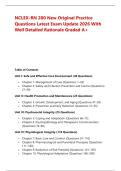
NCLEX-RN 200 New Original Practice
Questions Latest Exam Update 2026 With
Well Detailed Rationale Graded A+
Table of Contents
Unit I: Safe and Effective Care Environment (40 Questions)
• Chapter 1: Management of Care (Questions 1–20)
• Chapter 2: Safety and Infection Prevention and Control (Questions
21–40)
Unit II: Health Promotion and Maintenance (25 Questions)
• Chapter 3: Growth, Development, and Aging (Questions 41–50)
• Chapter 4: Prevention and Early Detection (Questions 51–65)
Unit III: Psychosocial Integrity (25 Questions)
• Chapter 5: Coping and Adaptation (Questions 66–75)
• Chapter 6: Psychopathology and Therapeutic Communication
(Questions 76–90)
Unit IV: Physiological Integrity (110 Questions)
• Chapter 7: Basic Care and Comfort (Questions 91–110)
• Chapter 8: Pharmacological and Parenteral Therapies (Questions
111–140)
• Chapter 9: Reduction of Risk Potential (Questions 141–165)
• Chapter 10: Physiological Adaptation (Questions 166–200)
,Unit I: Safe and Effective Care Environment
Chapter 1: Management of Care
Question 1
A nurse is caring for four clients on a medical-surgical unit. Which client
should the nurse assess first?
A. A client who is 2 days postoperative with a temperature of 100.8°F
(38.2°C)
B. A client with a new onset of confusion and a heart rate of 118 bpm
C. A client with a chronic wound requiring a dressing change
D. A client requesting pain medication for a headache rated 4/10
Correct Answer: B
Rationale: The client with new-onset confusion and tachycardia is
demonstrating signs of potential hypoxia, infection, or a neurological
event such as delirium or early sepsis. New-onset confusion is a critical
"red flag" finding that requires immediate assessment because it can
indicate a life-threatening change in condition. Using the ABC (Airway,
Breathing, Circulation) framework, this client's cardiovascular and
neurological status is unstable. A low-grade fever postoperatively is
common and not immediately life-threatening. A dressing change is
routine. A headache rated 4/10 is important but stable.
Clinical Judgment Skill: Recognize Cues / Prioritize Hypotheses
Question 2
,A nurse is delegating tasks to an unlicensed assistive personnel (UAP).
Which task is most appropriate to delegate?
A. Administering oral medications to a stable client
B. Performing a sterile dressing change
C. Measuring a client's intake and output
D. Teaching a client about a new medication
Correct Answer: C
Rationale: UAPs can perform routine, non-invasive tasks such as
measuring intake and output on stable clients. Administering
medications (A), performing sterile procedures (B), and teaching (D) are
within the RN's scope of practice and cannot be delegated to UAPs.
The RN is responsible for assessment, teaching, and evaluation.
Clinical Judgment Skill: Generate Solutions
Question 3
A client is being discharged with a new prescription for warfarin. Which
statement by the client indicates a need for further teaching?
A. "I will use an electric razor instead of a disposable one."
B. "I will avoid eating large amounts of spinach and kale."
C. "I will take ibuprofen instead of acetaminophen for headaches."
D. "I will wear a medical alert bracelet that says I take blood thinners."
Correct Answer: C
Rationale: The client stating they will take ibuprofen indicates a need
for further teaching. Ibuprofen is an NSAID that increases bleeding risk
when combined with warfarin by inhibiting platelet function and
irritating the gastric mucosa. Clients on warfarin should use
acetaminophen for mild pain unless otherwise directed. Using an
electric razor (A), avoiding large amounts of vitamin K-rich foods (B), and
wearing a medical alert bracelet (D) are all correct statements.
, Clinical Judgment Skill: Evaluate Outcomes
Question 4
A nurse witnesses a client sign an informed consent for surgery. The
client says, "I don't really understand what the surgeon is going to do,
but I trust him." What is the nurse's priority action?
A. Witness the consent and proceed with preoperative preparation
B. Explain the procedure to the client in simple terms
C. Notify the surgeon that the client has questions about the procedure
D. Document the client's statement and continue with the plan of care
Correct Answer: C
Rationale: Informed consent requires that the client understands the
procedure, including risks, benefits, and alternatives. If the client
expresses a lack of understanding, the nurse must notify the surgeon to
provide further explanation before the consent is valid. The nurse cannot
explain the procedure (B) because that is the provider's responsibility.
Witnessing the consent (A) or simply documenting (D) without acting
would violate the client's rights.
Clinical Judgment Skill: Take Action
Question 5
A nurse is caring for a client who speaks limited English. The client needs
to sign a consent form for a procedure. Which action is most
appropriate?
A. Ask the client's 12-year-old child to interpret the consent form
B. Use a certified medical interpreter to facilitate communication
C. Have the client sign the form and explain it later with a translator
D. Provide written materials in English and ask the client to read them
Questions Latest Exam Update 2026 With
Well Detailed Rationale Graded A+
Table of Contents
Unit I: Safe and Effective Care Environment (40 Questions)
• Chapter 1: Management of Care (Questions 1–20)
• Chapter 2: Safety and Infection Prevention and Control (Questions
21–40)
Unit II: Health Promotion and Maintenance (25 Questions)
• Chapter 3: Growth, Development, and Aging (Questions 41–50)
• Chapter 4: Prevention and Early Detection (Questions 51–65)
Unit III: Psychosocial Integrity (25 Questions)
• Chapter 5: Coping and Adaptation (Questions 66–75)
• Chapter 6: Psychopathology and Therapeutic Communication
(Questions 76–90)
Unit IV: Physiological Integrity (110 Questions)
• Chapter 7: Basic Care and Comfort (Questions 91–110)
• Chapter 8: Pharmacological and Parenteral Therapies (Questions
111–140)
• Chapter 9: Reduction of Risk Potential (Questions 141–165)
• Chapter 10: Physiological Adaptation (Questions 166–200)
,Unit I: Safe and Effective Care Environment
Chapter 1: Management of Care
Question 1
A nurse is caring for four clients on a medical-surgical unit. Which client
should the nurse assess first?
A. A client who is 2 days postoperative with a temperature of 100.8°F
(38.2°C)
B. A client with a new onset of confusion and a heart rate of 118 bpm
C. A client with a chronic wound requiring a dressing change
D. A client requesting pain medication for a headache rated 4/10
Correct Answer: B
Rationale: The client with new-onset confusion and tachycardia is
demonstrating signs of potential hypoxia, infection, or a neurological
event such as delirium or early sepsis. New-onset confusion is a critical
"red flag" finding that requires immediate assessment because it can
indicate a life-threatening change in condition. Using the ABC (Airway,
Breathing, Circulation) framework, this client's cardiovascular and
neurological status is unstable. A low-grade fever postoperatively is
common and not immediately life-threatening. A dressing change is
routine. A headache rated 4/10 is important but stable.
Clinical Judgment Skill: Recognize Cues / Prioritize Hypotheses
Question 2
,A nurse is delegating tasks to an unlicensed assistive personnel (UAP).
Which task is most appropriate to delegate?
A. Administering oral medications to a stable client
B. Performing a sterile dressing change
C. Measuring a client's intake and output
D. Teaching a client about a new medication
Correct Answer: C
Rationale: UAPs can perform routine, non-invasive tasks such as
measuring intake and output on stable clients. Administering
medications (A), performing sterile procedures (B), and teaching (D) are
within the RN's scope of practice and cannot be delegated to UAPs.
The RN is responsible for assessment, teaching, and evaluation.
Clinical Judgment Skill: Generate Solutions
Question 3
A client is being discharged with a new prescription for warfarin. Which
statement by the client indicates a need for further teaching?
A. "I will use an electric razor instead of a disposable one."
B. "I will avoid eating large amounts of spinach and kale."
C. "I will take ibuprofen instead of acetaminophen for headaches."
D. "I will wear a medical alert bracelet that says I take blood thinners."
Correct Answer: C
Rationale: The client stating they will take ibuprofen indicates a need
for further teaching. Ibuprofen is an NSAID that increases bleeding risk
when combined with warfarin by inhibiting platelet function and
irritating the gastric mucosa. Clients on warfarin should use
acetaminophen for mild pain unless otherwise directed. Using an
electric razor (A), avoiding large amounts of vitamin K-rich foods (B), and
wearing a medical alert bracelet (D) are all correct statements.
, Clinical Judgment Skill: Evaluate Outcomes
Question 4
A nurse witnesses a client sign an informed consent for surgery. The
client says, "I don't really understand what the surgeon is going to do,
but I trust him." What is the nurse's priority action?
A. Witness the consent and proceed with preoperative preparation
B. Explain the procedure to the client in simple terms
C. Notify the surgeon that the client has questions about the procedure
D. Document the client's statement and continue with the plan of care
Correct Answer: C
Rationale: Informed consent requires that the client understands the
procedure, including risks, benefits, and alternatives. If the client
expresses a lack of understanding, the nurse must notify the surgeon to
provide further explanation before the consent is valid. The nurse cannot
explain the procedure (B) because that is the provider's responsibility.
Witnessing the consent (A) or simply documenting (D) without acting
would violate the client's rights.
Clinical Judgment Skill: Take Action
Question 5
A nurse is caring for a client who speaks limited English. The client needs
to sign a consent form for a procedure. Which action is most
appropriate?
A. Ask the client's 12-year-old child to interpret the consent form
B. Use a certified medical interpreter to facilitate communication
C. Have the client sign the form and explain it later with a translator
D. Provide written materials in English and ask the client to read them