
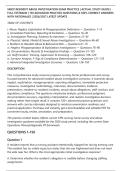
SMQT RESIDENT ABUSE INVESTIGATION EXAM PRACTICE | ACTUAL STUDY GUIDE |
FULL TESTBANK | 150 ADVANCED PRACTICE QUESTIONS & 100% CORRECT ANSWERS
WITH RATIONALES | 2026/2027 LATEST UPDATE
TABLE OF CONTENTS
i. Abuse, Neglect, Exploitation & Misappropriation Definitions — Questions 1–15
ii. Immediate Protection, Reporting & Escalation — Questions 16–30
iii. Investigation Planning, Evidence & Interviews — Questions 31–45
iv. Physical, Verbal, Mental & Sexual Abuse Investigations — Questions 46–60
v. Resident-to-Resident Abuse & Behavioral Risk — Questions 61–75
vi. Neglect, Misappropriation & Exploitation Investigations — Questions 76–90
vii. Documentation, Records & Investigative Findings — Questions 91–105
viii. Staff Conduct, Training, Supervision & Screening — Questions 106–120
ix. Surveyor Analysis, F-Tags & Compliance Determinations — Questions 121–135
x. Advanced Integrated Investigation Scenarios — Questions 136–150
DESCRIPTION
This comprehensive study resource prepares nursing-home professionals and survey-
focused learners for advanced resident abuse investigation scenarios. It examines abuse,
neglect, exploitation, misappropriation, reporting obligations, immediate protective
measures, investigative methodology, interviews, documentation, evidence
preservation, resident-to-resident incidents, sexual-abuse allegations, staff conduct, and
regulatory compliance. The questions emphasize analysis, professional judgment,
documentation accuracy, regulatory interpretation, and realistic investigative decision-
making rather than simple recall. It contains 100+ advanced practice questions and
answers with concise rationales designed to reinforce examination readiness and
practical application. Purchase and instantly get a downloadable and editable PDF for
convenient study, review, annotation, and preparation.
The practice content below reflects current CMS nursing-home survey and abuse-
investigation guidance available for the 2026 study period, including the current State
Operations Manual/Appendix PP framework.
QUESTIONS 1–150
Question 1
A resident reports that a nursing assistant intentionally slapped her during evening care.
The resident has no visible injury but states that she was frightened and does not want
the aide near her. What is the most appropriate initial investigative response?
A. Determine whether the resident's allegation is credible before changing staffing
assignments.
,B. Immediately protect the resident from potential further abuse while initiating the
required investigation.
C. Wait until the next scheduled interdisciplinary team meeting.
D. Ask the alleged perpetrator to conduct the resident's next care episode under
supervision.
🔴 Correct Answer: B. Immediately protect the resident from potential further abuse
while initiating the required investigation.
🔵 Explanation: Protection from further potential abuse is an immediate responsibility
and should not depend on completing the investigation or establishing credibility first. The
investigation then determines what occurred and what corrective actions are required.
Question 2
During an investigation, a facility manager states, "We cannot determine abuse unless
there is physical evidence." Which response best reflects the appropriate investigative
standard?
A. Agree because allegations without injuries cannot support an abuse finding.
B. Require a physician diagnosis before considering the allegation.
C. Explain that abuse may involve physical, verbal, mental, sexual, or other prohibited
conduct and may be substantiated through multiple evidence sources.
D. Require two eyewitnesses before documenting abuse.
🔴 Correct Answer: C. Explain that abuse may involve physical, verbal, mental, sexual,
or other prohibited conduct and may be substantiated through multiple evidence
sources.
🔵 Explanation: Abuse investigations are not limited to visible injuries. Interviews,
observations, records, behavioral changes, electronic evidence, staffing information, and
other corroborating facts may establish what occurred.
Question 3
A resident with dementia repeatedly tells staff that another resident "hits me at night."
The alleged aggressor denies the allegation. No staff member witnessed the event.
What should investigators do?
A. Close the investigation because the allegation cannot be corroborated.
B. Investigate the allegation using resident interviews, assessments, care plans, staffing
information, observations, and other relevant evidence.
C. Automatically classify the incident as dementia-related hallucination.
D. Transfer the alleged victim immediately without further investigation.
🔴 Correct Answer: B. Investigate the allegation using resident interviews,
assessments, care plans, staffing information, observations, and other relevant
evidence.
,🔵 Explanation: Cognitive impairment does not eliminate the need to investigate an
allegation. Investigators should consider the resident's condition while evaluating all
available evidence.
Question 4
Which finding most strongly indicates that an investigation was incomplete?
A. The facility interviewed the resident and alleged perpetrator.
B. The facility documented the date and location of the incident.
C. The facility reached a conclusion without reviewing relevant records or interviewing
available witnesses.
D. The facility implemented immediate protective measures.
🔴 Correct Answer: C. The facility reached a conclusion without reviewing relevant
records or interviewing available witnesses.
🔵 Explanation: A thorough investigation requires evidence appropriate to the allegation.
Ignoring readily available evidence can make the conclusion unsupported and incomplete.
Question 5
A resident alleges that staff intentionally withheld his hearing aids to punish him. Which
investigative approach is most appropriate?
A. Investigate only whether the hearing aids were eventually returned.
B. Determine the circumstances, staff involvement, intent, impact on the resident,
relevant policies, and whether the conduct constituted prohibited treatment.
C. Treat the allegation as a property-management issue only.
D. Exclude the allegation because no physical injury occurred.
🔴 Correct Answer: B. Determine the circumstances, staff involvement, intent, impact
on the resident, relevant policies, and whether the conduct constituted prohibited
treatment.
🔵 Explanation: Abuse investigations must consider the nature of the conduct and its
impact, not merely whether a physical injury occurred. Deprivation of necessary goods or
services may require abuse or neglect analysis depending on the evidence.
Question 6
An investigator finds that a staff member yelled degrading insults at a resident but
caused no physical injury. What is the most appropriate conclusion?
A. No abuse occurred because the resident was not injured.
B. The conduct may constitute verbal or mental abuse and requires appropriate
investigation and response.
C. The conduct is acceptable if the staff member was frustrated.
D. Abuse exists only when the resident files a written complaint.
, 🔴 Correct Answer: B. The conduct may constitute verbal or mental abuse and
requires appropriate investigation and response.
🔵 Explanation: Abuse is not limited to physical injury. Verbal and mental abuse can
violate resident protections even when no physical injury is documented.
Question 7
A resident's unexplained bruising appears after several shifts involving the same aide.
Which evidence would be most useful for determining whether the aide had an
opportunity to cause the injury?
A. The aide's annual performance evaluation only.
B. Staffing schedules, time records, assignment sheets, interviews, and relevant
observations.
C. The facility's marketing materials.
D. The resident's insurance information.
🔴 Correct Answer: B. Staffing schedules, time records, assignment sheets,
interviews, and relevant observations.
🔵 Explanation: Opportunity analysis requires establishing who was present and
providing care during the relevant period. Staffing and assignment records can help
reconstruct access and opportunity.
Question 8
An investigator interviews the alleged perpetrator before interviewing the resident and
witnesses. Why may this sequencing create a problem?
A. It automatically invalidates the investigation.
B. It may allow the alleged perpetrator to influence subsequent accounts or alter
relevant evidence.
C. It violates all federal interview requirements.
D. It proves that the allegation is false.
🔴 Correct Answer: B. It may allow the alleged perpetrator to influence subsequent
accounts or alter relevant evidence.
🔵 Explanation: Investigation sequencing should preserve the integrity of evidence.
Interviewing witnesses and securing relevant records before potentially influential
discussions may reduce opportunities for contamination.
Question 9
Which documentation is most useful when reconstructing a disputed incident?
A. General facility policies unrelated to the allegation.
B. Contemporaneous clinical records, assignment records, incident reports, interviews,
and relevant electronic evidence.
FULL TESTBANK | 150 ADVANCED PRACTICE QUESTIONS & 100% CORRECT ANSWERS
WITH RATIONALES | 2026/2027 LATEST UPDATE
TABLE OF CONTENTS
i. Abuse, Neglect, Exploitation & Misappropriation Definitions — Questions 1–15
ii. Immediate Protection, Reporting & Escalation — Questions 16–30
iii. Investigation Planning, Evidence & Interviews — Questions 31–45
iv. Physical, Verbal, Mental & Sexual Abuse Investigations — Questions 46–60
v. Resident-to-Resident Abuse & Behavioral Risk — Questions 61–75
vi. Neglect, Misappropriation & Exploitation Investigations — Questions 76–90
vii. Documentation, Records & Investigative Findings — Questions 91–105
viii. Staff Conduct, Training, Supervision & Screening — Questions 106–120
ix. Surveyor Analysis, F-Tags & Compliance Determinations — Questions 121–135
x. Advanced Integrated Investigation Scenarios — Questions 136–150
DESCRIPTION
This comprehensive study resource prepares nursing-home professionals and survey-
focused learners for advanced resident abuse investigation scenarios. It examines abuse,
neglect, exploitation, misappropriation, reporting obligations, immediate protective
measures, investigative methodology, interviews, documentation, evidence
preservation, resident-to-resident incidents, sexual-abuse allegations, staff conduct, and
regulatory compliance. The questions emphasize analysis, professional judgment,
documentation accuracy, regulatory interpretation, and realistic investigative decision-
making rather than simple recall. It contains 100+ advanced practice questions and
answers with concise rationales designed to reinforce examination readiness and
practical application. Purchase and instantly get a downloadable and editable PDF for
convenient study, review, annotation, and preparation.
The practice content below reflects current CMS nursing-home survey and abuse-
investigation guidance available for the 2026 study period, including the current State
Operations Manual/Appendix PP framework.
QUESTIONS 1–150
Question 1
A resident reports that a nursing assistant intentionally slapped her during evening care.
The resident has no visible injury but states that she was frightened and does not want
the aide near her. What is the most appropriate initial investigative response?
A. Determine whether the resident's allegation is credible before changing staffing
assignments.
,B. Immediately protect the resident from potential further abuse while initiating the
required investigation.
C. Wait until the next scheduled interdisciplinary team meeting.
D. Ask the alleged perpetrator to conduct the resident's next care episode under
supervision.
🔴 Correct Answer: B. Immediately protect the resident from potential further abuse
while initiating the required investigation.
🔵 Explanation: Protection from further potential abuse is an immediate responsibility
and should not depend on completing the investigation or establishing credibility first. The
investigation then determines what occurred and what corrective actions are required.
Question 2
During an investigation, a facility manager states, "We cannot determine abuse unless
there is physical evidence." Which response best reflects the appropriate investigative
standard?
A. Agree because allegations without injuries cannot support an abuse finding.
B. Require a physician diagnosis before considering the allegation.
C. Explain that abuse may involve physical, verbal, mental, sexual, or other prohibited
conduct and may be substantiated through multiple evidence sources.
D. Require two eyewitnesses before documenting abuse.
🔴 Correct Answer: C. Explain that abuse may involve physical, verbal, mental, sexual,
or other prohibited conduct and may be substantiated through multiple evidence
sources.
🔵 Explanation: Abuse investigations are not limited to visible injuries. Interviews,
observations, records, behavioral changes, electronic evidence, staffing information, and
other corroborating facts may establish what occurred.
Question 3
A resident with dementia repeatedly tells staff that another resident "hits me at night."
The alleged aggressor denies the allegation. No staff member witnessed the event.
What should investigators do?
A. Close the investigation because the allegation cannot be corroborated.
B. Investigate the allegation using resident interviews, assessments, care plans, staffing
information, observations, and other relevant evidence.
C. Automatically classify the incident as dementia-related hallucination.
D. Transfer the alleged victim immediately without further investigation.
🔴 Correct Answer: B. Investigate the allegation using resident interviews,
assessments, care plans, staffing information, observations, and other relevant
evidence.
,🔵 Explanation: Cognitive impairment does not eliminate the need to investigate an
allegation. Investigators should consider the resident's condition while evaluating all
available evidence.
Question 4
Which finding most strongly indicates that an investigation was incomplete?
A. The facility interviewed the resident and alleged perpetrator.
B. The facility documented the date and location of the incident.
C. The facility reached a conclusion without reviewing relevant records or interviewing
available witnesses.
D. The facility implemented immediate protective measures.
🔴 Correct Answer: C. The facility reached a conclusion without reviewing relevant
records or interviewing available witnesses.
🔵 Explanation: A thorough investigation requires evidence appropriate to the allegation.
Ignoring readily available evidence can make the conclusion unsupported and incomplete.
Question 5
A resident alleges that staff intentionally withheld his hearing aids to punish him. Which
investigative approach is most appropriate?
A. Investigate only whether the hearing aids were eventually returned.
B. Determine the circumstances, staff involvement, intent, impact on the resident,
relevant policies, and whether the conduct constituted prohibited treatment.
C. Treat the allegation as a property-management issue only.
D. Exclude the allegation because no physical injury occurred.
🔴 Correct Answer: B. Determine the circumstances, staff involvement, intent, impact
on the resident, relevant policies, and whether the conduct constituted prohibited
treatment.
🔵 Explanation: Abuse investigations must consider the nature of the conduct and its
impact, not merely whether a physical injury occurred. Deprivation of necessary goods or
services may require abuse or neglect analysis depending on the evidence.
Question 6
An investigator finds that a staff member yelled degrading insults at a resident but
caused no physical injury. What is the most appropriate conclusion?
A. No abuse occurred because the resident was not injured.
B. The conduct may constitute verbal or mental abuse and requires appropriate
investigation and response.
C. The conduct is acceptable if the staff member was frustrated.
D. Abuse exists only when the resident files a written complaint.
, 🔴 Correct Answer: B. The conduct may constitute verbal or mental abuse and
requires appropriate investigation and response.
🔵 Explanation: Abuse is not limited to physical injury. Verbal and mental abuse can
violate resident protections even when no physical injury is documented.
Question 7
A resident's unexplained bruising appears after several shifts involving the same aide.
Which evidence would be most useful for determining whether the aide had an
opportunity to cause the injury?
A. The aide's annual performance evaluation only.
B. Staffing schedules, time records, assignment sheets, interviews, and relevant
observations.
C. The facility's marketing materials.
D. The resident's insurance information.
🔴 Correct Answer: B. Staffing schedules, time records, assignment sheets,
interviews, and relevant observations.
🔵 Explanation: Opportunity analysis requires establishing who was present and
providing care during the relevant period. Staffing and assignment records can help
reconstruct access and opportunity.
Question 8
An investigator interviews the alleged perpetrator before interviewing the resident and
witnesses. Why may this sequencing create a problem?
A. It automatically invalidates the investigation.
B. It may allow the alleged perpetrator to influence subsequent accounts or alter
relevant evidence.
C. It violates all federal interview requirements.
D. It proves that the allegation is false.
🔴 Correct Answer: B. It may allow the alleged perpetrator to influence subsequent
accounts or alter relevant evidence.
🔵 Explanation: Investigation sequencing should preserve the integrity of evidence.
Interviewing witnesses and securing relevant records before potentially influential
discussions may reduce opportunities for contamination.
Question 9
Which documentation is most useful when reconstructing a disputed incident?
A. General facility policies unrelated to the allegation.
B. Contemporaneous clinical records, assignment records, incident reports, interviews,
and relevant electronic evidence.


