
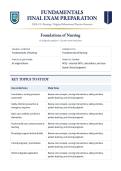
FUNDAMENTALS
SLATNEMADNUF
RN
FINAL EXAM PREPARATION
2026 U.S. Nursing • Original Educational Practice Resource
Foundations of Nursing
60 original questions • 13-point main-body text
COURSE / CONTENT COURSE TITLE
Fundamentals of Nursing Fundamentals of Nursing
PRACTICE QUESTIONS PRACTICE FORMAT
60 original items MCQ + selected SATA, calculations, and case-
based clinical judgment
KEY TOPICS TO STUDY
Key content area Study focus
Foundations, nursing process & Review core concepts, nursing interventions, safety priorities,
assessment patient teaching, and clinical judgment.
Safety, infection prevention & Review core concepts, nursing interventions, safety priorities,
emergency response patient teaching, and clinical judgment.
Basic care, mobility, nutrition & Review core concepts, nursing interventions, safety priorities,
elimination patient teaching, and clinical judgment.
Psychosocial care, communication & Review core concepts, nursing interventions, safety priorities,
teaching patient teaching, and clinical judgment.
Physiologic support & clinical skills Review core concepts, nursing interventions, safety priorities,
patient teaching, and clinical judgment.
Clinical judgment / prioritization Review core concepts, nursing interventions, safety priorities,
patient teaching, and clinical judgment.
SATA & integrated application Review core concepts, nursing interventions, safety priorities,
patient teaching, and clinical judgment.
,Calculation / medication-safety Review core concepts, nursing interventions, safety priorities,
integration patient teaching, and clinical judgment.
PREPARATION CHECKLIST
Know the underlying physiology and the nursing reason for each intervention.
Practice priority questions by identifying the most dangerous cue first.
Review medications by class, mechanism, major adverse effects, contraindications,
monitoring, and teaching.
Know high-yield laboratory values and what abnormal trends mean clinically.
Practice dosage calculations using units, dimensional analysis, and a final
reasonableness check.
For delegation, retain assessment, initial teaching, unstable-client management, and
evaluation.
Use current course materials and the student's Canvas syllabus as the controlling
source for the actual exam.
PRACTICE QUESTIONS 60 ITEMS
,Question 1 Multiple Choice Moderate
A client reports new dizziness after standing. Which assessment should the nurse
perform first?
A. Check orthostatic vital signs.
B. Ask about favorite foods.
C. Document the report and reassess tomorrow.
D. Encourage the client to walk independently.
CORRECT ANSWER: A. Check orthostatic vital signs.
RATIONALE: Orthostatic measurements help determine whether the dizziness is
associated with a postural blood-pressure change; the other actions either delay
assessment or add fall risk.
WHY THE OTHER OPTIONS ARE WRONG:
B — Ask about favorite foods. is less appropriate because it does not best satisfy the clinical
priority or tested principle.
C — Document the report and reassess tomorrow. is less appropriate because it does not best
satisfy the clinical priority or tested principle.
D — Encourage the client to walk independently. is less appropriate because it does not best
satisfy the clinical priority or tested principle.
TESTED CONCEPT CLINICAL JUDGMENT
Focused assessment The cue is a new symptom associated with
position; assessment precedes intervention.
CONTENT AREA: Nursing Process & Assessment
, Question 2 Multiple Choice Easy
Which finding is subjective data?
A. The client states, “My pain is 7 out of 10.”
B. Blood pressure is 146/88 mm Hg.
C. The wound is 3 cm long.
D. The client is guarding the abdomen.
CORRECT ANSWER: A. The client states, “My pain is 7 out of 10.”
RATIONALE: A client's verbal report is subjective data; the remaining findings are
observable or measurable.
WHY THE OTHER OPTIONS ARE WRONG:
B — Blood pressure is 146/88 mm Hg. is less appropriate because it does not best satisfy the
clinical priority or tested principle.
C — The wound is 3 cm long. is less appropriate because it does not best satisfy the clinical
priority or tested principle.
D — The client is guarding the abdomen. is less appropriate because it does not best satisfy
the clinical priority or tested principle.
TESTED CONCEPT CLINICAL JUDGMENT
Data classification Separate what the client reports from what the
nurse can observe or measure.
CONTENT AREA: Nursing Process & Assessment
SLATNEMADNUF
RN
FINAL EXAM PREPARATION
2026 U.S. Nursing • Original Educational Practice Resource
Foundations of Nursing
60 original questions • 13-point main-body text
COURSE / CONTENT COURSE TITLE
Fundamentals of Nursing Fundamentals of Nursing
PRACTICE QUESTIONS PRACTICE FORMAT
60 original items MCQ + selected SATA, calculations, and case-
based clinical judgment
KEY TOPICS TO STUDY
Key content area Study focus
Foundations, nursing process & Review core concepts, nursing interventions, safety priorities,
assessment patient teaching, and clinical judgment.
Safety, infection prevention & Review core concepts, nursing interventions, safety priorities,
emergency response patient teaching, and clinical judgment.
Basic care, mobility, nutrition & Review core concepts, nursing interventions, safety priorities,
elimination patient teaching, and clinical judgment.
Psychosocial care, communication & Review core concepts, nursing interventions, safety priorities,
teaching patient teaching, and clinical judgment.
Physiologic support & clinical skills Review core concepts, nursing interventions, safety priorities,
patient teaching, and clinical judgment.
Clinical judgment / prioritization Review core concepts, nursing interventions, safety priorities,
patient teaching, and clinical judgment.
SATA & integrated application Review core concepts, nursing interventions, safety priorities,
patient teaching, and clinical judgment.
,Calculation / medication-safety Review core concepts, nursing interventions, safety priorities,
integration patient teaching, and clinical judgment.
PREPARATION CHECKLIST
Know the underlying physiology and the nursing reason for each intervention.
Practice priority questions by identifying the most dangerous cue first.
Review medications by class, mechanism, major adverse effects, contraindications,
monitoring, and teaching.
Know high-yield laboratory values and what abnormal trends mean clinically.
Practice dosage calculations using units, dimensional analysis, and a final
reasonableness check.
For delegation, retain assessment, initial teaching, unstable-client management, and
evaluation.
Use current course materials and the student's Canvas syllabus as the controlling
source for the actual exam.
PRACTICE QUESTIONS 60 ITEMS
,Question 1 Multiple Choice Moderate
A client reports new dizziness after standing. Which assessment should the nurse
perform first?
A. Check orthostatic vital signs.
B. Ask about favorite foods.
C. Document the report and reassess tomorrow.
D. Encourage the client to walk independently.
CORRECT ANSWER: A. Check orthostatic vital signs.
RATIONALE: Orthostatic measurements help determine whether the dizziness is
associated with a postural blood-pressure change; the other actions either delay
assessment or add fall risk.
WHY THE OTHER OPTIONS ARE WRONG:
B — Ask about favorite foods. is less appropriate because it does not best satisfy the clinical
priority or tested principle.
C — Document the report and reassess tomorrow. is less appropriate because it does not best
satisfy the clinical priority or tested principle.
D — Encourage the client to walk independently. is less appropriate because it does not best
satisfy the clinical priority or tested principle.
TESTED CONCEPT CLINICAL JUDGMENT
Focused assessment The cue is a new symptom associated with
position; assessment precedes intervention.
CONTENT AREA: Nursing Process & Assessment
, Question 2 Multiple Choice Easy
Which finding is subjective data?
A. The client states, “My pain is 7 out of 10.”
B. Blood pressure is 146/88 mm Hg.
C. The wound is 3 cm long.
D. The client is guarding the abdomen.
CORRECT ANSWER: A. The client states, “My pain is 7 out of 10.”
RATIONALE: A client's verbal report is subjective data; the remaining findings are
observable or measurable.
WHY THE OTHER OPTIONS ARE WRONG:
B — Blood pressure is 146/88 mm Hg. is less appropriate because it does not best satisfy the
clinical priority or tested principle.
C — The wound is 3 cm long. is less appropriate because it does not best satisfy the clinical
priority or tested principle.
D — The client is guarding the abdomen. is less appropriate because it does not best satisfy
the clinical priority or tested principle.
TESTED CONCEPT CLINICAL JUDGMENT
Data classification Separate what the client reports from what the
nurse can observe or measure.
CONTENT AREA: Nursing Process & Assessment


