
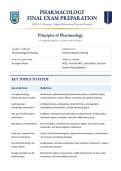
PHARMACOLOGY
YGOLOCAMRAHP
RN
FINAL EXAM PREPARATION
2026 U.S. Nursing • Original Educational Practice Resource
Principles of Pharmacology
60 original questions • 13-point main-body text
COURSE / CONTENT COURSE TITLE
Pharmacology for Nursing Pharmacology for Nursing
PRACTICE QUESTIONS PRACTICE FORMAT
60 original items MCQ + selected SATA, calculations, and case-
based clinical judgment
KEY TOPICS TO STUDY
Key content area Study focus
Core pharmacology, Mechanisms, pharmacokinetics/pharmacodynamics, medication rights,
kinetics/dynamics & safety contraindications, adverse effects, monitoring, and patient teaching.
Cardiovascular / Antihypertensives, antianginals, antiarrhythmics, anticoagulants,
hematologic medications antiplatelets, thrombolytics, and lipid-lowering agents.
CNS, pain & inflammation Analgesics, CNS depressants/stimulants, antidepressants, antipsychotics,
medications antiseizure agents, anxiolytics, and anti-inflammatory drugs.
Respiratory / GI medications Bronchodilators, corticosteroids, respiratory agents, acid-control drugs,
antiemetics, and bowel-regimen medications.
Endocrine / reproductive / Insulins, thyroid/adrenal agents, reproductive medications, corticosteroids,
immune medications and immune-modulating therapies.
Anti-infectives & high-risk Antibacterials, antivirals, antifungals, major toxicities, interactions, cultures,
adverse effects and safe administration.
Dosage calculation & safe Dimensional analysis, dose/volume, weight-based dosing, IV rates, units,
administration conversions, and reasonableness checks.
,Clinical judgment / SATA / Recognize cues, identify priorities, implement interventions, evaluate
integrated cases outcomes, delegation, and select-all-that-apply reasoning.
PREPARATION CHECKLIST
Know the underlying physiology and the nursing reason for each intervention.
Practice priority questions by identifying the most dangerous cue first.
Review medications by class, mechanism, major adverse effects, contraindications,
monitoring, and teaching.
Know high-yield laboratory values and what abnormal trends mean clinically.
Practice dosage calculations using units, dimensional analysis, and a final
reasonableness check.
For delegation, retain assessment, initial teaching, unstable-client management, and
evaluation.
Use current course materials and the student's Canvas syllabus as the controlling
source for the actual exam.
PRACTICE QUESTIONS 60 ITEMS
,Question 1 Multiple Choice Moderate
What is pharmacodynamics?
A. How a drug produces effects in the body
B. How the body absorbs a drug
C. How a drug is excreted
D. How a drug is stored
CORRECT ANSWER: A. How a drug produces effects in the body
RATIONALE: The best answer is How a drug produces effects in the body because it
directly addresses the pharmacologic mechanism, safety risk, or monitoring principle
described in the question.
WHY THE OTHER OPTIONS ARE WRONG:
B — How the body absorbs a drug is less appropriate because it does not best satisfy the
clinical priority or tested principle.
C — How a drug is excreted is less appropriate because it does not best satisfy the clinical
priority or tested principle.
D — How a drug is stored is less appropriate because it does not best satisfy the clinical
priority or tested principle.
TESTED CONCEPT CLINICAL JUDGMENT
Pharmacodynamics Identify the medication-related cue, connect it
to mechanism/adverse effect, and choose the
safest nursing action.
CONTENT AREA: Core pharmacology
, Question 2 Multiple Choice Moderate
What organ metabolizes many medications?
A. Liver
B. Lung
C. Skin
D. Bone marrow
CORRECT ANSWER: A. Liver
RATIONALE: The best answer is Liver because it directly addresses the pharmacologic
mechanism, safety risk, or monitoring principle described in the question.
WHY THE OTHER OPTIONS ARE WRONG:
B — Lung is less appropriate because it does not best satisfy the clinical priority or tested
principle.
C — Skin is less appropriate because it does not best satisfy the clinical priority or tested
principle.
D — Bone marrow is less appropriate because it does not best satisfy the clinical priority or
tested principle.
TESTED CONCEPT CLINICAL JUDGMENT
Drug metabolism Identify the medication-related cue, connect it
to mechanism/adverse effect, and choose the
safest nursing action.
CONTENT AREA: Core pharmacology
YGOLOCAMRAHP
RN
FINAL EXAM PREPARATION
2026 U.S. Nursing • Original Educational Practice Resource
Principles of Pharmacology
60 original questions • 13-point main-body text
COURSE / CONTENT COURSE TITLE
Pharmacology for Nursing Pharmacology for Nursing
PRACTICE QUESTIONS PRACTICE FORMAT
60 original items MCQ + selected SATA, calculations, and case-
based clinical judgment
KEY TOPICS TO STUDY
Key content area Study focus
Core pharmacology, Mechanisms, pharmacokinetics/pharmacodynamics, medication rights,
kinetics/dynamics & safety contraindications, adverse effects, monitoring, and patient teaching.
Cardiovascular / Antihypertensives, antianginals, antiarrhythmics, anticoagulants,
hematologic medications antiplatelets, thrombolytics, and lipid-lowering agents.
CNS, pain & inflammation Analgesics, CNS depressants/stimulants, antidepressants, antipsychotics,
medications antiseizure agents, anxiolytics, and anti-inflammatory drugs.
Respiratory / GI medications Bronchodilators, corticosteroids, respiratory agents, acid-control drugs,
antiemetics, and bowel-regimen medications.
Endocrine / reproductive / Insulins, thyroid/adrenal agents, reproductive medications, corticosteroids,
immune medications and immune-modulating therapies.
Anti-infectives & high-risk Antibacterials, antivirals, antifungals, major toxicities, interactions, cultures,
adverse effects and safe administration.
Dosage calculation & safe Dimensional analysis, dose/volume, weight-based dosing, IV rates, units,
administration conversions, and reasonableness checks.
,Clinical judgment / SATA / Recognize cues, identify priorities, implement interventions, evaluate
integrated cases outcomes, delegation, and select-all-that-apply reasoning.
PREPARATION CHECKLIST
Know the underlying physiology and the nursing reason for each intervention.
Practice priority questions by identifying the most dangerous cue first.
Review medications by class, mechanism, major adverse effects, contraindications,
monitoring, and teaching.
Know high-yield laboratory values and what abnormal trends mean clinically.
Practice dosage calculations using units, dimensional analysis, and a final
reasonableness check.
For delegation, retain assessment, initial teaching, unstable-client management, and
evaluation.
Use current course materials and the student's Canvas syllabus as the controlling
source for the actual exam.
PRACTICE QUESTIONS 60 ITEMS
,Question 1 Multiple Choice Moderate
What is pharmacodynamics?
A. How a drug produces effects in the body
B. How the body absorbs a drug
C. How a drug is excreted
D. How a drug is stored
CORRECT ANSWER: A. How a drug produces effects in the body
RATIONALE: The best answer is How a drug produces effects in the body because it
directly addresses the pharmacologic mechanism, safety risk, or monitoring principle
described in the question.
WHY THE OTHER OPTIONS ARE WRONG:
B — How the body absorbs a drug is less appropriate because it does not best satisfy the
clinical priority or tested principle.
C — How a drug is excreted is less appropriate because it does not best satisfy the clinical
priority or tested principle.
D — How a drug is stored is less appropriate because it does not best satisfy the clinical
priority or tested principle.
TESTED CONCEPT CLINICAL JUDGMENT
Pharmacodynamics Identify the medication-related cue, connect it
to mechanism/adverse effect, and choose the
safest nursing action.
CONTENT AREA: Core pharmacology
, Question 2 Multiple Choice Moderate
What organ metabolizes many medications?
A. Liver
B. Lung
C. Skin
D. Bone marrow
CORRECT ANSWER: A. Liver
RATIONALE: The best answer is Liver because it directly addresses the pharmacologic
mechanism, safety risk, or monitoring principle described in the question.
WHY THE OTHER OPTIONS ARE WRONG:
B — Lung is less appropriate because it does not best satisfy the clinical priority or tested
principle.
C — Skin is less appropriate because it does not best satisfy the clinical priority or tested
principle.
D — Bone marrow is less appropriate because it does not best satisfy the clinical priority or
tested principle.
TESTED CONCEPT CLINICAL JUDGMENT
Drug metabolism Identify the medication-related cue, connect it
to mechanism/adverse effect, and choose the
safest nursing action.
CONTENT AREA: Core pharmacology


