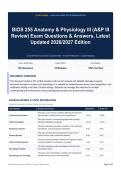
[STUDY GUIDE] • HIGH-YIELD PRACTICE & REVIEW EDITION
BIOS 255 Anatomy & Physiology III (A&P III
Review) Exam Questions & Answers, Latest
Updated 2026/2027 Edition
Comprehensive Examination Question Bank • In-Depth Rationales • Concept Mapping
TOTAL QUESTIONS EXAM TOPICS RATIONALES
100 Questions 10 Modules 100% Verified
DOCUMENT OVERVIEW
This document contains 100 verified questions with correct answers and detailed rationales covering
advanced concepts in anatomy and physiology. It is suitable for comprehensive review, exam preparation, and
certification testing in the field of human biology. Students can leverage this resource for in-depth
understanding and reinforcement of key physiological principles and anatomical knowledge.
EXAM BLUEPRINT & TOPIC DISTRIBUTION
Systematic breakdown of subject domains and exam coverage.
Topic Module Scope & Core Focus Questions Share (%)
This topic covers various conditions affecting the heart and
Cardiovascular System blood vessels, including ischemia and hypertension. 10 Qs 10.0%
This topic focuses on hormonal regulation and disorders
Endocrine System affecting metabolism and growth. 10 Qs 10.0%
This topic addresses respiratory conditions, their underlying
Respiratory System mechanisms, and physiological implications. 9 Qs 9.0%
This topic examines immune responses and the role of
Immune System various immune cells in health and disease. 9 Qs 9.0%
This topic explores disorders related to the digestive system,
Gastrointestinal System including metabolic consequences of surgery. 9 Qs 9.0%
This topic addresses acute neurological events and their
Neurological System physiological basis. 9 Qs 9.0%
This topic covers hematologic conditions and malignancies
Hematology and Oncology identified through lymph node examination. 9 Qs 9.0%
Confidential • Student Study Edition • Practice & Review Guide Page 1 of 51
,STUDENT STUDY & MASTERY EDITION PRACTICE & REVIEW GUIDE
Pulmonary Function and This topic focuses on pulmonary function tests and chronic
Disorders pulmonary conditions. 9 Qs 9.0%
Metabolic and Nutritional This topic examines metabolic disorders and their clinical
Disorders presentations. 8 Qs 8.0%
This topic explores various pathophysiological processes
General Pathophysiology across different body systems. 18 Qs 18.0%
Total Exam Coverage 10 Integrated Topic Modules 100 Qs 100.0%
Confidential • Student Study Edition • Practice & Review Guide Page 2 of 51
,STUDENT STUDY & MASTERY EDITION PRACTICE & REVIEW GUIDE
TOPIC 1: CARDIOVASCULAR SYSTEM
10 Questions • 10.0% of Exam • This topic covers various conditions affecting the heart and blood vessels, including ischemia and
hypertension.
QUESTION 1
A 62-year-old woman presents with exertional chest pain after a brisk walk. ECG is
normal, troponin is negative, yet she has hypertension and hypercholesterolemia.
Coronary angiography shows a 70% stenosis of the left anterior descending artery.
Which of the following best explains the limited coronary vasodilation during increased
myocardial demand?
[A] Endothelial dysfunction reducing NO bioavailability
[B] Increased sympathetic tone causing vasoconstriction
[C] Elevated endothelin-1 production
[D] Decreased coronary artery smooth muscle mass
Correct Answer: Endothelial dysfunction reducing NO bioavailability.
Rationale: Endothelial dysfunction impairs NO-mediated vasodilation, limiting coronary blood flow increase.
QUESTION 2
A 62-year-old man presents with chest pain radiating to the left arm and shortness of
breath. His ECG shows ST elevation in leads II, III, and aVF. Which cardiac structure is
most likely damaged, and what conduction pathway is most affected?
[A] Inferior wall myocardium, AV node.
[B] Anterior wall myocardium, His bundle.
[C] Inferior wall myocardium, AV bundle.
[D] Posterior wall myocardium, Purkinje fibers.
Correct Answer: Inferior wall myocardium, AV node.
Rationale: ST elevation in inferior leads indicates inferior myocardial infarction affecting the AV node region in the
conduction system.
Confidential • Student Study Edition • Practice & Review Guide Page 3 of 51
, STUDENT STUDY & MASTERY EDITION PRACTICE & REVIEW GUIDE
QUESTION 3
A 70-year-old man reports exertional chest pain lasting 10 minutes during walking that
resolves with rest. His ECG shows ST-segment depression in leads V2-V4, and cardiac
troponin levels are negative. He denies any radiation to arm or jaw. Which condition
best explains these findings?
[A] Stable angina pectoris due to coronary artery atherosclerosis
[B] Unstable angina from plaque rupture
[C] Acute myocardial infarction
[D] Prinzmetal angina from coronary vasospasm
Correct Answer: Stable angina pectoris due to coronary artery atherosclerosis.
Rationale: Pain relieved by rest, ECG changes, and normal troponin are classic for stable angina from fixed coronary
stenosis.
QUESTION 4
A 65-year-old woman experiences crushing chest pain radiating to the left leg, followed
by diaphoresis. An ECG shows ST-segment elevation in leads II, III, and aVF. Which
coronary artery is most likely occluded for this patient?
[A] Left anterior descending (LAD)
[B] Left circumflex (LCX)
[C] Right coronary artery (RCA)
[D] Posterior descending
Correct Answer: Right coronary artery (RCA)
Rationale: ST elevation in leads II, III, aVF indicates inferior wall infarction, most commonly due to occlusion of the right
coronary artery.
Confidential • Student Study Edition • Practice & Review Guide Page 4 of 51
BIOS 255 Anatomy & Physiology III (A&P III
Review) Exam Questions & Answers, Latest
Updated 2026/2027 Edition
Comprehensive Examination Question Bank • In-Depth Rationales • Concept Mapping
TOTAL QUESTIONS EXAM TOPICS RATIONALES
100 Questions 10 Modules 100% Verified
DOCUMENT OVERVIEW
This document contains 100 verified questions with correct answers and detailed rationales covering
advanced concepts in anatomy and physiology. It is suitable for comprehensive review, exam preparation, and
certification testing in the field of human biology. Students can leverage this resource for in-depth
understanding and reinforcement of key physiological principles and anatomical knowledge.
EXAM BLUEPRINT & TOPIC DISTRIBUTION
Systematic breakdown of subject domains and exam coverage.
Topic Module Scope & Core Focus Questions Share (%)
This topic covers various conditions affecting the heart and
Cardiovascular System blood vessels, including ischemia and hypertension. 10 Qs 10.0%
This topic focuses on hormonal regulation and disorders
Endocrine System affecting metabolism and growth. 10 Qs 10.0%
This topic addresses respiratory conditions, their underlying
Respiratory System mechanisms, and physiological implications. 9 Qs 9.0%
This topic examines immune responses and the role of
Immune System various immune cells in health and disease. 9 Qs 9.0%
This topic explores disorders related to the digestive system,
Gastrointestinal System including metabolic consequences of surgery. 9 Qs 9.0%
This topic addresses acute neurological events and their
Neurological System physiological basis. 9 Qs 9.0%
This topic covers hematologic conditions and malignancies
Hematology and Oncology identified through lymph node examination. 9 Qs 9.0%
Confidential • Student Study Edition • Practice & Review Guide Page 1 of 51
,STUDENT STUDY & MASTERY EDITION PRACTICE & REVIEW GUIDE
Pulmonary Function and This topic focuses on pulmonary function tests and chronic
Disorders pulmonary conditions. 9 Qs 9.0%
Metabolic and Nutritional This topic examines metabolic disorders and their clinical
Disorders presentations. 8 Qs 8.0%
This topic explores various pathophysiological processes
General Pathophysiology across different body systems. 18 Qs 18.0%
Total Exam Coverage 10 Integrated Topic Modules 100 Qs 100.0%
Confidential • Student Study Edition • Practice & Review Guide Page 2 of 51
,STUDENT STUDY & MASTERY EDITION PRACTICE & REVIEW GUIDE
TOPIC 1: CARDIOVASCULAR SYSTEM
10 Questions • 10.0% of Exam • This topic covers various conditions affecting the heart and blood vessels, including ischemia and
hypertension.
QUESTION 1
A 62-year-old woman presents with exertional chest pain after a brisk walk. ECG is
normal, troponin is negative, yet she has hypertension and hypercholesterolemia.
Coronary angiography shows a 70% stenosis of the left anterior descending artery.
Which of the following best explains the limited coronary vasodilation during increased
myocardial demand?
[A] Endothelial dysfunction reducing NO bioavailability
[B] Increased sympathetic tone causing vasoconstriction
[C] Elevated endothelin-1 production
[D] Decreased coronary artery smooth muscle mass
Correct Answer: Endothelial dysfunction reducing NO bioavailability.
Rationale: Endothelial dysfunction impairs NO-mediated vasodilation, limiting coronary blood flow increase.
QUESTION 2
A 62-year-old man presents with chest pain radiating to the left arm and shortness of
breath. His ECG shows ST elevation in leads II, III, and aVF. Which cardiac structure is
most likely damaged, and what conduction pathway is most affected?
[A] Inferior wall myocardium, AV node.
[B] Anterior wall myocardium, His bundle.
[C] Inferior wall myocardium, AV bundle.
[D] Posterior wall myocardium, Purkinje fibers.
Correct Answer: Inferior wall myocardium, AV node.
Rationale: ST elevation in inferior leads indicates inferior myocardial infarction affecting the AV node region in the
conduction system.
Confidential • Student Study Edition • Practice & Review Guide Page 3 of 51
, STUDENT STUDY & MASTERY EDITION PRACTICE & REVIEW GUIDE
QUESTION 3
A 70-year-old man reports exertional chest pain lasting 10 minutes during walking that
resolves with rest. His ECG shows ST-segment depression in leads V2-V4, and cardiac
troponin levels are negative. He denies any radiation to arm or jaw. Which condition
best explains these findings?
[A] Stable angina pectoris due to coronary artery atherosclerosis
[B] Unstable angina from plaque rupture
[C] Acute myocardial infarction
[D] Prinzmetal angina from coronary vasospasm
Correct Answer: Stable angina pectoris due to coronary artery atherosclerosis.
Rationale: Pain relieved by rest, ECG changes, and normal troponin are classic for stable angina from fixed coronary
stenosis.
QUESTION 4
A 65-year-old woman experiences crushing chest pain radiating to the left leg, followed
by diaphoresis. An ECG shows ST-segment elevation in leads II, III, and aVF. Which
coronary artery is most likely occluded for this patient?
[A] Left anterior descending (LAD)
[B] Left circumflex (LCX)
[C] Right coronary artery (RCA)
[D] Posterior descending
Correct Answer: Right coronary artery (RCA)
Rationale: ST elevation in leads II, III, aVF indicates inferior wall infarction, most commonly due to occlusion of the right
coronary artery.
Confidential • Student Study Edition • Practice & Review Guide Page 4 of 51