[STUDY GUIDE] • HIGH-YIELD PRACTICE & REVIEW EDITION
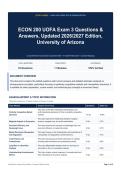
ECON 200 UOFA Exam 3 Questions &
Answers, Updated 2026/2027 Edition,
University of Arizona
Comprehensive Examination Question Bank • In-Depth Rationales • Concept Mapping
TOTAL QUESTIONS EXAM TOPICS RATIONALES
93 Questions 11 Modules 100% Verified
DOCUMENT OVERVIEW
This document contains 93 verified questions with correct answers and detailed rationales centered on
microeconomic principles, particularly focusing on perfectly competitive markets and monopolistic structures. It
is suitable for exam preparation, course review, and reinforcing key concepts in economic theory.
EXAM BLUEPRINT & TOPIC DISTRIBUTION
Systematic breakdown of subject domains and exam coverage.
Topic Module Scope & Core Focus Questions Share (%)
This topic covers the fundamental characteristics and
Perfectly Competitive Market profit-maximizing behaviors of firms in perfectly competitive
Dynamics markets. 10 Qs 10.8%
This topic explores the relationship between marginal
Marginal Analysis in Economics revenue, marginal cost, and profit maximization. 9 Qs 9.7%
Economic Efficiency and This topic examines the concepts of deadweight loss and
Deadweight Loss economic efficiency in market structures. 9 Qs 9.7%
Market Structures: Monopolies This topic focuses on the characteristics and implications of
and Oligopolies monopolistic and oligopolistic market behaviors. 9 Qs 9.7%
Trade Policies and This topic discusses government intervention in markets,
Protectionism including trade restrictions and protectionist policies. 8 Qs 8.6%
Long-Run vs. Short-Run This topic differentiates between short-run and long-run
Analysis outcomes for firms in competitive markets. 8 Qs 8.6%
Understanding Unemployment This topic reviews various measures of unemployment and
Metrics their implications for economic analysis. 8 Qs 8.6%
Confidential • Student Study Edition • Practice & Review Guide Page 1 of 43
,STUDENT STUDY & MASTERY EDITION PRACTICE & REVIEW GUIDE
This topic focuses on average total cost, marginal cost, and
Cost Structures in Economics their roles in firm decision-making. 8 Qs 8.6%
This topic explores the factors contributing to market power
Market Power and Price Setting and the ability to set prices above marginal cost. 8 Qs 8.6%
Diminishing Returns and This topic examines the law of diminishing returns and its
Production Inputs effect on production efficiency. 8 Qs 8.6%
This topic discusses the dynamics of firm entry and exit in
Entry and Exit in Markets competitive and monopolistic markets. 8 Qs 8.6%
Total Exam Coverage 11 Integrated Topic Modules 93 Qs 100.0%
Confidential • Student Study Edition • Practice & Review Guide Page 2 of 43
,STUDENT STUDY & MASTERY EDITION PRACTICE & REVIEW GUIDE
TOPIC 1: PERFECTLY COMPETITIVE MARKET DYNAMICS
10 Questions • 10.8% of Exam • This topic covers the fundamental characteristics and profit-maximizing behaviors of firms in perfectly
competitive markets.
QUESTION 1
In a perfectly competitive market, the firm's profit maximization occurs when the
marginal revenue (MR) equals the marginal cost (MC). What is the condition for a firm to
be in the long-run equilibrium?
[A] The firm's average revenue equals its average cost.
[B] The firm's marginal revenue equals its marginal cost.
[C] The firm produces at the minimum point of its average total cost curve.
[D] The firm's price equals its marginal cost.
Correct Answer: B. The firm's marginal revenue equals its marginal cost.
Rationale: In perfect competition, firms produce where MR = MC.
QUESTION 2
In a perfectly competitive market, the short-run equilibrium for a firm occurs at the
point where the marginal revenue (MR) and marginal cost (MC) curves intersect. What
happens to the firm's output in the long run if it is not earning economic profits?
[A] The firm increases its output to try to earn more profits.
[B] The firm decreases its output to reduce costs.
[C] The firm exits the market.
[D] The firm remains in the same output level.
Correct Answer: C. The firm exits the market.
Rationale: Firms will exit the market in the long run if they are not earning economic profits.
Confidential • Student Study Edition • Practice & Review Guide Page 3 of 43
, STUDENT STUDY & MASTERY EDITION PRACTICE & REVIEW GUIDE
QUESTION 3
In a perfectly competitive market, firms aim to maximize profits by setting the price
where marginal revenue (MR) equals marginal cost (MC). However, this price may not
be the same as the market equilibrium price.
[A] The market equilibrium price is always the lowest possible price.
[B] The market equilibrium price is determined by the intersection of the demand and supply curves.
[C] The market equilibrium price is not necessarily the same as the price that maximizes profits.
[D] Firms in a perfectly competitive market always set the price at the midpoint of the demand curve.
Correct Answer: C) The market equilibrium price is not necessarily the same as the price that maximizes
profits.
Rationale: Firms in a perfectly competitive market prioritize profit maximization, but the market equilibrium price may differ.
QUESTION 4
In a perfectly competitive market, which of the following scenarios indicates that firms
are operating in the long run?
[A] Each firm produces at the minimum efficient scale
[B] No firm has the ability to influence market price
[C] All firms have the same cost structure
[D] Firms are producing at the point where MR = MC
Correct Answer: B. No firm has the ability to influence market price.
Rationale: Long-run equilibrium is characterized by free entry and exit, and firms are price-takers.
Confidential • Student Study Edition • Practice & Review Guide Page 4 of 43
ECON 200 UOFA Exam 3 Questions &
Answers, Updated 2026/2027 Edition,
University of Arizona
Comprehensive Examination Question Bank • In-Depth Rationales • Concept Mapping
TOTAL QUESTIONS EXAM TOPICS RATIONALES
93 Questions 11 Modules 100% Verified
DOCUMENT OVERVIEW
This document contains 93 verified questions with correct answers and detailed rationales centered on
microeconomic principles, particularly focusing on perfectly competitive markets and monopolistic structures. It
is suitable for exam preparation, course review, and reinforcing key concepts in economic theory.
EXAM BLUEPRINT & TOPIC DISTRIBUTION
Systematic breakdown of subject domains and exam coverage.
Topic Module Scope & Core Focus Questions Share (%)
This topic covers the fundamental characteristics and
Perfectly Competitive Market profit-maximizing behaviors of firms in perfectly competitive
Dynamics markets. 10 Qs 10.8%
This topic explores the relationship between marginal
Marginal Analysis in Economics revenue, marginal cost, and profit maximization. 9 Qs 9.7%
Economic Efficiency and This topic examines the concepts of deadweight loss and
Deadweight Loss economic efficiency in market structures. 9 Qs 9.7%
Market Structures: Monopolies This topic focuses on the characteristics and implications of
and Oligopolies monopolistic and oligopolistic market behaviors. 9 Qs 9.7%
Trade Policies and This topic discusses government intervention in markets,
Protectionism including trade restrictions and protectionist policies. 8 Qs 8.6%
Long-Run vs. Short-Run This topic differentiates between short-run and long-run
Analysis outcomes for firms in competitive markets. 8 Qs 8.6%
Understanding Unemployment This topic reviews various measures of unemployment and
Metrics their implications for economic analysis. 8 Qs 8.6%
Confidential • Student Study Edition • Practice & Review Guide Page 1 of 43
,STUDENT STUDY & MASTERY EDITION PRACTICE & REVIEW GUIDE
This topic focuses on average total cost, marginal cost, and
Cost Structures in Economics their roles in firm decision-making. 8 Qs 8.6%
This topic explores the factors contributing to market power
Market Power and Price Setting and the ability to set prices above marginal cost. 8 Qs 8.6%
Diminishing Returns and This topic examines the law of diminishing returns and its
Production Inputs effect on production efficiency. 8 Qs 8.6%
This topic discusses the dynamics of firm entry and exit in
Entry and Exit in Markets competitive and monopolistic markets. 8 Qs 8.6%
Total Exam Coverage 11 Integrated Topic Modules 93 Qs 100.0%
Confidential • Student Study Edition • Practice & Review Guide Page 2 of 43
,STUDENT STUDY & MASTERY EDITION PRACTICE & REVIEW GUIDE
TOPIC 1: PERFECTLY COMPETITIVE MARKET DYNAMICS
10 Questions • 10.8% of Exam • This topic covers the fundamental characteristics and profit-maximizing behaviors of firms in perfectly
competitive markets.
QUESTION 1
In a perfectly competitive market, the firm's profit maximization occurs when the
marginal revenue (MR) equals the marginal cost (MC). What is the condition for a firm to
be in the long-run equilibrium?
[A] The firm's average revenue equals its average cost.
[B] The firm's marginal revenue equals its marginal cost.
[C] The firm produces at the minimum point of its average total cost curve.
[D] The firm's price equals its marginal cost.
Correct Answer: B. The firm's marginal revenue equals its marginal cost.
Rationale: In perfect competition, firms produce where MR = MC.
QUESTION 2
In a perfectly competitive market, the short-run equilibrium for a firm occurs at the
point where the marginal revenue (MR) and marginal cost (MC) curves intersect. What
happens to the firm's output in the long run if it is not earning economic profits?
[A] The firm increases its output to try to earn more profits.
[B] The firm decreases its output to reduce costs.
[C] The firm exits the market.
[D] The firm remains in the same output level.
Correct Answer: C. The firm exits the market.
Rationale: Firms will exit the market in the long run if they are not earning economic profits.
Confidential • Student Study Edition • Practice & Review Guide Page 3 of 43
, STUDENT STUDY & MASTERY EDITION PRACTICE & REVIEW GUIDE
QUESTION 3
In a perfectly competitive market, firms aim to maximize profits by setting the price
where marginal revenue (MR) equals marginal cost (MC). However, this price may not
be the same as the market equilibrium price.
[A] The market equilibrium price is always the lowest possible price.
[B] The market equilibrium price is determined by the intersection of the demand and supply curves.
[C] The market equilibrium price is not necessarily the same as the price that maximizes profits.
[D] Firms in a perfectly competitive market always set the price at the midpoint of the demand curve.
Correct Answer: C) The market equilibrium price is not necessarily the same as the price that maximizes
profits.
Rationale: Firms in a perfectly competitive market prioritize profit maximization, but the market equilibrium price may differ.
QUESTION 4
In a perfectly competitive market, which of the following scenarios indicates that firms
are operating in the long run?
[A] Each firm produces at the minimum efficient scale
[B] No firm has the ability to influence market price
[C] All firms have the same cost structure
[D] Firms are producing at the point where MR = MC
Correct Answer: B. No firm has the ability to influence market price.
Rationale: Long-run equilibrium is characterized by free entry and exit, and firms are price-takers.
Confidential • Student Study Edition • Practice & Review Guide Page 4 of 43