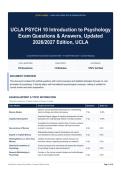
[STUDY GUIDE] • HIGH-YIELD PRACTICE & REVIEW EDITION
UCLA PSYCH 10 Introduction to Psychology
Exam Questions & Answers, Updated
2026/2027 Edition, UCLA
Comprehensive Examination Question Bank • In-Depth Rationales • Concept Mapping
TOTAL QUESTIONS EXAM TOPICS RATIONALES
65 Questions 14 Modules 100% Verified
DOCUMENT OVERVIEW
This document contains 65 verified questions with correct answers and detailed rationales focused on core
principles of psychology. It directly aligns with foundational psychological concepts, making it suitable for
course review and exam preparation.
EXAM BLUEPRINT & TOPIC DISTRIBUTION
Systematic breakdown of subject domains and exam coverage.
Topic Module Scope & Core Focus Questions Share (%)
Explores various theoretical frameworks for understanding
Memory Models memory storage and retrieval processes. 7 Qs 10.8%
Examines Piaget's stages of cognitive development and their
Cognitive Development implications for understanding children's mental processes. 7 Qs 10.8%
Investigates the biological underpinnings of memory systems,
including neurotransmitter functions and brain structures
Neuroscience of Memory involved in memory. 6 Qs 9.2%
Differentiates between explicit (declarative) and implicit
Explicit vs. Implicit Memory (non-declarative) memory systems and their characteristics. 6 Qs 9.2%
Working Memory vs. Short-Term Clarifies the distinctions between working memory and
Memory short-term memory regarding processing and retention. 4 Qs 6.2%
Historical Foundations of Covers key figures and movements that shaped the discipline
Psychology of psychology during its early development. 4 Qs 6.2%
Research Methodology in Focuses on the various research designs and methodologies
Psychology used in psychological studies. 4 Qs 6.2%
Confidential • Student Study Edition • Practice & Review Guide Page 1 of 35
,STUDENT STUDY & MASTERY EDITION PRACTICE & REVIEW GUIDE
Examines behaviorism as a psychological approach,
Behaviorism and Its Principles emphasizing observable behavior over internal mental states. 4 Qs 6.2%
The Role of Internal Mental Analyzes the significance of internal mental representations in
States cognitive processing. 4 Qs 6.2%
Discusses the mechanisms of neuronal communication,
including synaptic transmission and neurotransmitter
Neuronal Communication dynamics. 4 Qs 6.2%
Cognitive Limitations in Explores cognitive limitations observed in children during
Development different developmental stages. 4 Qs 6.2%
Investigates the physiological mechanisms that support
Physiological Aspects of memory function, including brain structures and
Memory neurotransmitters. 4 Qs 6.2%
Examines the capacity limits and duration of memory storage
Memory Capacity and Duration according to established psychological models. 4 Qs 6.2%
Information Processing Explores the classic information-processing model of
Framework cognition and its implications for understanding memory. 3 Qs 4.6%
Total Exam Coverage 14 Integrated Topic Modules 65 Qs 100.0%
Confidential • Student Study Edition • Practice & Review Guide Page 2 of 35
,STUDENT STUDY & MASTERY EDITION PRACTICE & REVIEW GUIDE
TOPIC 1: MEMORY MODELS
7 Questions • 10.8% of Exam • Explores various theoretical frameworks for understanding memory storage and retrieval processes.
QUESTION 1
Within the Atkinson-Shiffrin memory framework, short-term memory serves as a
limited-capacity store that retains unrehearsed information for a brief period. Which of
the following options correctly specifies both the typical number of chunks it can hold
and the approximate time span before decay occurs without rehearsal?
[A] Approximately 2-4 chunks for 5-10 seconds
[B] Around 5-9 chunks retained for 20-30 seconds
[C] Up to 12 chunks maintained for 1-2 minutes
[D] Unlimited chunks stored indefinitely
Correct Answer: Around 5-9 chunks retained for 20-30 seconds.
Rationale: Classic STM holds roughly five to nine information chunks and retains them only for about twenty to thirty
seconds without rehearsal.
QUESTION 2
According to classic cognitive models, what are the typical capacity limits and
temporal duration of short-term memory, often described as holding a specific number
of chunks of information for a brief period without rehearsal, in everyday tasks such as
remembering a phone number?
[A] About 2-3 chunks for 5-10 seconds.
[B] About 5-9 chunks for 20-30 seconds.
[C] Unlimited chunks for up to 2 minutes.
[D] About 12-15 chunks for 1-2 seconds.
Correct Answer: About 5-9 chunks for 20-30 seconds.
Rationale: Short-term memory holds roughly 5-9 chunks for 20-30 seconds without rehearsal.
Confidential • Student Study Edition • Practice & Review Guide Page 3 of 35
, STUDENT STUDY & MASTERY EDITION PRACTICE & REVIEW GUIDE
QUESTION 3
In the classic information-processing framework, short-term memory is described as a
limited-capacity store that can retain unrehearsed material for approximately twenty to
thirty seconds, typically holding how many discrete chunks of information
simultaneously? Understanding this capacity is essential for interpreting digit-span
tasks and for differentiating short-term from working memory processes in cognitive
experiments.
[A] 2-3 chunks
[B] 4-5 chunks
[C] 5-9 chunks
[D] 10-12 chunks
Correct Answer: 5-9 Chunks.
Rationale: Research shows short-term memory typically holds five to nine chunks, reflecting its limited storage before
rehearsal is needed.
QUESTION 4
The Atkinson-Shiffrin model of memory proposes three distinct stores: sensory
memory, short-term memory, and long-term memory. Which of the following best
describes the primary function of the sensory memory component within this model?
Consider its role in initial encoding of environmental stimuli and the duration of its
retention before information is transferred to subsequent stores.
[A] To hold information indefinitely for retrieval
[B] To maintain a brief, high-capacity trace of sensory input
[C] To manipulate information for complex tasks
[D] To encode procedural skills
Correct Answer: To maintain a brief, high-capacity trace of sensory input.
Rationale: Sensory memory briefly retains a large amount of raw sensory data, typically less than a second, before decay
or transfer.
Confidential • Student Study Edition • Practice & Review Guide Page 4 of 35
UCLA PSYCH 10 Introduction to Psychology
Exam Questions & Answers, Updated
2026/2027 Edition, UCLA
Comprehensive Examination Question Bank • In-Depth Rationales • Concept Mapping
TOTAL QUESTIONS EXAM TOPICS RATIONALES
65 Questions 14 Modules 100% Verified
DOCUMENT OVERVIEW
This document contains 65 verified questions with correct answers and detailed rationales focused on core
principles of psychology. It directly aligns with foundational psychological concepts, making it suitable for
course review and exam preparation.
EXAM BLUEPRINT & TOPIC DISTRIBUTION
Systematic breakdown of subject domains and exam coverage.
Topic Module Scope & Core Focus Questions Share (%)
Explores various theoretical frameworks for understanding
Memory Models memory storage and retrieval processes. 7 Qs 10.8%
Examines Piaget's stages of cognitive development and their
Cognitive Development implications for understanding children's mental processes. 7 Qs 10.8%
Investigates the biological underpinnings of memory systems,
including neurotransmitter functions and brain structures
Neuroscience of Memory involved in memory. 6 Qs 9.2%
Differentiates between explicit (declarative) and implicit
Explicit vs. Implicit Memory (non-declarative) memory systems and their characteristics. 6 Qs 9.2%
Working Memory vs. Short-Term Clarifies the distinctions between working memory and
Memory short-term memory regarding processing and retention. 4 Qs 6.2%
Historical Foundations of Covers key figures and movements that shaped the discipline
Psychology of psychology during its early development. 4 Qs 6.2%
Research Methodology in Focuses on the various research designs and methodologies
Psychology used in psychological studies. 4 Qs 6.2%
Confidential • Student Study Edition • Practice & Review Guide Page 1 of 35
,STUDENT STUDY & MASTERY EDITION PRACTICE & REVIEW GUIDE
Examines behaviorism as a psychological approach,
Behaviorism and Its Principles emphasizing observable behavior over internal mental states. 4 Qs 6.2%
The Role of Internal Mental Analyzes the significance of internal mental representations in
States cognitive processing. 4 Qs 6.2%
Discusses the mechanisms of neuronal communication,
including synaptic transmission and neurotransmitter
Neuronal Communication dynamics. 4 Qs 6.2%
Cognitive Limitations in Explores cognitive limitations observed in children during
Development different developmental stages. 4 Qs 6.2%
Investigates the physiological mechanisms that support
Physiological Aspects of memory function, including brain structures and
Memory neurotransmitters. 4 Qs 6.2%
Examines the capacity limits and duration of memory storage
Memory Capacity and Duration according to established psychological models. 4 Qs 6.2%
Information Processing Explores the classic information-processing model of
Framework cognition and its implications for understanding memory. 3 Qs 4.6%
Total Exam Coverage 14 Integrated Topic Modules 65 Qs 100.0%
Confidential • Student Study Edition • Practice & Review Guide Page 2 of 35
,STUDENT STUDY & MASTERY EDITION PRACTICE & REVIEW GUIDE
TOPIC 1: MEMORY MODELS
7 Questions • 10.8% of Exam • Explores various theoretical frameworks for understanding memory storage and retrieval processes.
QUESTION 1
Within the Atkinson-Shiffrin memory framework, short-term memory serves as a
limited-capacity store that retains unrehearsed information for a brief period. Which of
the following options correctly specifies both the typical number of chunks it can hold
and the approximate time span before decay occurs without rehearsal?
[A] Approximately 2-4 chunks for 5-10 seconds
[B] Around 5-9 chunks retained for 20-30 seconds
[C] Up to 12 chunks maintained for 1-2 minutes
[D] Unlimited chunks stored indefinitely
Correct Answer: Around 5-9 chunks retained for 20-30 seconds.
Rationale: Classic STM holds roughly five to nine information chunks and retains them only for about twenty to thirty
seconds without rehearsal.
QUESTION 2
According to classic cognitive models, what are the typical capacity limits and
temporal duration of short-term memory, often described as holding a specific number
of chunks of information for a brief period without rehearsal, in everyday tasks such as
remembering a phone number?
[A] About 2-3 chunks for 5-10 seconds.
[B] About 5-9 chunks for 20-30 seconds.
[C] Unlimited chunks for up to 2 minutes.
[D] About 12-15 chunks for 1-2 seconds.
Correct Answer: About 5-9 chunks for 20-30 seconds.
Rationale: Short-term memory holds roughly 5-9 chunks for 20-30 seconds without rehearsal.
Confidential • Student Study Edition • Practice & Review Guide Page 3 of 35
, STUDENT STUDY & MASTERY EDITION PRACTICE & REVIEW GUIDE
QUESTION 3
In the classic information-processing framework, short-term memory is described as a
limited-capacity store that can retain unrehearsed material for approximately twenty to
thirty seconds, typically holding how many discrete chunks of information
simultaneously? Understanding this capacity is essential for interpreting digit-span
tasks and for differentiating short-term from working memory processes in cognitive
experiments.
[A] 2-3 chunks
[B] 4-5 chunks
[C] 5-9 chunks
[D] 10-12 chunks
Correct Answer: 5-9 Chunks.
Rationale: Research shows short-term memory typically holds five to nine chunks, reflecting its limited storage before
rehearsal is needed.
QUESTION 4
The Atkinson-Shiffrin model of memory proposes three distinct stores: sensory
memory, short-term memory, and long-term memory. Which of the following best
describes the primary function of the sensory memory component within this model?
Consider its role in initial encoding of environmental stimuli and the duration of its
retention before information is transferred to subsequent stores.
[A] To hold information indefinitely for retrieval
[B] To maintain a brief, high-capacity trace of sensory input
[C] To manipulate information for complex tasks
[D] To encode procedural skills
Correct Answer: To maintain a brief, high-capacity trace of sensory input.
Rationale: Sensory memory briefly retains a large amount of raw sensory data, typically less than a second, before decay
or transfer.
Confidential • Student Study Edition • Practice & Review Guide Page 4 of 35