[STUDY GUIDE] • HIGH-YIELD PRACTICE & REVIEW EDITION
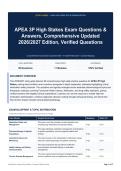
APEA 3P High Stakes Exam Questions &
Answers, Comprehensive Updated
2026/2027 Edition, Verified Questions
Comprehensive Examination Question Bank • In-Depth Rationales • Concept Mapping
TOTAL QUESTIONS EXAM TOPICS RATIONALES
99 Questions 11 Modules 100% Verified
DOCUMENT OVERVIEW
This 2026/2027 study guide delivers 99 comprehensive high-yield practice questions for APEA 3P High
Stakes, pairing latest verified correct solutions alongside in-depth explanatory rationales highlighting critical
medication safety protocols. The questions are logically arranged across essential pharmacological topics and
therapeutic subtopics covering Functional Health Literacy, Medication, and drug safety standards, pairing
verified answers with targeted clinical explanations. Learners can use this resource to master high-risk
medication administration, reinforce diagnostic decision-making through self-paced testing, and direct their
final revision toward complex clinical pharmacotherapy.
EXAM BLUEPRINT & TOPIC DISTRIBUTION
Systematic breakdown of subject domains and exam coverage.
Topic Module Scope & Core Focus Questions Share (%)
Medication Safety and This topic covers the principles of safe medication use,
Management including drug interactions and adverse effects. 9 Qs 9.1%
This topic addresses medication management considerations
Pharmacotherapy in Special in specific populations, such as pregnant patients and
Populations children. 9 Qs 9.1%
Laboratory Values and This topic focuses on the interpretation of laboratory values
Monitoring relevant to pharmacotherapy and patient monitoring. 9 Qs 9.1%
This topic emphasizes the importance of effective
Health Literacy and Patient communication and health literacy in medication
Communication management. 9 Qs 9.1%
This topic explores pharmacological strategies for managing
Chronic Disease Management chronic conditions such as hypertension and diabetes. 9 Qs 9.1%
Confidential • Student Study Edition • Practice & Review Guide Page 1 of 37
,STUDENT STUDY & MASTERY EDITION PRACTICE & REVIEW GUIDE
Ethics and Professionalism in This topic examines ethical principles and professional
Pharmacy responsibilities in pharmacy practice. 9 Qs 9.1%
This topic focuses on strategies to optimize antimicrobial use
Antimicrobial Stewardship and reduce resistance. 9 Qs 9.1%
Emergency and Critical Care This topic covers pharmacological interventions in emergency
Pharmacology situations and critical care settings. 9 Qs 9.1%
Pharmacokinetics and This topic addresses the principles of drug absorption,
Pharmacodynamics distribution, metabolism, and excretion. 9 Qs 9.1%
Clinical Decision Support and This topic explores the use of technology and clinical decision
Technology support tools in pharmacy practice. 9 Qs 9.1%
Public Health and Community This topic discusses the role of pharmacists in public health
Pharmacy initiatives and community health. 9 Qs 9.1%
Total Exam Coverage 11 Integrated Topic Modules 99 Qs 100.0%
Confidential • Student Study Edition • Practice & Review Guide Page 2 of 37
,STUDENT STUDY & MASTERY EDITION PRACTICE & REVIEW GUIDE
TOPIC 1: MEDICATION SAFETY AND MANAGEMENT
9 Questions • 9.1% of Exam • This topic covers the principles of safe medication use, including drug interactions and adverse effects.
QUESTION 1
A patient on digoxin reports antacid use; what effect occurs?
[A] Increased digoxin absorption
[B] Decreased digoxin levels
[C] No change in digoxin
[D] Elevated serum potassium
Correct Answer: Decreased digoxin levels.
Rationale: Antacids bind digoxin, reducing its bioavailability.
QUESTION 2
A dry hacking cough is a side effect of which medication class?
[A] ARBs
[B] ACE inhibitors
[C] Beta-blockers
[D] Calcium channel blockers
Correct Answer: ACE inhibitors.
Rationale: ACE inhibition increases bradykinin, causing transient cough.
QUESTION 3
Which drug interaction is clinically significant with warfarin?
[A] Acetaminophen
[B] Metformin
[C] Azole antifungals
[D] Lisinopril
Correct Answer: Azole antifungals.
Rationale: Azoles inhibit metabolism, markedly increasing warfarin anticoagulation.
Confidential • Student Study Edition • Practice & Review Guide Page 3 of 37
, STUDENT STUDY & MASTERY EDITION PRACTICE & REVIEW GUIDE
QUESTION 4
A pharmacist reviews a lab showing INR 3.5 on warfarin; the next step is:
[A] Increase warfarin dose
[B] Hold warfarin and repeat INR
[C] Add aspirin
[D] Switch to direct oral anticoagulant
Correct Answer: Hold warfarin and repeat INR.
Rationale: High INR warrants temporary cessation and rechecking to avoid bleeding.
QUESTION 5
Which of the following is a recommended practice for reducing antimicrobial resistance
in outpatient settings?
[A] Prescribe antibiotics for viral infections
[B] Use narrow-spectrum agents when appropriate
[C] Increase duration to 14 days
[D] Avoid culture testing
Correct Answer: Use narrow-spectrum agents when appropriate.
Rationale: Targeted therapy limits selection pressure and resistance development.
QUESTION 6
A pharmacist receives a request for a controlled substance without a valid prescription;
the correct action is:
[A] Dispense to maintain patient satisfaction
[B] Contact prescriber for verification
[C] Ignore the request
[D] Sell the medication on the black market
Correct Answer: Contact prescriber for verification.
Rationale: Verification ensures legal compliance and patient safety.
Confidential • Student Study Edition • Practice & Review Guide Page 4 of 37
APEA 3P High Stakes Exam Questions &
Answers, Comprehensive Updated
2026/2027 Edition, Verified Questions
Comprehensive Examination Question Bank • In-Depth Rationales • Concept Mapping
TOTAL QUESTIONS EXAM TOPICS RATIONALES
99 Questions 11 Modules 100% Verified
DOCUMENT OVERVIEW
This 2026/2027 study guide delivers 99 comprehensive high-yield practice questions for APEA 3P High
Stakes, pairing latest verified correct solutions alongside in-depth explanatory rationales highlighting critical
medication safety protocols. The questions are logically arranged across essential pharmacological topics and
therapeutic subtopics covering Functional Health Literacy, Medication, and drug safety standards, pairing
verified answers with targeted clinical explanations. Learners can use this resource to master high-risk
medication administration, reinforce diagnostic decision-making through self-paced testing, and direct their
final revision toward complex clinical pharmacotherapy.
EXAM BLUEPRINT & TOPIC DISTRIBUTION
Systematic breakdown of subject domains and exam coverage.
Topic Module Scope & Core Focus Questions Share (%)
Medication Safety and This topic covers the principles of safe medication use,
Management including drug interactions and adverse effects. 9 Qs 9.1%
This topic addresses medication management considerations
Pharmacotherapy in Special in specific populations, such as pregnant patients and
Populations children. 9 Qs 9.1%
Laboratory Values and This topic focuses on the interpretation of laboratory values
Monitoring relevant to pharmacotherapy and patient monitoring. 9 Qs 9.1%
This topic emphasizes the importance of effective
Health Literacy and Patient communication and health literacy in medication
Communication management. 9 Qs 9.1%
This topic explores pharmacological strategies for managing
Chronic Disease Management chronic conditions such as hypertension and diabetes. 9 Qs 9.1%
Confidential • Student Study Edition • Practice & Review Guide Page 1 of 37
,STUDENT STUDY & MASTERY EDITION PRACTICE & REVIEW GUIDE
Ethics and Professionalism in This topic examines ethical principles and professional
Pharmacy responsibilities in pharmacy practice. 9 Qs 9.1%
This topic focuses on strategies to optimize antimicrobial use
Antimicrobial Stewardship and reduce resistance. 9 Qs 9.1%
Emergency and Critical Care This topic covers pharmacological interventions in emergency
Pharmacology situations and critical care settings. 9 Qs 9.1%
Pharmacokinetics and This topic addresses the principles of drug absorption,
Pharmacodynamics distribution, metabolism, and excretion. 9 Qs 9.1%
Clinical Decision Support and This topic explores the use of technology and clinical decision
Technology support tools in pharmacy practice. 9 Qs 9.1%
Public Health and Community This topic discusses the role of pharmacists in public health
Pharmacy initiatives and community health. 9 Qs 9.1%
Total Exam Coverage 11 Integrated Topic Modules 99 Qs 100.0%
Confidential • Student Study Edition • Practice & Review Guide Page 2 of 37
,STUDENT STUDY & MASTERY EDITION PRACTICE & REVIEW GUIDE
TOPIC 1: MEDICATION SAFETY AND MANAGEMENT
9 Questions • 9.1% of Exam • This topic covers the principles of safe medication use, including drug interactions and adverse effects.
QUESTION 1
A patient on digoxin reports antacid use; what effect occurs?
[A] Increased digoxin absorption
[B] Decreased digoxin levels
[C] No change in digoxin
[D] Elevated serum potassium
Correct Answer: Decreased digoxin levels.
Rationale: Antacids bind digoxin, reducing its bioavailability.
QUESTION 2
A dry hacking cough is a side effect of which medication class?
[A] ARBs
[B] ACE inhibitors
[C] Beta-blockers
[D] Calcium channel blockers
Correct Answer: ACE inhibitors.
Rationale: ACE inhibition increases bradykinin, causing transient cough.
QUESTION 3
Which drug interaction is clinically significant with warfarin?
[A] Acetaminophen
[B] Metformin
[C] Azole antifungals
[D] Lisinopril
Correct Answer: Azole antifungals.
Rationale: Azoles inhibit metabolism, markedly increasing warfarin anticoagulation.
Confidential • Student Study Edition • Practice & Review Guide Page 3 of 37
, STUDENT STUDY & MASTERY EDITION PRACTICE & REVIEW GUIDE
QUESTION 4
A pharmacist reviews a lab showing INR 3.5 on warfarin; the next step is:
[A] Increase warfarin dose
[B] Hold warfarin and repeat INR
[C] Add aspirin
[D] Switch to direct oral anticoagulant
Correct Answer: Hold warfarin and repeat INR.
Rationale: High INR warrants temporary cessation and rechecking to avoid bleeding.
QUESTION 5
Which of the following is a recommended practice for reducing antimicrobial resistance
in outpatient settings?
[A] Prescribe antibiotics for viral infections
[B] Use narrow-spectrum agents when appropriate
[C] Increase duration to 14 days
[D] Avoid culture testing
Correct Answer: Use narrow-spectrum agents when appropriate.
Rationale: Targeted therapy limits selection pressure and resistance development.
QUESTION 6
A pharmacist receives a request for a controlled substance without a valid prescription;
the correct action is:
[A] Dispense to maintain patient satisfaction
[B] Contact prescriber for verification
[C] Ignore the request
[D] Sell the medication on the black market
Correct Answer: Contact prescriber for verification.
Rationale: Verification ensures legal compliance and patient safety.
Confidential • Student Study Edition • Practice & Review Guide Page 4 of 37