
Verified Answers 100% Correct · Grade A
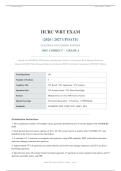
IICRC WRT EXAM
( UPDATE)
QUESTIONS AND VERIFIED ANSWERS
100% CORRECT · GRADE A
Aligned with ANSI/IICRC S500 Standard and Reference Guide for Professional Water Damage Restoration
Aligned with IICRC Water Damage Restoration Technician (WRT) Certification Competencies (2026/2027 Edition)
Total Questions 150
Number of Sections 8
Cognitive Mix 25% Recall · 50% Application · 25% Analysis
Question Style 75% Scenario-based · 25% Direct Knowledge
Format Multiple Choice (A–D), ONE Correct Answer
Special Coverage 20 Scenario Restoration · 15 Cat/Class · 10 PPE/Health
Standards ANSI/IICRC S500 · IICRC S520 · OSHA · EPA
Examination Instructions
1. This examination contains 150 multiple-choice questions distributed across 8 sections aligned with ANSI/IICRC
S500.
2. Each question has four answer options (A, B, C, D). The correct answer is marked with *[CORRECT]* and
identified in the 'Correct Answer' line that follows.
3. A rationale of 2–4 sentences accompanies each question, citing S500 standards, WRT certification references,
and water damage restoration best practices.
4. Approximately 75% of questions are scenario-based (real-world water damage situations), and 25% are direct
knowledge questions.
5. Special focus areas: 20 scenario-based restoration questions, 15 questions on water categories and classes, and 10
questions on health, safety, and PPE.
IICRC WRT Exam (2026/2027 Update) · Page 1
,Verified Answers 100% Correct · Grade A
Prepared in accordance with IICRC Water Damage Restoration Technician (WRT) Certification Standards (2026/2027 Edition).
IICRC WRT Exam (2026/2027 Update) · Page 2
,Verified Answers 100% Correct · Grade A
Section 1: Water Damage Restoration Fundamentals
IICRC S500 overview, principles, water categories (1–3), water classes (1–4), restoration process, roles, ethics, and liability.
Q1: According to ANSI/IICRC S500, which of the following best defines the primary goal of
professional water damage restoration?
A. To replace all affected building materials with new materials as quickly as possible
B. To return the structure and contents to a clean, dry, and pre-loss condition safely and efficiently
*[CORRECT]*
C. To apply chemical antimicrobials to all wet surfaces regardless of contamination category
D. To maximize equipment usage on every job to ensure the highest invoice total
Correct Answer: B
Rationale: ANSI/IICRC S500 establishes that the restorer's primary goal is to return the structure and contents to a clean,
dry, and pre-loss condition while protecting health and safety. Replacement (A) is unnecessary when materials can be
salvaged; blanket antimicrobial use (C) violates product-label and S500 principles; invoice maximization (D) is unethical and
contrary to professional standards.
Q2: A restorer arrives at a residential loss where a supply line to the kitchen sink has been leaking for
approximately 6 hours. The water is clear, originated from a potable source, and has saturated the
cabinetry and drywall behind the sink. Under IICRC S500, what is the correct Category classification
of this water?
A. Category 1 — clean water from a sanitary source *[CORRECT]*
B. Category 2 — gray water with significant contamination
C. Category 3 — black water containing pathogenic agents
D. Category 4 — specialty water requiring desiccant drying
Correct Answer: A
Rationale: Category 1 water originates from a sanitary source such as a potable supply line. Although it can degrade over
time and through contact with surfaces, a fresh 6-hour leak from a clean supply line remains Category 1. Category 2 (B)
applies to water with some degree of contamination; Category 3 (C) involves sewage or grossly unsanitary sources. There is
no 'Category 4' classification in S500 — Class 4 (D) refers to deep absorption, not water category.
Q3: Which of the following statements about the four IICRC moisture Classes is correct?
A. Class 1 is the greatest amount of water, absorption, and evaporation load
B. Class 2 involves slow evaporation and affects only non-porous surfaces
C. Class 3 involves the greatest amount of water with fast evaporation, often affecting ceilings, walls,
insulation, and subfloor *[CORRECT]*
D. Class 4 applies only to surface water on hard, non-porous flooring such as tile
Correct Answer: C
Rationale: Under S500, Class 3 describes the greatest amount of water, absorption, and evaporation load, typically with
water affecting ceilings, walls, insulation, and flooring. Class 1 (A) is the least amount of water/absorption. Class 2 (B)
involves significant absorption into materials but is not limited to non-porous surfaces. Class 4 (D) refers to specialty drying
situations with deep-bound moisture in low-permeance materials such as hardwood or plaster — not surface water.
Q4: A homeowner reports a toilet overflow from a clogged sewer line. The water has visible fecal
matter and has saturated the carpet and pad in the bathroom and adjacent hallway. What is the
appropriate Category and required material disposition per S500?
A. Category 2; dry in place with refrigerant dehumidifiers and apply antimicrobial
IICRC WRT Exam (2026/2027 Update) · Page 3
, Verified Answers 100% Correct · Grade A
B. Category 3; remove and dispose of all porous materials that cannot be effectively cleaned, including
carpet and pad *[CORRECT]*
C. Category 1 because the source is a plumbing fixture; extract and dry normally
D. Category 3; dry carpet and pad in place with desiccant dehumidification only
Correct Answer: B
Rationale: A toilet backup containing fecal matter is Category 3 (black water) and S500 requires the removal and disposal
of highly porous, salvageable-unfriendly materials such as carpet and pad, cushion, and saturated drywall. Drying in place
(A, D) is prohibited for Category 3 porous materials because pathogens cannot be reliably removed. Category 1 (C) is
incorrect because sewage contamination automatically elevates the classification.
Q5: Which of the following water sources is correctly classified as Category 2 (gray water)?
A. Rainwater entering through a broken roof vent during a hurricane
B. Discharge from a washing machine or dishwasher with mild contamination
C. Toilet backflow containing urine but no feces or solids
D. Both B and C may be considered Category 2, depending on contamination level *[CORRECT]*
Correct Answer: D
Rationale: Category 2 water has a significant level of contamination but not the pathogenic load of Category 3. Washing
machine discharge (B) and toilet overflows containing urine without feces (C) are both examples of Category 2. Hurricane
rainwater (A) can be Category 2 or 3 depending on what it contacted; it is not automatically Category 2. S500 explicitly
allows restorers to downgrade or upgrade categories based on time, temperature, and contact materials.
Q6: A restorer responds to a Category 1 clean water loss in a finished basement. The homeowner
reports the leak started 72 hours ago. What is the most appropriate Category reclassification?
A. Remains Category 1 regardless of time elapsed
B. Reclassify as Category 2 or 3 because clean water that remains stagnant for more than 48–72 hours
can support microbial growth and contamination *[CORRECT]*
C. Reclassify only if visible mold is present; otherwise maintain Category 1
D. Reclassify as Class 4 because the time element automatically triggers specialty drying
Correct Answer: B
Rationale: S500 requires restorers to consider time and temperature when classifying water. Clean water that has remained
in a structure beyond roughly 48–72 hours can support microbial growth and must be reclassified as Category 2 or 3 based
on inspection and contamination assessment. The reclassification is independent of visible mold (C) and not related to drying
Class (D), which describes the extent of absorption.
Q7: Which of the following best describes the relationship between the IICRC S500 and S520
standards?
A. S500 covers water damage restoration; S520 covers mold remediation and is referenced when
microbial growth is encountered during a water loss *[CORRECT]*
B. S500 covers mold remediation; S520 covers water damage restoration
C. S500 and S520 are identical and interchangeable documents
D. S500 is a legal regulation; S520 is a voluntary industry guideline
Correct Answer: A
Rationale: S500 is the Standard and Reference Guide for Professional Water Damage Restoration, while S520 is the
Standard for Professional Mold Remediation. When water losses lead to suspected mold growth, S520 principles
(containment, removal, clearance) are applied alongside S500. Neither is a federal law, but both are ANSI/IICRC consensus
standards that may be adopted by reference in contracts, regulations, or insurance policies.
IICRC WRT Exam (2026/2027 Update) · Page 4
IICRC WRT EXAM
( UPDATE)
QUESTIONS AND VERIFIED ANSWERS
100% CORRECT · GRADE A
Aligned with ANSI/IICRC S500 Standard and Reference Guide for Professional Water Damage Restoration
Aligned with IICRC Water Damage Restoration Technician (WRT) Certification Competencies (2026/2027 Edition)
Total Questions 150
Number of Sections 8
Cognitive Mix 25% Recall · 50% Application · 25% Analysis
Question Style 75% Scenario-based · 25% Direct Knowledge
Format Multiple Choice (A–D), ONE Correct Answer
Special Coverage 20 Scenario Restoration · 15 Cat/Class · 10 PPE/Health
Standards ANSI/IICRC S500 · IICRC S520 · OSHA · EPA
Examination Instructions
1. This examination contains 150 multiple-choice questions distributed across 8 sections aligned with ANSI/IICRC
S500.
2. Each question has four answer options (A, B, C, D). The correct answer is marked with *[CORRECT]* and
identified in the 'Correct Answer' line that follows.
3. A rationale of 2–4 sentences accompanies each question, citing S500 standards, WRT certification references,
and water damage restoration best practices.
4. Approximately 75% of questions are scenario-based (real-world water damage situations), and 25% are direct
knowledge questions.
5. Special focus areas: 20 scenario-based restoration questions, 15 questions on water categories and classes, and 10
questions on health, safety, and PPE.
IICRC WRT Exam (2026/2027 Update) · Page 1
,Verified Answers 100% Correct · Grade A
Prepared in accordance with IICRC Water Damage Restoration Technician (WRT) Certification Standards (2026/2027 Edition).
IICRC WRT Exam (2026/2027 Update) · Page 2
,Verified Answers 100% Correct · Grade A
Section 1: Water Damage Restoration Fundamentals
IICRC S500 overview, principles, water categories (1–3), water classes (1–4), restoration process, roles, ethics, and liability.
Q1: According to ANSI/IICRC S500, which of the following best defines the primary goal of
professional water damage restoration?
A. To replace all affected building materials with new materials as quickly as possible
B. To return the structure and contents to a clean, dry, and pre-loss condition safely and efficiently
*[CORRECT]*
C. To apply chemical antimicrobials to all wet surfaces regardless of contamination category
D. To maximize equipment usage on every job to ensure the highest invoice total
Correct Answer: B
Rationale: ANSI/IICRC S500 establishes that the restorer's primary goal is to return the structure and contents to a clean,
dry, and pre-loss condition while protecting health and safety. Replacement (A) is unnecessary when materials can be
salvaged; blanket antimicrobial use (C) violates product-label and S500 principles; invoice maximization (D) is unethical and
contrary to professional standards.
Q2: A restorer arrives at a residential loss where a supply line to the kitchen sink has been leaking for
approximately 6 hours. The water is clear, originated from a potable source, and has saturated the
cabinetry and drywall behind the sink. Under IICRC S500, what is the correct Category classification
of this water?
A. Category 1 — clean water from a sanitary source *[CORRECT]*
B. Category 2 — gray water with significant contamination
C. Category 3 — black water containing pathogenic agents
D. Category 4 — specialty water requiring desiccant drying
Correct Answer: A
Rationale: Category 1 water originates from a sanitary source such as a potable supply line. Although it can degrade over
time and through contact with surfaces, a fresh 6-hour leak from a clean supply line remains Category 1. Category 2 (B)
applies to water with some degree of contamination; Category 3 (C) involves sewage or grossly unsanitary sources. There is
no 'Category 4' classification in S500 — Class 4 (D) refers to deep absorption, not water category.
Q3: Which of the following statements about the four IICRC moisture Classes is correct?
A. Class 1 is the greatest amount of water, absorption, and evaporation load
B. Class 2 involves slow evaporation and affects only non-porous surfaces
C. Class 3 involves the greatest amount of water with fast evaporation, often affecting ceilings, walls,
insulation, and subfloor *[CORRECT]*
D. Class 4 applies only to surface water on hard, non-porous flooring such as tile
Correct Answer: C
Rationale: Under S500, Class 3 describes the greatest amount of water, absorption, and evaporation load, typically with
water affecting ceilings, walls, insulation, and flooring. Class 1 (A) is the least amount of water/absorption. Class 2 (B)
involves significant absorption into materials but is not limited to non-porous surfaces. Class 4 (D) refers to specialty drying
situations with deep-bound moisture in low-permeance materials such as hardwood or plaster — not surface water.
Q4: A homeowner reports a toilet overflow from a clogged sewer line. The water has visible fecal
matter and has saturated the carpet and pad in the bathroom and adjacent hallway. What is the
appropriate Category and required material disposition per S500?
A. Category 2; dry in place with refrigerant dehumidifiers and apply antimicrobial
IICRC WRT Exam (2026/2027 Update) · Page 3
, Verified Answers 100% Correct · Grade A
B. Category 3; remove and dispose of all porous materials that cannot be effectively cleaned, including
carpet and pad *[CORRECT]*
C. Category 1 because the source is a plumbing fixture; extract and dry normally
D. Category 3; dry carpet and pad in place with desiccant dehumidification only
Correct Answer: B
Rationale: A toilet backup containing fecal matter is Category 3 (black water) and S500 requires the removal and disposal
of highly porous, salvageable-unfriendly materials such as carpet and pad, cushion, and saturated drywall. Drying in place
(A, D) is prohibited for Category 3 porous materials because pathogens cannot be reliably removed. Category 1 (C) is
incorrect because sewage contamination automatically elevates the classification.
Q5: Which of the following water sources is correctly classified as Category 2 (gray water)?
A. Rainwater entering through a broken roof vent during a hurricane
B. Discharge from a washing machine or dishwasher with mild contamination
C. Toilet backflow containing urine but no feces or solids
D. Both B and C may be considered Category 2, depending on contamination level *[CORRECT]*
Correct Answer: D
Rationale: Category 2 water has a significant level of contamination but not the pathogenic load of Category 3. Washing
machine discharge (B) and toilet overflows containing urine without feces (C) are both examples of Category 2. Hurricane
rainwater (A) can be Category 2 or 3 depending on what it contacted; it is not automatically Category 2. S500 explicitly
allows restorers to downgrade or upgrade categories based on time, temperature, and contact materials.
Q6: A restorer responds to a Category 1 clean water loss in a finished basement. The homeowner
reports the leak started 72 hours ago. What is the most appropriate Category reclassification?
A. Remains Category 1 regardless of time elapsed
B. Reclassify as Category 2 or 3 because clean water that remains stagnant for more than 48–72 hours
can support microbial growth and contamination *[CORRECT]*
C. Reclassify only if visible mold is present; otherwise maintain Category 1
D. Reclassify as Class 4 because the time element automatically triggers specialty drying
Correct Answer: B
Rationale: S500 requires restorers to consider time and temperature when classifying water. Clean water that has remained
in a structure beyond roughly 48–72 hours can support microbial growth and must be reclassified as Category 2 or 3 based
on inspection and contamination assessment. The reclassification is independent of visible mold (C) and not related to drying
Class (D), which describes the extent of absorption.
Q7: Which of the following best describes the relationship between the IICRC S500 and S520
standards?
A. S500 covers water damage restoration; S520 covers mold remediation and is referenced when
microbial growth is encountered during a water loss *[CORRECT]*
B. S500 covers mold remediation; S520 covers water damage restoration
C. S500 and S520 are identical and interchangeable documents
D. S500 is a legal regulation; S520 is a voluntary industry guideline
Correct Answer: A
Rationale: S500 is the Standard and Reference Guide for Professional Water Damage Restoration, while S520 is the
Standard for Professional Mold Remediation. When water losses lead to suspected mold growth, S520 principles
(containment, removal, clearance) are applied alongside S500. Neither is a federal law, but both are ANSI/IICRC consensus
standards that may be adopted by reference in contracts, regulations, or insurance policies.
IICRC WRT Exam (2026/2027 Update) · Page 4


