

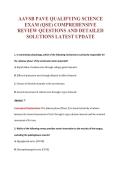
AAVSB PAVE QUALIFYING SCIENCE
EXAM (QSE) COMPREHENSIVE
REVIEW QUESTIONS AND DETAILED
SOLUTIONS LATEST UPDATE
1. In mammalian physiology, which of the following mechanisms is primarily responsible for
the ‘plateau phase’ of the ventricular action potential?
A. Rapid influx of sodium ions through voltage-gated channels
B. Efflux of potassium ions through delayed rectifier channels
C. Closure of chloride channels in the sarcolemma
D. Inward movement of calcium ions through L-type channels
Answer: D
Conceptual Explanation: The plateau phase (Phase 2) is characterized by a balance
between the inward movement of Ca2+ through L-type calcium channels and the outward
movement of K+ ions.
2. Which of the following nerves provides motor innervation to the muscles of the tongue,
excluding the palatoglossus muscle?
A. Hypoglossal nerve (CN XII)
B. Glossopharyngeal nerve (CN IX)
,C. Facial nerve (CN VII)
D. Vagus nerve (CN X)
Answer: A
Conceptual Explanation: The hypoglossal nerve (CN XII) provides motor innervation to
all intrinsic and extrinsic muscles of the tongue, except the palatoglossus (innervated by CN
X).
3. A deficiency in which of the following clotting factors is characteristic of Hemophilia B in
dogs?
A. Factor VIII
B. Factor X
C. Factor IX
D. Factor XI
Answer: C
Conceptual Explanation: Hemophilia B (Christmas disease) is caused by a deficiency of
Factor IX, whereas Hemophilia A is a deficiency of Factor VIII.
4. Which enzyme is responsible for the rate-limiting step in the synthesis of catecholamines?
A. Dopamine beta-hydroxylase
B. Dopa decarboxylase
C. Phenylethanolamine N-methyltransferase
, D. Tyrosine hydroxylase
Answer: D
Conceptual Explanation: Tyrosine hydroxylase converts L-tyrosine to L-DOPA and is the
rate-limiting enzyme in the catecholamine biosynthetic pathway.
5. In the bovine, the ‘hardware disease’ (traumatic reticuloperitonitis) most frequently
involves the penetration of the foreign body through which structure?
A. Omasum
B. Abomasum
C. Reticulum
D. Rumen
Answer: C
Conceptual Explanation: The reticulum’s honeycombed mucosa traps heavy foreign
objects, and its proximity to the diaphragm and heart makes it the primary site of
penetration.
6. Which of the following pharmacologic agents acts as a competitive antagonist at the H2
receptors in the parietal cells of the stomach?
A. Famotidine
B. Misoprostol
C. Omeprazole
EXAM (QSE) COMPREHENSIVE
REVIEW QUESTIONS AND DETAILED
SOLUTIONS LATEST UPDATE
1. In mammalian physiology, which of the following mechanisms is primarily responsible for
the ‘plateau phase’ of the ventricular action potential?
A. Rapid influx of sodium ions through voltage-gated channels
B. Efflux of potassium ions through delayed rectifier channels
C. Closure of chloride channels in the sarcolemma
D. Inward movement of calcium ions through L-type channels
Answer: D
Conceptual Explanation: The plateau phase (Phase 2) is characterized by a balance
between the inward movement of Ca2+ through L-type calcium channels and the outward
movement of K+ ions.
2. Which of the following nerves provides motor innervation to the muscles of the tongue,
excluding the palatoglossus muscle?
A. Hypoglossal nerve (CN XII)
B. Glossopharyngeal nerve (CN IX)
,C. Facial nerve (CN VII)
D. Vagus nerve (CN X)
Answer: A
Conceptual Explanation: The hypoglossal nerve (CN XII) provides motor innervation to
all intrinsic and extrinsic muscles of the tongue, except the palatoglossus (innervated by CN
X).
3. A deficiency in which of the following clotting factors is characteristic of Hemophilia B in
dogs?
A. Factor VIII
B. Factor X
C. Factor IX
D. Factor XI
Answer: C
Conceptual Explanation: Hemophilia B (Christmas disease) is caused by a deficiency of
Factor IX, whereas Hemophilia A is a deficiency of Factor VIII.
4. Which enzyme is responsible for the rate-limiting step in the synthesis of catecholamines?
A. Dopamine beta-hydroxylase
B. Dopa decarboxylase
C. Phenylethanolamine N-methyltransferase
, D. Tyrosine hydroxylase
Answer: D
Conceptual Explanation: Tyrosine hydroxylase converts L-tyrosine to L-DOPA and is the
rate-limiting enzyme in the catecholamine biosynthetic pathway.
5. In the bovine, the ‘hardware disease’ (traumatic reticuloperitonitis) most frequently
involves the penetration of the foreign body through which structure?
A. Omasum
B. Abomasum
C. Reticulum
D. Rumen
Answer: C
Conceptual Explanation: The reticulum’s honeycombed mucosa traps heavy foreign
objects, and its proximity to the diaphragm and heart makes it the primary site of
penetration.
6. Which of the following pharmacologic agents acts as a competitive antagonist at the H2
receptors in the parietal cells of the stomach?
A. Famotidine
B. Misoprostol
C. Omeprazole


