
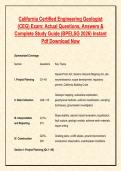
California Certified Engineering Geologist
(CEG) Exam: Actual Questions, Answers &
Complete Study Guide (BPELSG 2026) Instant
Pdf Download Now
Summarized Coverage
Section Questions Key Topics
Alquist-Priolo Act, Seismic Hazards Mapping Act, site
I. Project Planning Q1–45 reconnaissance, scope development, regulatory
permits, California Building Code
Geologic mapping, subsurface exploration,
II. Data Collection Q46–115 geophysical methods, soil/rock classification, sampling
techniques, groundwater investigation
Slope stability, seismic hazard evaluation, liquefaction,
III. Interpretation Q116–
fault rupture, geologic models, adverse earth materials,
and Reporting 215
report writing
Q216– Grading plans, cut/fill slopes, ground improvement,
IV. Construction
250 construction observation, unanticipated conditions
Section I: Project Planning (Qs 1–45)
,Q1. Which California legislative act specifically established the requirement for geologic
reports to identify and mitigate the hazards of surface fault rupture for most structures for
human occupancy?
A) The Professional Engineers Act
B) The Alquist-Priolo Earthquake Fault Zoning Act
C) The Seismic Hazards Mapping Act
D) The Subdivision Map Act
Answer: B
The Alquist-Priolo Act regulates development near active fault traces to mitigate surface
rupture hazards for human occupancy structures.
Q2. What is the primary purpose of the Seismic Hazards Mapping Act?
A) To regulate building construction on active faults
B) To identify and mitigate seismic hazards including liquefaction and landslides
C) To govern groundwater withdrawal
D) To regulate mining activities
Answer: B
The Seismic Hazards Mapping Act addresses seismic hazards such as liquefaction,
earthquake-induced landslides, and amplified ground shaking.
Q3. Which California agency enforces seismic safety requirements for public schools?
A) Caltrans
B) Division of Mines and Geology
C) Division of the State Architect (DSA)
D) FEMA
Answer: C
The DSA ensures schools meet seismic safety standards.
,Q4. Under the Alquist-Priolo Act, what is the definition of an "active fault"?
A) A fault that has demonstrated movement in the past 11,000 years (Holocene)
B) A fault that has moved in the past 1.6 million years (Quaternary)
C) A fault that has moved in the past 100 years
D) A fault that is capable of movement in the future
Answer: A
An active fault is one that has demonstrated surface displacement within the past 11,000
years (Holocene time).
Q5. What is the purpose of a Fault Evaluation Report (FER)?
A) To evaluate the seismic design parameters of a building
B) To document the evaluation of a fault's activity status for regulatory purposes
C) To map landslide deposits
D) To assess groundwater conditions
Answer: B
A Fault Evaluation Report documents the evaluation of a fault's activity status, typically for
Alquist-Priolo compliance.
Q6. Which document provides guidance for engineering geologic studies in California?
A) CGS Special Publication 117A
B) ASCE 7-22
C) AASHTO LRFD Bridge Design Specifications
D) ACI 318
Answer: A
CGS Special Publication 117A provides guidelines for evaluating and mitigating seismic
hazards in California.
, Q7. What is the minimum education requirement for the CEG exam?
A) High school diploma
B) Associate degree
C) Bachelor's degree in geology
D) Master's degree in engineering geology
Answer: C
A bachelor's degree in geology is required, along with work experience.
Q8. Which California regulation governs the licensing of geologists?
A) CEQA
B) Professional Engineers Act
C) Geologist and Geophysicist Act
D) California Environmental Law
Answer: C
The Geologist and Geophysicist Act regulates the licensing of professional geologists and
geophysicists in California.
Q9. What is the primary purpose of site reconnaissance?
A) To collect soil samples
B) To assess topography, access, and geologic hazards
C) To install monitoring wells
D) To conduct geophysical surveys
Answer: B
Site reconnaissance assesses topography, access, and geologic hazards.
Q10. Which of the following is a California-specific guideline for siting schools?
A) CGS Note 48
B) California Field Act
(CEG) Exam: Actual Questions, Answers &
Complete Study Guide (BPELSG 2026) Instant
Pdf Download Now
Summarized Coverage
Section Questions Key Topics
Alquist-Priolo Act, Seismic Hazards Mapping Act, site
I. Project Planning Q1–45 reconnaissance, scope development, regulatory
permits, California Building Code
Geologic mapping, subsurface exploration,
II. Data Collection Q46–115 geophysical methods, soil/rock classification, sampling
techniques, groundwater investigation
Slope stability, seismic hazard evaluation, liquefaction,
III. Interpretation Q116–
fault rupture, geologic models, adverse earth materials,
and Reporting 215
report writing
Q216– Grading plans, cut/fill slopes, ground improvement,
IV. Construction
250 construction observation, unanticipated conditions
Section I: Project Planning (Qs 1–45)
,Q1. Which California legislative act specifically established the requirement for geologic
reports to identify and mitigate the hazards of surface fault rupture for most structures for
human occupancy?
A) The Professional Engineers Act
B) The Alquist-Priolo Earthquake Fault Zoning Act
C) The Seismic Hazards Mapping Act
D) The Subdivision Map Act
Answer: B
The Alquist-Priolo Act regulates development near active fault traces to mitigate surface
rupture hazards for human occupancy structures.
Q2. What is the primary purpose of the Seismic Hazards Mapping Act?
A) To regulate building construction on active faults
B) To identify and mitigate seismic hazards including liquefaction and landslides
C) To govern groundwater withdrawal
D) To regulate mining activities
Answer: B
The Seismic Hazards Mapping Act addresses seismic hazards such as liquefaction,
earthquake-induced landslides, and amplified ground shaking.
Q3. Which California agency enforces seismic safety requirements for public schools?
A) Caltrans
B) Division of Mines and Geology
C) Division of the State Architect (DSA)
D) FEMA
Answer: C
The DSA ensures schools meet seismic safety standards.
,Q4. Under the Alquist-Priolo Act, what is the definition of an "active fault"?
A) A fault that has demonstrated movement in the past 11,000 years (Holocene)
B) A fault that has moved in the past 1.6 million years (Quaternary)
C) A fault that has moved in the past 100 years
D) A fault that is capable of movement in the future
Answer: A
An active fault is one that has demonstrated surface displacement within the past 11,000
years (Holocene time).
Q5. What is the purpose of a Fault Evaluation Report (FER)?
A) To evaluate the seismic design parameters of a building
B) To document the evaluation of a fault's activity status for regulatory purposes
C) To map landslide deposits
D) To assess groundwater conditions
Answer: B
A Fault Evaluation Report documents the evaluation of a fault's activity status, typically for
Alquist-Priolo compliance.
Q6. Which document provides guidance for engineering geologic studies in California?
A) CGS Special Publication 117A
B) ASCE 7-22
C) AASHTO LRFD Bridge Design Specifications
D) ACI 318
Answer: A
CGS Special Publication 117A provides guidelines for evaluating and mitigating seismic
hazards in California.
, Q7. What is the minimum education requirement for the CEG exam?
A) High school diploma
B) Associate degree
C) Bachelor's degree in geology
D) Master's degree in engineering geology
Answer: C
A bachelor's degree in geology is required, along with work experience.
Q8. Which California regulation governs the licensing of geologists?
A) CEQA
B) Professional Engineers Act
C) Geologist and Geophysicist Act
D) California Environmental Law
Answer: C
The Geologist and Geophysicist Act regulates the licensing of professional geologists and
geophysicists in California.
Q9. What is the primary purpose of site reconnaissance?
A) To collect soil samples
B) To assess topography, access, and geologic hazards
C) To install monitoring wells
D) To conduct geophysical surveys
Answer: B
Site reconnaissance assesses topography, access, and geologic hazards.
Q10. Which of the following is a California-specific guideline for siting schools?
A) CGS Note 48
B) California Field Act


