

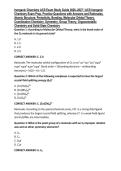
Inorganic Chemistry ACS Exam Study Guide 2026–2027 | ACS Inorganic
Chemistry Exam Prep, Practice Questions with Answers and Rationales,
Atomic Structure, Periodicity, Bonding, Molecular Orbital Theory,
Coordination Chemistry, Symmetry, Group Theory, Organometallic
Chemistry and Solid-State Chemistry
Question 1: According to Molecular Orbital Theory, what is the bond order of
the O₂ molecule in its ground state?
A. 1.0
B. 1.5
C. 2.0
D. 2.5
CORRECT ANSWER: C. 2.0
Rationale: The molecular orbital configuration of O₂ is σ₁s² σ₁s² σ₂s² σ₂s² σ₂pz²
π₂px² π₂py² π₂px¹ π₂py¹. Bond order = ½(bonding electrons – antibonding
electrons) = ½(10 – 6) = 2.0.
Question 2: Which of the following complexes is expected to have the largest
crystal field splitting energy (Δ₀)?
A. [Co(H₂O)₆]²⁺
B. [Co(NH₃)₆]²⁺
C. [Co(CN)₆]⁴⁻
D. [CoCl₆]⁴⁻
CORRECT ANSWER: C. [Co(CN)₆]⁴⁻
Rationale: According to the spectrochemical series, CN⁻ is a strong-field ligand
that produces the largest crystal field splitting, whereas Cl⁻ is a weak-field ligand
and H₂O/NH₃ are intermediate.
Question 3: What is the point group of a molecule with an S₄ improper rotation
axis and no other symmetry elements?
A. S₄
B. C₄
C. D₂d
D. C₄h
CORRECT ANSWER: A. S₄
,Rationale: If the only symmetry element present is an S₄ axis (and the identity E),
the point group is S₄. The presence of a C₄ axis would require the S₄ axis and
additional elements that are not specified.
Question 4: Which statement correctly describes the trend in first ionization
energy across Period 3 from Na to Ar?
A. It decreases monotonically due to increasing nuclear charge.
B. It increases monotonically due to decreasing atomic radius.
C. It generally increases, with exceptions at Al and S.
D. It generally decreases, with exceptions at Si and Cl.
CORRECT ANSWER: C. It generally increases, with exceptions at Al and S.
Rationale: First ionization energy generally increases across a period due to
increasing effective nuclear charge. Exceptions occur at Al (electron removed
from 3p after stable 3s²) and S (electron removed from paired 3p orbital,
experiencing repulsion).
Question 5: In the 18-electron rule, a metal center that has 16 valence electrons
and accepts a bidentate ligand would have a total electron count of:
A. 16
B. 17
C. 18
D. 20
CORRECT ANSWER: C. 18
Rationale: The 18-electron rule states that stable transition metal complexes
typically have 18 valence electrons. A 16-electron metal center accepting a
bidentate ligand (which donates 4 electrons) would achieve 16 + 4 = 20, but if the
ligand is η² (2 electrons), it achieves 18.
Question 6: Which of the following species is expected to be paramagnetic?
A. [Ni(CN)₄]²⁻
B. [NiCl₄]²⁻
C. [Zn(NH₃)₄]²⁺
D. [Cu(CN)₄]³⁻
,CORRECT ANSWER: B. [NiCl₄]²⁻
Rationale: [NiCl₄]²⁻ is tetrahedral with Ni²⁺ (d⁸). Tetrahedral complexes have small
Δt and are typically high-spin, giving two unpaired electrons (paramagnetic).
[Ni(CN)₄]²⁻ is square planar and diamagnetic.
Question 7: Which of the following is the correct electron configuration for a
Cr³⁺ ion?
A. [Ar] 3d³
B. [Ar] 3d⁴ 4s¹
C. [Ar] 3d⁵ 4s¹
D. [Ar] 3d⁶
CORRECT ANSWER: A. [Ar] 3d³
Rationale: Chromium (Cr) has the configuration [Ar] 3d⁵ 4s¹. Removing three
electrons gives Cr³⁺ with [Ar] 3d³.
Question 8: Which of the following molecules has a dipole moment of zero?
A. H₂O
B. NH₃
C. CO₂
D. SO₂
CORRECT ANSWER: C. CO₂
Rationale: CO₂ is linear with two polar C=O bonds that are equal and opposite,
resulting in cancellation of dipole moments (μ = 0). H₂O, NH₃, and SO₂ are bent
and have net dipole moments.
Question 9: According to VSEPR theory, what is the molecular geometry of SF₄?
A. Tetrahedral
B. Trigonal bipyramidal
C. Seesaw
D. Square planar
CORRECT ANSWER: C. Seesaw
, Rationale: SF₄ has five electron pairs around sulfur (four bonding pairs and one
lone pair), giving a trigonal bipyramidal electron geometry. The lone pair occupies
an equatorial position, resulting in a seesaw molecular geometry.
Question 10: Which of the following ligands is classified as a π-acceptor?
A. NH₃
B. Cl⁻
C. CO
D. OH⁻
CORRECT ANSWER: C. CO
Rationale: Carbon monoxide (CO) is a classic π-acceptor ligand due to its empty π*
orbitals that can accept electron density from filled metal d orbitals. NH₃ is a σ-
donor, while Cl⁻ and OH⁻ are π-donors.
Question 11: What is the hybridization of the central atom in XeF₄?
A. sp³
B. sp³d
C. sp³d²
D. sp³d³
CORRECT ANSWER: C. sp³d²
Rationale: XeF₄ has four bonding pairs and two lone pairs on xenon, giving an
octahedral electron geometry (steric number 6) and square planar molecular
geometry. The hybridization is sp³d².
Question 12: Which of the following complexes exhibits linkage isomerism?
A. [Co(NH₃)₅Cl]SO₄
B. [Co(NH₃)₅(NO₂)]Cl₂
C. [Cr(H₂O)₆]Cl₃
D. [Pt(NH₃)₂Cl₂]
CORRECT ANSWER: B. [Co(NH₃)₅(NO₂)]Cl₂
Rationale: Linkage isomerism occurs when a ligand can coordinate through
different donor atoms. The nitrite ligand (NO₂⁻) can bind through nitrogen (nitro)
or oxygen (nitrito), making this complex capable of linkage isomerism.
Chemistry Exam Prep, Practice Questions with Answers and Rationales,
Atomic Structure, Periodicity, Bonding, Molecular Orbital Theory,
Coordination Chemistry, Symmetry, Group Theory, Organometallic
Chemistry and Solid-State Chemistry
Question 1: According to Molecular Orbital Theory, what is the bond order of
the O₂ molecule in its ground state?
A. 1.0
B. 1.5
C. 2.0
D. 2.5
CORRECT ANSWER: C. 2.0
Rationale: The molecular orbital configuration of O₂ is σ₁s² σ₁s² σ₂s² σ₂s² σ₂pz²
π₂px² π₂py² π₂px¹ π₂py¹. Bond order = ½(bonding electrons – antibonding
electrons) = ½(10 – 6) = 2.0.
Question 2: Which of the following complexes is expected to have the largest
crystal field splitting energy (Δ₀)?
A. [Co(H₂O)₆]²⁺
B. [Co(NH₃)₆]²⁺
C. [Co(CN)₆]⁴⁻
D. [CoCl₆]⁴⁻
CORRECT ANSWER: C. [Co(CN)₆]⁴⁻
Rationale: According to the spectrochemical series, CN⁻ is a strong-field ligand
that produces the largest crystal field splitting, whereas Cl⁻ is a weak-field ligand
and H₂O/NH₃ are intermediate.
Question 3: What is the point group of a molecule with an S₄ improper rotation
axis and no other symmetry elements?
A. S₄
B. C₄
C. D₂d
D. C₄h
CORRECT ANSWER: A. S₄
,Rationale: If the only symmetry element present is an S₄ axis (and the identity E),
the point group is S₄. The presence of a C₄ axis would require the S₄ axis and
additional elements that are not specified.
Question 4: Which statement correctly describes the trend in first ionization
energy across Period 3 from Na to Ar?
A. It decreases monotonically due to increasing nuclear charge.
B. It increases monotonically due to decreasing atomic radius.
C. It generally increases, with exceptions at Al and S.
D. It generally decreases, with exceptions at Si and Cl.
CORRECT ANSWER: C. It generally increases, with exceptions at Al and S.
Rationale: First ionization energy generally increases across a period due to
increasing effective nuclear charge. Exceptions occur at Al (electron removed
from 3p after stable 3s²) and S (electron removed from paired 3p orbital,
experiencing repulsion).
Question 5: In the 18-electron rule, a metal center that has 16 valence electrons
and accepts a bidentate ligand would have a total electron count of:
A. 16
B. 17
C. 18
D. 20
CORRECT ANSWER: C. 18
Rationale: The 18-electron rule states that stable transition metal complexes
typically have 18 valence electrons. A 16-electron metal center accepting a
bidentate ligand (which donates 4 electrons) would achieve 16 + 4 = 20, but if the
ligand is η² (2 electrons), it achieves 18.
Question 6: Which of the following species is expected to be paramagnetic?
A. [Ni(CN)₄]²⁻
B. [NiCl₄]²⁻
C. [Zn(NH₃)₄]²⁺
D. [Cu(CN)₄]³⁻
,CORRECT ANSWER: B. [NiCl₄]²⁻
Rationale: [NiCl₄]²⁻ is tetrahedral with Ni²⁺ (d⁸). Tetrahedral complexes have small
Δt and are typically high-spin, giving two unpaired electrons (paramagnetic).
[Ni(CN)₄]²⁻ is square planar and diamagnetic.
Question 7: Which of the following is the correct electron configuration for a
Cr³⁺ ion?
A. [Ar] 3d³
B. [Ar] 3d⁴ 4s¹
C. [Ar] 3d⁵ 4s¹
D. [Ar] 3d⁶
CORRECT ANSWER: A. [Ar] 3d³
Rationale: Chromium (Cr) has the configuration [Ar] 3d⁵ 4s¹. Removing three
electrons gives Cr³⁺ with [Ar] 3d³.
Question 8: Which of the following molecules has a dipole moment of zero?
A. H₂O
B. NH₃
C. CO₂
D. SO₂
CORRECT ANSWER: C. CO₂
Rationale: CO₂ is linear with two polar C=O bonds that are equal and opposite,
resulting in cancellation of dipole moments (μ = 0). H₂O, NH₃, and SO₂ are bent
and have net dipole moments.
Question 9: According to VSEPR theory, what is the molecular geometry of SF₄?
A. Tetrahedral
B. Trigonal bipyramidal
C. Seesaw
D. Square planar
CORRECT ANSWER: C. Seesaw
, Rationale: SF₄ has five electron pairs around sulfur (four bonding pairs and one
lone pair), giving a trigonal bipyramidal electron geometry. The lone pair occupies
an equatorial position, resulting in a seesaw molecular geometry.
Question 10: Which of the following ligands is classified as a π-acceptor?
A. NH₃
B. Cl⁻
C. CO
D. OH⁻
CORRECT ANSWER: C. CO
Rationale: Carbon monoxide (CO) is a classic π-acceptor ligand due to its empty π*
orbitals that can accept electron density from filled metal d orbitals. NH₃ is a σ-
donor, while Cl⁻ and OH⁻ are π-donors.
Question 11: What is the hybridization of the central atom in XeF₄?
A. sp³
B. sp³d
C. sp³d²
D. sp³d³
CORRECT ANSWER: C. sp³d²
Rationale: XeF₄ has four bonding pairs and two lone pairs on xenon, giving an
octahedral electron geometry (steric number 6) and square planar molecular
geometry. The hybridization is sp³d².
Question 12: Which of the following complexes exhibits linkage isomerism?
A. [Co(NH₃)₅Cl]SO₄
B. [Co(NH₃)₅(NO₂)]Cl₂
C. [Cr(H₂O)₆]Cl₃
D. [Pt(NH₃)₂Cl₂]
CORRECT ANSWER: B. [Co(NH₃)₅(NO₂)]Cl₂
Rationale: Linkage isomerism occurs when a ligand can coordinate through
different donor atoms. The nitrite ligand (NO₂⁻) can bind through nitrogen (nitro)
or oxygen (nitrito), making this complex capable of linkage isomerism.



