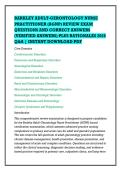
BARKLEY ADULT-GERONTOLOGY NURSE
PRACTITIONER (AGNP) REVIEW EXAM
QUESTIONS AND CORRECT ANSWERS
(VERIFIED ANSWERS) PLUS RATIONALES 2026
Q&A | INSTANT DOWNLOAD PDF
Core Domains
Cardiovascular Disorders
Pulmonary and Respiratory Disorders
Neurological Disorders
Endocrine and Metabolic Disorders
Gastrointestinal and Hepatic Disorders
Renal and Genitourinary Disorders
Musculoskeletal and Rheumatologic Disorders
Hematologic and Oncologic Disorders
Infectious Diseases and Immunology
Geriatric Syndromes and Polypharmacy
Introduction
This comprehensive review examination is designed to prepare candidates
for the Barkley Adult-Gerontology Nurse Practitioner (AGNP) board
certification examination, which assesses advanced practice nursing
competence in primary and acute care for adult and geriatric populations.
The test covers the full spectrum of adult-gerontology practice including
chronic disease management, health promotion, disease prevention, and
management of acute and complex conditions. Questions are structured to
reflect the clinical reasoning, diagnostic decision-making, and evidence-
based practice required in primary care, outpatient clinics, and long-term
,care settings. Emphasis is placed on comprehensive assessment,
differential diagnosis, pharmacologic and non-pharmacologic
interventions, and patient-centered care across the adult lifespan.
Successful completion of this practice test indicates readiness for board
certification and entry into advanced nursing practice with adult and
geriatric populations.
SECTION ONE: QUESTIONS 1–100
Question 1
A 72-year-old patient presents with a blood pressure of 152/92 mmHg
on two separate visits. The patient has no history of cardiovascular
disease and has no target organ damage. According to the JNC-8
guidelines, what is the most appropriate initial treatment target?
A. Blood pressure <120/80 mmHg
B. Blood pressure <130/80 mmHg
C. Blood pressure <140/90 mmHg
D. Blood pressure <150/90 mmHg
Correct answer: D
RATIONALE: According to JNC-8 guidelines, the recommended
blood pressure target for adults aged 60 years and older is less than
150/90 mmHg. This recommendation is based on evidence that
aggressive targets in older adults may lead to adverse effects without
additional cardiovascular benefit. The target for younger adults is
<140/90 mmHg.
Question 2
A 65-year-old patient with type 2 diabetes mellitus presents with a
fasting blood glucose of 168 mg/dL and HbA1c of 8.5%. The patient is
currently on metformin 1000 mg twice daily. Which medication should
the AGNP add as second-line therapy?
A. Insulin glargine
B. Sulfonylurea
,C. DPP-4 inhibitor
D. SGLT2 inhibitor
Correct answer: D
RATIONALE: SGLT2 inhibitors (such as empagliflozin, canagliflozin)
are recommended as second-line therapy in patients with type 2
diabetes, especially those with established cardiovascular disease or
multiple risk factors, due to their cardiovascular and renal protective
benefits. They also have a lower risk of hypoglycemia compared to
sulfonylureas and insulin.
Question 3
A 70-year-old patient with a history of COPD presents with worsening
dyspnea, increased sputum production, and a fever. The patient is
coughing up purulent sputum. Which antibiotic is most appropriate for
empiric treatment of an acute exacerbation?
A. Amoxicillin
B. Azithromycin
C. Levofloxacin
D. Doxycycline
Correct answer: C
RATIONALE: For acute exacerbations of COPD with purulent sputum,
empiric antibiotic therapy should cover common pathogens including
Streptococcus pneumoniae, Haemophilus influenzae, and Moraxella
catarrhalis. Levofloxacin (a respiratory fluoroquinolone) provides
broad-spectrum coverage and is appropriate for patients with risk
factors for resistant organisms or recent antibiotic use.
Question 4
A 72-year-old woman with a 50-pack-year smoking history presents with
dyspnea and a chronic cough. Pulmonary function tests show FEV1/FVC
, <0.70 and an FEV1 of 55% predicted without significant reversibility.
What is the correct GOLD classification?
A. GOLD 1 (mild)
B. GOLD 2 (moderate)
C. GOLD 3 (severe)
D. GOLD 4 (very severe)
Correct answer: B
RATIONALE: GOLD 2 (moderate) is defined as FEV1 50-79%
predicted after bronchodilator, with FEV1/FVC <0.70. GOLD 1 is FEV1
≥80%; GOLD 3 is 30-49%; GOLD 4 is <30%.
Question 5
An 85-year-old man with BPH and hypertension presents with acute
onset of urinary retention, severe flank pain, and hematuria. What is the
most appropriate initial diagnostic test?
A. Abdominal ultrasound
B. Intravenous pyelogram
C. CT scan of the abdomen and pelvis without contrast
D. Plain abdominal X-ray
Correct answer: C
RATIONALE: CT scan without contrast is the gold standard for
diagnosing renal calculi, which is suspected given acute flank pain and
hematuria. Ultrasound may miss small stones. IVP is less commonly
used. CT is rapid, sensitive, and specific.
Question 6
A 68-year-old woman with a history of type 2 diabetes and hypertension
has an LDL-C of 140 mg/dL. She is already on atorvastatin 40 mg. What is
the next step according to the 2018 AHA/ACC cholesterol guidelines?
A. Add ezetimibe
B. Increase atorvastatin to 80 mg
PRACTITIONER (AGNP) REVIEW EXAM
QUESTIONS AND CORRECT ANSWERS
(VERIFIED ANSWERS) PLUS RATIONALES 2026
Q&A | INSTANT DOWNLOAD PDF
Core Domains
Cardiovascular Disorders
Pulmonary and Respiratory Disorders
Neurological Disorders
Endocrine and Metabolic Disorders
Gastrointestinal and Hepatic Disorders
Renal and Genitourinary Disorders
Musculoskeletal and Rheumatologic Disorders
Hematologic and Oncologic Disorders
Infectious Diseases and Immunology
Geriatric Syndromes and Polypharmacy
Introduction
This comprehensive review examination is designed to prepare candidates
for the Barkley Adult-Gerontology Nurse Practitioner (AGNP) board
certification examination, which assesses advanced practice nursing
competence in primary and acute care for adult and geriatric populations.
The test covers the full spectrum of adult-gerontology practice including
chronic disease management, health promotion, disease prevention, and
management of acute and complex conditions. Questions are structured to
reflect the clinical reasoning, diagnostic decision-making, and evidence-
based practice required in primary care, outpatient clinics, and long-term
,care settings. Emphasis is placed on comprehensive assessment,
differential diagnosis, pharmacologic and non-pharmacologic
interventions, and patient-centered care across the adult lifespan.
Successful completion of this practice test indicates readiness for board
certification and entry into advanced nursing practice with adult and
geriatric populations.
SECTION ONE: QUESTIONS 1–100
Question 1
A 72-year-old patient presents with a blood pressure of 152/92 mmHg
on two separate visits. The patient has no history of cardiovascular
disease and has no target organ damage. According to the JNC-8
guidelines, what is the most appropriate initial treatment target?
A. Blood pressure <120/80 mmHg
B. Blood pressure <130/80 mmHg
C. Blood pressure <140/90 mmHg
D. Blood pressure <150/90 mmHg
Correct answer: D
RATIONALE: According to JNC-8 guidelines, the recommended
blood pressure target for adults aged 60 years and older is less than
150/90 mmHg. This recommendation is based on evidence that
aggressive targets in older adults may lead to adverse effects without
additional cardiovascular benefit. The target for younger adults is
<140/90 mmHg.
Question 2
A 65-year-old patient with type 2 diabetes mellitus presents with a
fasting blood glucose of 168 mg/dL and HbA1c of 8.5%. The patient is
currently on metformin 1000 mg twice daily. Which medication should
the AGNP add as second-line therapy?
A. Insulin glargine
B. Sulfonylurea
,C. DPP-4 inhibitor
D. SGLT2 inhibitor
Correct answer: D
RATIONALE: SGLT2 inhibitors (such as empagliflozin, canagliflozin)
are recommended as second-line therapy in patients with type 2
diabetes, especially those with established cardiovascular disease or
multiple risk factors, due to their cardiovascular and renal protective
benefits. They also have a lower risk of hypoglycemia compared to
sulfonylureas and insulin.
Question 3
A 70-year-old patient with a history of COPD presents with worsening
dyspnea, increased sputum production, and a fever. The patient is
coughing up purulent sputum. Which antibiotic is most appropriate for
empiric treatment of an acute exacerbation?
A. Amoxicillin
B. Azithromycin
C. Levofloxacin
D. Doxycycline
Correct answer: C
RATIONALE: For acute exacerbations of COPD with purulent sputum,
empiric antibiotic therapy should cover common pathogens including
Streptococcus pneumoniae, Haemophilus influenzae, and Moraxella
catarrhalis. Levofloxacin (a respiratory fluoroquinolone) provides
broad-spectrum coverage and is appropriate for patients with risk
factors for resistant organisms or recent antibiotic use.
Question 4
A 72-year-old woman with a 50-pack-year smoking history presents with
dyspnea and a chronic cough. Pulmonary function tests show FEV1/FVC
, <0.70 and an FEV1 of 55% predicted without significant reversibility.
What is the correct GOLD classification?
A. GOLD 1 (mild)
B. GOLD 2 (moderate)
C. GOLD 3 (severe)
D. GOLD 4 (very severe)
Correct answer: B
RATIONALE: GOLD 2 (moderate) is defined as FEV1 50-79%
predicted after bronchodilator, with FEV1/FVC <0.70. GOLD 1 is FEV1
≥80%; GOLD 3 is 30-49%; GOLD 4 is <30%.
Question 5
An 85-year-old man with BPH and hypertension presents with acute
onset of urinary retention, severe flank pain, and hematuria. What is the
most appropriate initial diagnostic test?
A. Abdominal ultrasound
B. Intravenous pyelogram
C. CT scan of the abdomen and pelvis without contrast
D. Plain abdominal X-ray
Correct answer: C
RATIONALE: CT scan without contrast is the gold standard for
diagnosing renal calculi, which is suspected given acute flank pain and
hematuria. Ultrasound may miss small stones. IVP is less commonly
used. CT is rapid, sensitive, and specific.
Question 6
A 68-year-old woman with a history of type 2 diabetes and hypertension
has an LDL-C of 140 mg/dL. She is already on atorvastatin 40 mg. What is
the next step according to the 2018 AHA/ACC cholesterol guidelines?
A. Add ezetimibe
B. Increase atorvastatin to 80 mg