
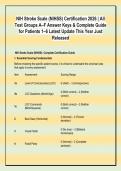
NIH Stroke Scale (NIHSS) Certification 2026 | All
Test Groups A–F Answer Keys & Complete Guide
for Patients 1–6 Latest Update This Year Just
Released
NIH Stroke Scale (NIHSS): Complete Certification Guide
1. Essential Scoring Fundamentals
Before reviewing the specific patient scores, it is critical to understand the universal rules
that apply to every assessment.
Item Assessment Scoring Range
1a Level of Consciousness (LOC) 0 (Alert) – 3 (Unresponsive)
0 (Both correct) – 2 (Neither
1b LOC Questions (Month/Age)
correct)
LOC Commands 0 (Both correct) – 2 (Neither
1c
(Blink/Squeeze) correct)
0 (Normal) – 2 (Forced
2 Best Gaze (Horizontal)
deviation)
0 (No loss) – 3 (Bilateral
3 Visual Fields
hemianopia)
0 (Normal) – 3 (Complete
4 Facial Palsy
paralysis)
, Item Assessment Scoring Range
5a/5b Motor Arm (Left/Right) 0 (No drift) – 4 (No movement)
6a/6b Motor Leg (Left/Right) 0 (No drift) – 4 (No movement)
0 (Absent) – 2 (Present in two
7 Limb Ataxia
limbs)
0 (Normal) – 2 (Severe/total
8 Sensory
loss)
9 Best Language 0 (No aphasia) – 3 (Mute)
10 Dysarthria 0 (Normal) – 2 (Severe)
0 (No abnormality) – 2
11 Extinction/Inattention
(Profound)
Key Administration Rules:
LOC Questions (1b): The standardized questions are the current month and
the patient's age.
LOC Commands (1c): The two commands are "Open and close your
eyes" and "Grip and release your hand." A score of 1 is given if only one task is
performed correctly.
Motor Arm (5): The patient must hold the arm at 90° (if sitting) or 45° (if supine) for
a full 10 seconds.
Untestable Items: If a patient is intubated and cannot be assessed for dysarthria
(item 10), it is scored as a 1.
Stroke Severity Classification:
0: No stroke symptoms
Test Groups A–F Answer Keys & Complete Guide
for Patients 1–6 Latest Update This Year Just
Released
NIH Stroke Scale (NIHSS): Complete Certification Guide
1. Essential Scoring Fundamentals
Before reviewing the specific patient scores, it is critical to understand the universal rules
that apply to every assessment.
Item Assessment Scoring Range
1a Level of Consciousness (LOC) 0 (Alert) – 3 (Unresponsive)
0 (Both correct) – 2 (Neither
1b LOC Questions (Month/Age)
correct)
LOC Commands 0 (Both correct) – 2 (Neither
1c
(Blink/Squeeze) correct)
0 (Normal) – 2 (Forced
2 Best Gaze (Horizontal)
deviation)
0 (No loss) – 3 (Bilateral
3 Visual Fields
hemianopia)
0 (Normal) – 3 (Complete
4 Facial Palsy
paralysis)
, Item Assessment Scoring Range
5a/5b Motor Arm (Left/Right) 0 (No drift) – 4 (No movement)
6a/6b Motor Leg (Left/Right) 0 (No drift) – 4 (No movement)
0 (Absent) – 2 (Present in two
7 Limb Ataxia
limbs)
0 (Normal) – 2 (Severe/total
8 Sensory
loss)
9 Best Language 0 (No aphasia) – 3 (Mute)
10 Dysarthria 0 (Normal) – 2 (Severe)
0 (No abnormality) – 2
11 Extinction/Inattention
(Profound)
Key Administration Rules:
LOC Questions (1b): The standardized questions are the current month and
the patient's age.
LOC Commands (1c): The two commands are "Open and close your
eyes" and "Grip and release your hand." A score of 1 is given if only one task is
performed correctly.
Motor Arm (5): The patient must hold the arm at 90° (if sitting) or 45° (if supine) for
a full 10 seconds.
Untestable Items: If a patient is intubated and cannot be assessed for dysarthria
(item 10), it is scored as a 1.
Stroke Severity Classification:
0: No stroke symptoms


