

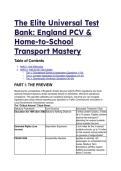
The Elite Universal Test
Bank: England PCV &
Home-to-School
Transport Mastery
Table of Contents
1. PART I: THE PREVIEW
2. PART II: THE ELITE TEST BANK
○ Tier 1: Foundational Syntax & Application (Questions 1–18)
○ Tier 2: Complex Application & Simulation (Questions 19–37)
○ Tier 3: Grandmaster Synthesis (Questions 38–55)
PART I: THE PREVIEW
Mastering the complexities of England’s Public Service Vehicle (PSV) regulations and local
authority transport statutory duties translates directly to defensible, elite-level operational
compliance. This gauntlet calibrates your analytical precision, ensuring you can navigate
legislative grey areas without exposing your operation to Traffic Commissioner revocation or
Local Government Ombudsman censure.
The "Critical Axioms" Cheat Sheet:
Statutory Framework Core Directive Actionable Threshold / Rule
Education Act 1996 (Sch 35B) Statutory Walking Distance 2 miles (under 8 years), 3 miles
(8 to 16 years). Eligible children
receive free transport if
attending the nearest suitable
school outside this limit.
Extended Rights (Low Deprivation Expansion 2 to 6 miles for the 3 nearest
Income) suitable schools; up to 15 miles
for the nearest school preferred
on grounds of religion/belief.
PSVAR 2000 Accessibility Mandate Applies to vehicles >22
passengers on scheduled local
routes. Medium Term
Exemptions (MTEs) require
fulfilling accessibility requests
within 2 months.
,Statutory Framework Core Directive Actionable Threshold / Rule
Maintenance (DVSA) Brake Efficiency & Control Laden roller brake tests (RBT)
or EBPMS required at every
safety inspection. Unladen tests
require documented risk
assessments.
Drivers' Hours & WTR 2005 Fatigue Management Regular routes <50km fall
under GB Domestic rules. PSV
night work (01:00-05:00) strictly
caps working time at 10 hours
in 24 hours.
PART II: THE ELITE TEST BANK
Tier 1: Foundational Syntax & Application
Q1: A local authority evaluates a 7-year-old child attending their nearest qualifying school. The
shortest safe walking route is measured at 2.2 miles. Based on the principles of Schedule 35B
of the Education Act 1996, which determination is MOST APPROPRIATE? A) The child is
ineligible because parents hold primary responsibility for attendance up to 3 miles. B) The child
is eligible because the distance exceeds the statutory walking distance for their specific age
cohort. C) The child is ineligible because the route falls below the universal 3-mile threshold for
primary students. D) The child is eligible only if the family meets extended rights criteria for
targeted free school meals.
● Answer: B (The child is eligible because the distance exceeds the statutory walking
distance for their specific age cohort.)
● Distractor Analysis:
○ A is incorrect: Parental attendance responsibility is superseded by the local
authority's duty when statutory distance thresholds are breached.
○ C is incorrect: The 3-mile threshold applies exclusively to children aged 8 and over;
the threshold for under-8s is 2 miles.
○ D is incorrect: Income criteria expand rights separately; standard distance rules are
universally applicable regardless of wealth.
The Mentor's Analysis: Statutory eligibility is binary and strictly age-dependent. When facing
basic distance queries, the immediate priority is mapping the child's age to the correct statutory
walking distance. By utilizing the 2-mile threshold for under-8s, you bypass the common trap of
misapplying the older cohort's parameters. Professional Intuition: Age dictates the hard
deck—2 miles for under-8s, 3 miles for everyone else.
Q2: A 14-year-old student lives 1.5 miles from school. The route crosses common land lacking
street lighting. The local authority deems the route safe for an accompanied child. Based on the
principles of the DfE Home-to-School Travel Statutory Guidance, which conclusion is FIRST
drawn regarding the route's availability? A) The route is inherently unsafe due to the lack of
artificial street lighting. B) The route is unsafe because unpaved common land cannot be legally
measured. C) The route is deemed available because the absence of lighting does not
automatically render a route hazardous. D) The route is unavailable because secondary
students cannot be reasonably expected to be accompanied.
● Answer: C (The route is deemed available because the absence of lighting does not
automatically render a route hazardous.)
, ● Distractor Analysis:
○ A is incorrect: The absence of street lighting is not a standalone reason to assess a
route as unsuitable.
○ B is incorrect: Statutory measurement utilizes the shortest route a child can walk,
including footpaths and unpaved rights of way.
○ D is incorrect: The statutory expectation of parental accompaniment applies to all
children of compulsory school age if it makes the route safe.
The Mentor's Analysis: Hazards are assessed objectively against traffic and highway geometry,
not aesthetics. When facing route safety disputes, the immediate priority is recognizing that
transient factors (lighting, mud) do not negate route availability. By utilizing objective hazard
criteria, you bypass the common trap of equating parental inconvenience with statutory
unsafety. Professional Intuition: Darkness and dirt do not equal danger under statutory
highway assessment.
Q3: An operator utilizes a 24-seat coach exclusively for a closed-door home-to-school transport
contract, charging separate fares. Based on the principles of the Public Service Vehicles
Accessibility Regulations 2000 (PSVAR), what is the MANDATORY compliance requirement? A)
The vehicle is entirely exempt because it operates a private closed-door service. B) The vehicle
must hold an Accessibility Certificate or a valid medium-term exemption. C) The vehicle only
requires compliance if carrying passengers with documented EHCPs. D) The vehicle is exempt
because PSVAR exclusively governs public stage carriage over 30 seats.
● Answer: B (The vehicle must hold an Accessibility Certificate or a valid medium-term
exemption.)
● Distractor Analysis:
○ A is incorrect: Closed-door home-to-school services charging separate fares
operate as scheduled routes and are strictly in scope for PSVAR.
○ C is incorrect: PSVAR mandates structural fleet compliance regardless of the
specific passenger manifest on any given day.
○ D is incorrect: The PSVAR threshold is explicitly set at vehicles carrying more than
22 passengers.
The Mentor's Analysis: Accessibility laws govern the vehicle's structural certification, not the
passenger list. When facing PSVAR applicability, the immediate priority is checking the 22-seat
capacity threshold alongside the presence of scheduled separate fares. By utilizing
medium-term exemptions or accessibility certificates, you bypass the common trap of assuming
school exclusivity equates to statutory immunity. Professional Intuition: Over 22 seats plus
scheduled fares equals absolute PSVAR scope.
Q4: An operator runs a local school bus service, registering a route that measures 42 kilometres
from terminus to terminus. Based on the principles of Regulation (EC) 561/2006, which
regulatory framework MUST the driver follow regarding driving hours? A) EU Drivers' Hours
rules, as it is a passenger-carrying service. B) AETR Rules, due to the commercial vehicle
capacity. C) GB Domestic rules, as the route is a regular service not exceeding 50km. D) Road
Transport (Working Time) Regulations exclusively, ignoring drive time limits.
● Answer: C (GB Domestic rules, as the route is a regular service not exceeding 50km.)
● Distractor Analysis:
○ A is incorrect: Regular passenger services on routes not exceeding 50km are
expressly exempt from EU tachograph and driving rules.
○ B is incorrect: AETR applies to international transit outside EU zones, completely
irrelevant to a 42km domestic route.
○ D is incorrect: While WTR 2005 applies to total working hours, driving time itself
Bank: England PCV &
Home-to-School
Transport Mastery
Table of Contents
1. PART I: THE PREVIEW
2. PART II: THE ELITE TEST BANK
○ Tier 1: Foundational Syntax & Application (Questions 1–18)
○ Tier 2: Complex Application & Simulation (Questions 19–37)
○ Tier 3: Grandmaster Synthesis (Questions 38–55)
PART I: THE PREVIEW
Mastering the complexities of England’s Public Service Vehicle (PSV) regulations and local
authority transport statutory duties translates directly to defensible, elite-level operational
compliance. This gauntlet calibrates your analytical precision, ensuring you can navigate
legislative grey areas without exposing your operation to Traffic Commissioner revocation or
Local Government Ombudsman censure.
The "Critical Axioms" Cheat Sheet:
Statutory Framework Core Directive Actionable Threshold / Rule
Education Act 1996 (Sch 35B) Statutory Walking Distance 2 miles (under 8 years), 3 miles
(8 to 16 years). Eligible children
receive free transport if
attending the nearest suitable
school outside this limit.
Extended Rights (Low Deprivation Expansion 2 to 6 miles for the 3 nearest
Income) suitable schools; up to 15 miles
for the nearest school preferred
on grounds of religion/belief.
PSVAR 2000 Accessibility Mandate Applies to vehicles >22
passengers on scheduled local
routes. Medium Term
Exemptions (MTEs) require
fulfilling accessibility requests
within 2 months.
,Statutory Framework Core Directive Actionable Threshold / Rule
Maintenance (DVSA) Brake Efficiency & Control Laden roller brake tests (RBT)
or EBPMS required at every
safety inspection. Unladen tests
require documented risk
assessments.
Drivers' Hours & WTR 2005 Fatigue Management Regular routes <50km fall
under GB Domestic rules. PSV
night work (01:00-05:00) strictly
caps working time at 10 hours
in 24 hours.
PART II: THE ELITE TEST BANK
Tier 1: Foundational Syntax & Application
Q1: A local authority evaluates a 7-year-old child attending their nearest qualifying school. The
shortest safe walking route is measured at 2.2 miles. Based on the principles of Schedule 35B
of the Education Act 1996, which determination is MOST APPROPRIATE? A) The child is
ineligible because parents hold primary responsibility for attendance up to 3 miles. B) The child
is eligible because the distance exceeds the statutory walking distance for their specific age
cohort. C) The child is ineligible because the route falls below the universal 3-mile threshold for
primary students. D) The child is eligible only if the family meets extended rights criteria for
targeted free school meals.
● Answer: B (The child is eligible because the distance exceeds the statutory walking
distance for their specific age cohort.)
● Distractor Analysis:
○ A is incorrect: Parental attendance responsibility is superseded by the local
authority's duty when statutory distance thresholds are breached.
○ C is incorrect: The 3-mile threshold applies exclusively to children aged 8 and over;
the threshold for under-8s is 2 miles.
○ D is incorrect: Income criteria expand rights separately; standard distance rules are
universally applicable regardless of wealth.
The Mentor's Analysis: Statutory eligibility is binary and strictly age-dependent. When facing
basic distance queries, the immediate priority is mapping the child's age to the correct statutory
walking distance. By utilizing the 2-mile threshold for under-8s, you bypass the common trap of
misapplying the older cohort's parameters. Professional Intuition: Age dictates the hard
deck—2 miles for under-8s, 3 miles for everyone else.
Q2: A 14-year-old student lives 1.5 miles from school. The route crosses common land lacking
street lighting. The local authority deems the route safe for an accompanied child. Based on the
principles of the DfE Home-to-School Travel Statutory Guidance, which conclusion is FIRST
drawn regarding the route's availability? A) The route is inherently unsafe due to the lack of
artificial street lighting. B) The route is unsafe because unpaved common land cannot be legally
measured. C) The route is deemed available because the absence of lighting does not
automatically render a route hazardous. D) The route is unavailable because secondary
students cannot be reasonably expected to be accompanied.
● Answer: C (The route is deemed available because the absence of lighting does not
automatically render a route hazardous.)
, ● Distractor Analysis:
○ A is incorrect: The absence of street lighting is not a standalone reason to assess a
route as unsuitable.
○ B is incorrect: Statutory measurement utilizes the shortest route a child can walk,
including footpaths and unpaved rights of way.
○ D is incorrect: The statutory expectation of parental accompaniment applies to all
children of compulsory school age if it makes the route safe.
The Mentor's Analysis: Hazards are assessed objectively against traffic and highway geometry,
not aesthetics. When facing route safety disputes, the immediate priority is recognizing that
transient factors (lighting, mud) do not negate route availability. By utilizing objective hazard
criteria, you bypass the common trap of equating parental inconvenience with statutory
unsafety. Professional Intuition: Darkness and dirt do not equal danger under statutory
highway assessment.
Q3: An operator utilizes a 24-seat coach exclusively for a closed-door home-to-school transport
contract, charging separate fares. Based on the principles of the Public Service Vehicles
Accessibility Regulations 2000 (PSVAR), what is the MANDATORY compliance requirement? A)
The vehicle is entirely exempt because it operates a private closed-door service. B) The vehicle
must hold an Accessibility Certificate or a valid medium-term exemption. C) The vehicle only
requires compliance if carrying passengers with documented EHCPs. D) The vehicle is exempt
because PSVAR exclusively governs public stage carriage over 30 seats.
● Answer: B (The vehicle must hold an Accessibility Certificate or a valid medium-term
exemption.)
● Distractor Analysis:
○ A is incorrect: Closed-door home-to-school services charging separate fares
operate as scheduled routes and are strictly in scope for PSVAR.
○ C is incorrect: PSVAR mandates structural fleet compliance regardless of the
specific passenger manifest on any given day.
○ D is incorrect: The PSVAR threshold is explicitly set at vehicles carrying more than
22 passengers.
The Mentor's Analysis: Accessibility laws govern the vehicle's structural certification, not the
passenger list. When facing PSVAR applicability, the immediate priority is checking the 22-seat
capacity threshold alongside the presence of scheduled separate fares. By utilizing
medium-term exemptions or accessibility certificates, you bypass the common trap of assuming
school exclusivity equates to statutory immunity. Professional Intuition: Over 22 seats plus
scheduled fares equals absolute PSVAR scope.
Q4: An operator runs a local school bus service, registering a route that measures 42 kilometres
from terminus to terminus. Based on the principles of Regulation (EC) 561/2006, which
regulatory framework MUST the driver follow regarding driving hours? A) EU Drivers' Hours
rules, as it is a passenger-carrying service. B) AETR Rules, due to the commercial vehicle
capacity. C) GB Domestic rules, as the route is a regular service not exceeding 50km. D) Road
Transport (Working Time) Regulations exclusively, ignoring drive time limits.
● Answer: C (GB Domestic rules, as the route is a regular service not exceeding 50km.)
● Distractor Analysis:
○ A is incorrect: Regular passenger services on routes not exceeding 50km are
expressly exempt from EU tachograph and driving rules.
○ B is incorrect: AETR applies to international transit outside EU zones, completely
irrelevant to a 42km domestic route.
○ D is incorrect: While WTR 2005 applies to total working hours, driving time itself


