
ATI Nutrition for Nursing (Edition 8.0) (New 2026/2027 Update) Questions & A
ATI Nutrition for Nursing (Edition 8.0)
Study online at https://quizlet.com/_i0qwal
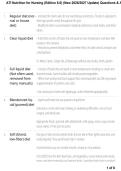
1. Regular diet (nor- - Indicated for clients who do not need dietary restrictions. The diet is adjusted to
mal or house meet age specific needs throughout life cycle.
diet) - Modify the diet to accommodate individual preferences, food habits, and ethnic
values.
2. Clear liquid diet - A diet that consists of foods that are liquid at room temperature and leave little
residue in the intestine.
- Primarily to prevent dehydration and relieve thirst, this diet consists of water and
carbohydrates.
Ex: Water, Sprite, Ginger Ale, all beverages without any residue, broth, gelatin
3. Full liquid diet - Consists of foods that are liquid at room temperature including ice cream and
(Not often used, strained cereals. Some facilities will include pureed vegetables.
removed from - Offers more variety/nutritional support than clear liquid diet, but still may require
many manuals) supplementation of proteins and carbs.
-Use cautiously in clients with dysphagia, unless thickened appropriately
4. Blenderized liq- - liquids and foods that are pureed to liquid form
uid (pureed) diet
Indications: clients who have chewing or swallowing difficulties, oral or facial
surgery, and wired jaws
Appropriate foods: any food with added broth, milk, gravy, cream, soup, tomato
sauce, water, or fruit juice to puree.
5. Soft (bland, this type of diet contains whole foods that are low in fiber, lightly seasoned, and
low-fiber) diet easily digested. They avoid foods high in residue.
Food selections vary can include smooth, creamy or crisp textures
EXCLUDED from this diet: Raw fruits, and vegetables, coarse breads and cereals,
beans and other potentially gas forming foods. (avoiding foods high in residue)
1/8
1 of 8
, ATI Nutrition for Nursing (Edition 8.0) (New 2026/2027 Update) Questions & A
ATI Nutrition for Nursing (Edition 8.0)
Study online at https://quizlet.com/_i0qwal
Indications: include clients transitioning between full liquid and regular diets, and
those who have acute infections, chwing difficulties or GI disorders
6. Mechanical soft - regular diet that is modified in texture
diet
Indications: limited chewing ability, dysphagia, poorly fitting dentures, and clients
who are edentulous (without teeth), surgery to the head, neck, or mouth, and
strictures of the intestinal tract
Appropriate foods: require minimal chewing before swallowing such as ground
meats, canned fruits, softly cooked vegetables
7. Dysphagia diet Prescribed when swallowing is impaired (following a stroke)
Manifestations of dysphagia are drooling, pocketing food, choking, or gagging.
International Dysphagia diet: www.iddsi.org
8. Examples of Na- NG tubes, nasoduodenal tubes, nasojejunal tubes)
soenteric tubes
9. How long do na- Used short-term (less than 3-4 weeks)
soenteric tubes
stay placed?
10. Placement of Na- passed through the nose to the stomach
sogastric (NG)
tubes
11. Placement of pass from the nose through the stomach and end in the duodenum
Nasoduodenal
tubes
12. pass from the nose through the stomach and end in the jejunum
2/8
2 of 8
ATI Nutrition for Nursing (Edition 8.0)
Study online at https://quizlet.com/_i0qwal
1. Regular diet (nor- - Indicated for clients who do not need dietary restrictions. The diet is adjusted to
mal or house meet age specific needs throughout life cycle.
diet) - Modify the diet to accommodate individual preferences, food habits, and ethnic
values.
2. Clear liquid diet - A diet that consists of foods that are liquid at room temperature and leave little
residue in the intestine.
- Primarily to prevent dehydration and relieve thirst, this diet consists of water and
carbohydrates.
Ex: Water, Sprite, Ginger Ale, all beverages without any residue, broth, gelatin
3. Full liquid diet - Consists of foods that are liquid at room temperature including ice cream and
(Not often used, strained cereals. Some facilities will include pureed vegetables.
removed from - Offers more variety/nutritional support than clear liquid diet, but still may require
many manuals) supplementation of proteins and carbs.
-Use cautiously in clients with dysphagia, unless thickened appropriately
4. Blenderized liq- - liquids and foods that are pureed to liquid form
uid (pureed) diet
Indications: clients who have chewing or swallowing difficulties, oral or facial
surgery, and wired jaws
Appropriate foods: any food with added broth, milk, gravy, cream, soup, tomato
sauce, water, or fruit juice to puree.
5. Soft (bland, this type of diet contains whole foods that are low in fiber, lightly seasoned, and
low-fiber) diet easily digested. They avoid foods high in residue.
Food selections vary can include smooth, creamy or crisp textures
EXCLUDED from this diet: Raw fruits, and vegetables, coarse breads and cereals,
beans and other potentially gas forming foods. (avoiding foods high in residue)
1/8
1 of 8
, ATI Nutrition for Nursing (Edition 8.0) (New 2026/2027 Update) Questions & A
ATI Nutrition for Nursing (Edition 8.0)
Study online at https://quizlet.com/_i0qwal
Indications: include clients transitioning between full liquid and regular diets, and
those who have acute infections, chwing difficulties or GI disorders
6. Mechanical soft - regular diet that is modified in texture
diet
Indications: limited chewing ability, dysphagia, poorly fitting dentures, and clients
who are edentulous (without teeth), surgery to the head, neck, or mouth, and
strictures of the intestinal tract
Appropriate foods: require minimal chewing before swallowing such as ground
meats, canned fruits, softly cooked vegetables
7. Dysphagia diet Prescribed when swallowing is impaired (following a stroke)
Manifestations of dysphagia are drooling, pocketing food, choking, or gagging.
International Dysphagia diet: www.iddsi.org
8. Examples of Na- NG tubes, nasoduodenal tubes, nasojejunal tubes)
soenteric tubes
9. How long do na- Used short-term (less than 3-4 weeks)
soenteric tubes
stay placed?
10. Placement of Na- passed through the nose to the stomach
sogastric (NG)
tubes
11. Placement of pass from the nose through the stomach and end in the duodenum
Nasoduodenal
tubes
12. pass from the nose through the stomach and end in the jejunum
2/8
2 of 8


