1
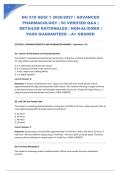
NU 518 QUIZ 1 2026/2027 | ADVANCED
PHARMACOLOGY | 50 VERIFIED Q&A |
DETAILED RATIONALES | NGN-ALIGNED |
PASS GUARANTEED – A+ GRADED
SECTION 1: PHARMACOKINETICS AND PHARMACODYNAMICS - Questions 1-10
Q1: Volume of Distribution and Drug Distribution
The student is reviewing pharmacokinetic parameters. A drug has a volume of distribution (Vd) of
0.1 L/kg. Which statement best describes the distribution of this drug?
A. It is extensively distributed into tissues
B. It is primarily confined to the vascular space
C. It has a high tissue binding affinity
D. It is highly lipophilic
Correct Answer: B
Rationale: A volume of distribution of 0.1 L/kg is very small and close to the plasma volume
(approximately 0.04 L/kg) and extracellular fluid volume. This indicates the drug is largely confined
to the vascular space and does not distribute extensively into tissues. Drugs with large Vd (e.g., >1
L/kg) are extensively distributed into tissues. [100% CORRECT]
Q2: Half-Life and Steady State
The student is reviewing pharmacokinetics. A drug has a half-life of 12 hours. How long will it take to
reach approximately 94% of steady-state concentration?
A. 24 hours
B. 36 hours
C. 48 hours
D. 60 hours
Correct Answer: C
Rationale: Steady state is reached after approximately 4-5 half-lives. With a half-life of 12 hours, 4
half-lives = 48 hours (94% of steady state). 5 half-lives = 60 hours (97% of steady state). The most
common clinical estimate for steady state is 4-5 half-lives. [100% CORRECT]
Q3: First-Pass Metabolism
The student is reviewing routes of administration. Which route avoids first-pass metabolism
entirely?
,2
A. Oral
B. Rectal
C. Sublingual
D. Enteral
Correct Answer: C
Rationale: Sublingual administration allows the drug to be absorbed directly into the systemic
circulation through the venous drainage of the mouth, bypassing the portal circulation and first-pass
metabolism in the liver. Oral and enteral routes undergo first-pass metabolism. Rectal
administration partially bypasses first-pass metabolism but not entirely. [100% CORRECT]
Q4: Protein Binding and Drug Interactions
The student is reviewing drug interactions. A patient is taking warfarin (99% protein-bound). Which
condition would increase the risk of bleeding?
A. Hypoalbuminemia
B. Hyperalbuminemia
C. Increased renal function
D. Decreased hepatic function
Correct Answer: A
Rationale: Hypoalbuminemia reduces the number of binding sites for warfarin, increasing the free
(unbound) fraction. The free drug is pharmacologically active, so this increases the anticoagulant
effect and bleeding risk. Hyperalbuminemia would decrease free drug. Renal and hepatic function
affect elimination, not protein binding directly. [100% CORRECT]
Q5: Zero-Order Kinetics
The student is reviewing elimination kinetics. Which drug is known to exhibit zero-order kinetics at
therapeutic doses?
A. Penicillin
B. Phenytoin
C. Metformin
D. Lisinopril
Correct Answer: B
Rationale: Phenytoin exhibits zero-order (saturation) kinetics at therapeutic concentrations because
its metabolic enzymes become saturated. This means a constant amount of drug is eliminated per
unit time, regardless of concentration. Small dose increases can lead to disproportionate increases in
plasma levels and toxicity. Penicillin, metformin, and lisinopril follow first-order kinetics. [100%
CORRECT]
Q6: Therapeutic Index
, 3
The student is reviewing drug safety. Which drug has a narrow therapeutic index and requires
routine serum monitoring?
A. Amoxicillin
B. Digoxin
C. Acetaminophen
D. Ibuprofen
Correct Answer: B
Rationale: Digoxin has a narrow therapeutic index (0.5-2.0 ng/mL) and requires routine monitoring
of serum levels to avoid toxicity. Amoxicillin, acetaminophen, and ibuprofen have wide therapeutic
indices and do not require routine serum monitoring. [100% CORRECT]
Q7: Enzyme Induction
The student is reviewing drug interactions. Which drug is a potent inducer of cytochrome P450
enzymes?
A. Ketoconazole
B. Erythromycin
C. Rifampin
D. Grapefruit juice
Correct Answer: C
Rationale: Rifampin is a potent inducer of CYP3A4 and other CYP enzymes, increasing the
metabolism of many drugs and reducing their efficacy. Ketoconazole, erythromycin, and grapefruit
juice are inhibitors. [100% CORRECT]
Q8: Pharmacodynamic Tolerance
The student is reviewing tolerance. What is pharmacodynamic tolerance?
A. Reduced response to a drug after repeated administration due to receptor downregulation
B. Increased metabolism of a drug after repeated administration
C. Reduced absorption of a drug after repeated administration
D. Increased excretion of a drug after repeated administration
Correct Answer: A
Rationale: Pharmacodynamic tolerance occurs when repeated administration of a drug leads to
decreased responsiveness, often due to receptor downregulation or desensitization. Examples
include opioids and beta-agonists. Pharmacokinetic tolerance involves increased metabolism. [100%
CORRECT]
Q9: Loading Dose Calculation
The student is reviewing dosing. A patient requires a loading dose of a drug with a volume of
distribution of 50 L and a target plasma concentration of 4 mg/L. What is the loading dose?
NU 518 QUIZ 1 2026/2027 | ADVANCED
PHARMACOLOGY | 50 VERIFIED Q&A |
DETAILED RATIONALES | NGN-ALIGNED |
PASS GUARANTEED – A+ GRADED
SECTION 1: PHARMACOKINETICS AND PHARMACODYNAMICS - Questions 1-10
Q1: Volume of Distribution and Drug Distribution
The student is reviewing pharmacokinetic parameters. A drug has a volume of distribution (Vd) of
0.1 L/kg. Which statement best describes the distribution of this drug?
A. It is extensively distributed into tissues
B. It is primarily confined to the vascular space
C. It has a high tissue binding affinity
D. It is highly lipophilic
Correct Answer: B
Rationale: A volume of distribution of 0.1 L/kg is very small and close to the plasma volume
(approximately 0.04 L/kg) and extracellular fluid volume. This indicates the drug is largely confined
to the vascular space and does not distribute extensively into tissues. Drugs with large Vd (e.g., >1
L/kg) are extensively distributed into tissues. [100% CORRECT]
Q2: Half-Life and Steady State
The student is reviewing pharmacokinetics. A drug has a half-life of 12 hours. How long will it take to
reach approximately 94% of steady-state concentration?
A. 24 hours
B. 36 hours
C. 48 hours
D. 60 hours
Correct Answer: C
Rationale: Steady state is reached after approximately 4-5 half-lives. With a half-life of 12 hours, 4
half-lives = 48 hours (94% of steady state). 5 half-lives = 60 hours (97% of steady state). The most
common clinical estimate for steady state is 4-5 half-lives. [100% CORRECT]
Q3: First-Pass Metabolism
The student is reviewing routes of administration. Which route avoids first-pass metabolism
entirely?
,2
A. Oral
B. Rectal
C. Sublingual
D. Enteral
Correct Answer: C
Rationale: Sublingual administration allows the drug to be absorbed directly into the systemic
circulation through the venous drainage of the mouth, bypassing the portal circulation and first-pass
metabolism in the liver. Oral and enteral routes undergo first-pass metabolism. Rectal
administration partially bypasses first-pass metabolism but not entirely. [100% CORRECT]
Q4: Protein Binding and Drug Interactions
The student is reviewing drug interactions. A patient is taking warfarin (99% protein-bound). Which
condition would increase the risk of bleeding?
A. Hypoalbuminemia
B. Hyperalbuminemia
C. Increased renal function
D. Decreased hepatic function
Correct Answer: A
Rationale: Hypoalbuminemia reduces the number of binding sites for warfarin, increasing the free
(unbound) fraction. The free drug is pharmacologically active, so this increases the anticoagulant
effect and bleeding risk. Hyperalbuminemia would decrease free drug. Renal and hepatic function
affect elimination, not protein binding directly. [100% CORRECT]
Q5: Zero-Order Kinetics
The student is reviewing elimination kinetics. Which drug is known to exhibit zero-order kinetics at
therapeutic doses?
A. Penicillin
B. Phenytoin
C. Metformin
D. Lisinopril
Correct Answer: B
Rationale: Phenytoin exhibits zero-order (saturation) kinetics at therapeutic concentrations because
its metabolic enzymes become saturated. This means a constant amount of drug is eliminated per
unit time, regardless of concentration. Small dose increases can lead to disproportionate increases in
plasma levels and toxicity. Penicillin, metformin, and lisinopril follow first-order kinetics. [100%
CORRECT]
Q6: Therapeutic Index
, 3
The student is reviewing drug safety. Which drug has a narrow therapeutic index and requires
routine serum monitoring?
A. Amoxicillin
B. Digoxin
C. Acetaminophen
D. Ibuprofen
Correct Answer: B
Rationale: Digoxin has a narrow therapeutic index (0.5-2.0 ng/mL) and requires routine monitoring
of serum levels to avoid toxicity. Amoxicillin, acetaminophen, and ibuprofen have wide therapeutic
indices and do not require routine serum monitoring. [100% CORRECT]
Q7: Enzyme Induction
The student is reviewing drug interactions. Which drug is a potent inducer of cytochrome P450
enzymes?
A. Ketoconazole
B. Erythromycin
C. Rifampin
D. Grapefruit juice
Correct Answer: C
Rationale: Rifampin is a potent inducer of CYP3A4 and other CYP enzymes, increasing the
metabolism of many drugs and reducing their efficacy. Ketoconazole, erythromycin, and grapefruit
juice are inhibitors. [100% CORRECT]
Q8: Pharmacodynamic Tolerance
The student is reviewing tolerance. What is pharmacodynamic tolerance?
A. Reduced response to a drug after repeated administration due to receptor downregulation
B. Increased metabolism of a drug after repeated administration
C. Reduced absorption of a drug after repeated administration
D. Increased excretion of a drug after repeated administration
Correct Answer: A
Rationale: Pharmacodynamic tolerance occurs when repeated administration of a drug leads to
decreased responsiveness, often due to receptor downregulation or desensitization. Examples
include opioids and beta-agonists. Pharmacokinetic tolerance involves increased metabolism. [100%
CORRECT]
Q9: Loading Dose Calculation
The student is reviewing dosing. A patient requires a loading dose of a drug with a volume of
distribution of 50 L and a target plasma concentration of 4 mg/L. What is the loading dose?