NURS 5220:Vital Signs & Pain Assessment:Latest Updated A+ Guide Solution
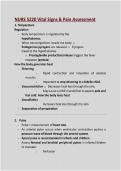
Temperature Regulation • Body temperature is regulated by the hypothalamus. • When microorganisms invade the body: o Endogenous pyrogens are released. o Pyrogens travel to the hypothalamus. o Prostaglandin production/release triggers the fever response (pyrexia). How the body generates heat • Shivering o Rapid contraction and relaxation of skeletal muscles. o Important to stop shivering in a febrile child. • Vasoconstriction o Decreases heat loss through the skin. o May cause a child’s hands/feet to appear pale and feel cold. How the body loses heat • Vasodilation o Increases heat loss through the skin. • Evaporation of perspiration 2. Pulse • Pulse = measurement of heart rate. • An arterial pulse occurs when ventricular contraction pushes a pressure wave of blood through the arterial system. • Apical pulse is recommended in infants and children. • Assess femoral and brachial peripheral pulses in infants/children to evaluate: o Perfusiono Hemodynamic stability Pulse Examination • Palpable pulse sites: o Carotid o Brachial o Radial o Femoral o Popliteal o Dorsalis pedis o Posterior tibial Counting • Normally count for 30 seconds × 2. • Adult average: 60–100 beats/min. • Assess: o Rate o Rhythm o Contour/waveform o Amplitude/force If rhythm is irregular • Count for the full 60 seconds. Children
Document information
- Uploaded on
- September 16, 2026
- Number of pages
- 16
- Written in
- 2026/2027
- Type
- Exam (elaborations)
- Contains
- Questions & answers