
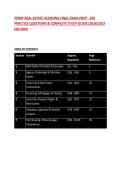
PERRY REAL ESTATE LICENSING FINAL EXAM PREP - 200
PRACTICE QUESTIONS & COMPLETE STUDY GUIDE (2026/2027
EDITION)
TABLE OF CONTENTS
Section Domain Approx. Page
Questions Reference
1 Real Estate Principles & Concepts Q1 - Q15 2
2 Agency, Brokerage & Fiduciary Q16 - Q30 6
Duties
3 Contracts & Real Estate Q31 - Q45 10
Transactions
4 Financing, Mortgages & Closing Q46 - Q60 14
5 Land Use, Property Rights & Q61 - Q75 18
Restrictions
6 Valuation, Appraisal & Market Q76 - Q90 22
Analysis
7 Fair Housing, Ethics & Legal Q91 - Q100 26
Compliance
,Section 1: Real Estate Principles and Concepts (Q1-15)
Q1: A homeowner installs a custom-built chandelier that is bolted to
the ceiling joists and wired into the home's electrical system. When
the property is sold, the buyer claims the chandelier was not included
in the sale. Which legal principle MOST strongly determines whether
the chandelier conveys with the property?
A. The chandelier is personal property because the seller paid for it
separately.
B. The chandelier is a trade fixture because it was professionally
installed.
C. The chandelier is a fixture because it is attached in a manner
intended to be permanent.
D. The chandelier is an emblement because it was installed by the
current owner.
Correct Answer: C. Rationale: Under the common-law fixture test
(attachment, adaptability, and intention), an item bolted and hardwired
into the structure is permanently annexed and thus conveys with the
real property.
Q2: A developer purchases 50 acres of land. Which physical
characteristic of land BEST explains why each acre commands a
different market value despite being part of the same parcel?
A. Immobility
B. Indestructibility
C. Nonhomogeneity
D. Situs
Correct Answer: C. Rationale: Nonhomogeneity (heterogeneity) holds
that no two parcels of land are exactly alike in location or physical
,attributes, directly explaining varying per-acre values within a single
acquisition.
Q3: A property owner dies without a will, leaving no heirs. The state
takes ownership of the property. Which governmental power allows
this transfer?
A. Eminent domain
B. Escheat
C. Police power
D. Taxation
Correct Answer: B. Rationale: Escheat is the right of the state to take
ownership of property when an owner dies intestate without heirs or a
will.
Q4: Two individuals own a property as joint tenants. One owner sells
their interest to a third party. What is the resulting form of ownership
between the remaining original owner and the new third party?
A. Joint tenancy
B. Tenancy in common
C. Tenancy by the entirety
D. Community property
Correct Answer: B. Rationale: A joint tenancy requires the four unities
(time, title, interest, and possession). Selling an interest breaks the unity
of time and title, converting the tenancy into a tenancy in common.
Q5: Which of the following BEST describes a cooperative (co-op)
ownership structure?
A. The owner holds a fee simple title to a specific apartment unit.
B. The owner holds stock in a corporation and a proprietary lease for a
specific unit.
, C. The owner holds a life estate in a specific unit.
D. The owner holds a tenancy in common for the entire building.
Correct Answer: B. Rationale: In a cooperative, the buyer purchases
shares of stock in the corporation that owns the building and receives a
proprietary lease for their specific unit.
Q6: A landowner whose property borders a non-navigable river
wishes to use the water. Which doctrine governs this right?
A. Littoral rights
B. Riparian rights
C. Prior appropriation
D. Doctrine of correlative rights
Correct Answer: B. Rationale: Riparian rights govern the use of water for
landowners whose property borders a river, stream, or non-navigable
body of water.
Q7: Which of the following is an example of an involuntary lien?
A. A mortgage lien
B. A mechanic's lien
C. A deed of trust
D. A home equity line of credit
Correct Answer: B. Rationale: A mechanic's lien is an involuntary lien
created by operation of law when a contractor or supplier is not paid for
work or materials, whereas mortgages and deeds of trust are voluntary.
Q8: A seller transfers property using a deed that contains no
warranties whatsoever. What type of deed is this?
A. General warranty deed
B. Special warranty deed
C. Bargain and sale deed
PRACTICE QUESTIONS & COMPLETE STUDY GUIDE (2026/2027
EDITION)
TABLE OF CONTENTS
Section Domain Approx. Page
Questions Reference
1 Real Estate Principles & Concepts Q1 - Q15 2
2 Agency, Brokerage & Fiduciary Q16 - Q30 6
Duties
3 Contracts & Real Estate Q31 - Q45 10
Transactions
4 Financing, Mortgages & Closing Q46 - Q60 14
5 Land Use, Property Rights & Q61 - Q75 18
Restrictions
6 Valuation, Appraisal & Market Q76 - Q90 22
Analysis
7 Fair Housing, Ethics & Legal Q91 - Q100 26
Compliance
,Section 1: Real Estate Principles and Concepts (Q1-15)
Q1: A homeowner installs a custom-built chandelier that is bolted to
the ceiling joists and wired into the home's electrical system. When
the property is sold, the buyer claims the chandelier was not included
in the sale. Which legal principle MOST strongly determines whether
the chandelier conveys with the property?
A. The chandelier is personal property because the seller paid for it
separately.
B. The chandelier is a trade fixture because it was professionally
installed.
C. The chandelier is a fixture because it is attached in a manner
intended to be permanent.
D. The chandelier is an emblement because it was installed by the
current owner.
Correct Answer: C. Rationale: Under the common-law fixture test
(attachment, adaptability, and intention), an item bolted and hardwired
into the structure is permanently annexed and thus conveys with the
real property.
Q2: A developer purchases 50 acres of land. Which physical
characteristic of land BEST explains why each acre commands a
different market value despite being part of the same parcel?
A. Immobility
B. Indestructibility
C. Nonhomogeneity
D. Situs
Correct Answer: C. Rationale: Nonhomogeneity (heterogeneity) holds
that no two parcels of land are exactly alike in location or physical
,attributes, directly explaining varying per-acre values within a single
acquisition.
Q3: A property owner dies without a will, leaving no heirs. The state
takes ownership of the property. Which governmental power allows
this transfer?
A. Eminent domain
B. Escheat
C. Police power
D. Taxation
Correct Answer: B. Rationale: Escheat is the right of the state to take
ownership of property when an owner dies intestate without heirs or a
will.
Q4: Two individuals own a property as joint tenants. One owner sells
their interest to a third party. What is the resulting form of ownership
between the remaining original owner and the new third party?
A. Joint tenancy
B. Tenancy in common
C. Tenancy by the entirety
D. Community property
Correct Answer: B. Rationale: A joint tenancy requires the four unities
(time, title, interest, and possession). Selling an interest breaks the unity
of time and title, converting the tenancy into a tenancy in common.
Q5: Which of the following BEST describes a cooperative (co-op)
ownership structure?
A. The owner holds a fee simple title to a specific apartment unit.
B. The owner holds stock in a corporation and a proprietary lease for a
specific unit.
, C. The owner holds a life estate in a specific unit.
D. The owner holds a tenancy in common for the entire building.
Correct Answer: B. Rationale: In a cooperative, the buyer purchases
shares of stock in the corporation that owns the building and receives a
proprietary lease for their specific unit.
Q6: A landowner whose property borders a non-navigable river
wishes to use the water. Which doctrine governs this right?
A. Littoral rights
B. Riparian rights
C. Prior appropriation
D. Doctrine of correlative rights
Correct Answer: B. Rationale: Riparian rights govern the use of water for
landowners whose property borders a river, stream, or non-navigable
body of water.
Q7: Which of the following is an example of an involuntary lien?
A. A mortgage lien
B. A mechanic's lien
C. A deed of trust
D. A home equity line of credit
Correct Answer: B. Rationale: A mechanic's lien is an involuntary lien
created by operation of law when a contractor or supplier is not paid for
work or materials, whereas mortgages and deeds of trust are voluntary.
Q8: A seller transfers property using a deed that contains no
warranties whatsoever. What type of deed is this?
A. General warranty deed
B. Special warranty deed
C. Bargain and sale deed


