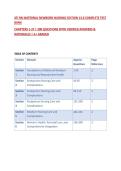
ATI RN MATERNAL NEWBORN NURSING EDITION 13.0 COMPLETE TEST
BANK
CHAPTERS 1-37 | 200 QUESTIONS WITH VERIFIED ANSWERS &
RATIONALES | A+ GRADED
TABLE OF CONTENTS
Section Domain Approx. Page
Questions Reference
Section Foundations of Maternal-Newborn 1-45 2
1 Nursing and Reproductive Health
Section Antepartum Nursing Care and 46-95 2
2 Complications
Section Intrapartum Nursing Care and 96-150 2
3 Complications
Section Postpartum Nursing Care and 151-200 2
4 Complications
Section Newborn Nursing Care and 201-255 2
5 Complications
Section Women's Health, Perinatal Loss, and 256-300 2
6 Comprehensive Integration
,SECTION 1 - FOUNDATIONS OF MATERNAL-NEWBORN NURSING AND
REPRODUCTIVE HEALTH
Chapters 1-6 | Questions 1-45
Q1: A nurse is reviewing maternal-newborn health statistics for a
community health presentation. Which statement should the nurse
include regarding infant mortality in the United States?
A. Infant mortality in the United States is the lowest of all industrialized
nations.
B. Congenital anomalies are a leading cause of infant death in the
United States.
C. Low birth weight increases an infant's chance of survival during the
first year.
D. Infant mortality rates are unrelated to maternal health status before
pregnancy.
Correct Answer: B. Congenital anomalies are a leading cause of infant
death in the United States. [CORRECT]
Rationale: Congenital anomalies, followed by disorders related to short
gestation and low birth weight, are leading causes of infant death in the
United States. Option A is incorrect because the U.S. infant mortality
rate remains higher than that of many other industrialized nations.
Option C reverses the evidence: low birth weight is a major risk factor
for infant death. Option D is wrong because maternal preconception
health strongly influences infant outcomes.
ATI strategy: When a question asks for statistics, choose the option that
reflects known population-level risk factors rather than absolutes.
Q2: A nurse is caring for a newborn who weighed 2,050 g at birth. The
nurse should recognize that this infant is classified as which of the
,following?
A. Very low birth weight
B. Extremely low birth weight
C. Low birth weight
D. Normal birth weight for gestational age
Correct Answer: C. Low birth weight [CORRECT]
Rationale: Low birth weight is defined as a birth weight of less than
2,500 g, and this newborn at 2,050 g meets that criterion. Very low
birth weight is below 1,500 g and extremely low birth weight is below
1,000 g. Option D is incorrect because 2,050 g is clearly outside the
normal range of 2,500 to 4,000 g.
ATI strategy: Memorize the three weight cut points (2,500 g, 1,500 g,
1,000 g) because classification questions are frequent recall items.
Q3: A nurse is developing the plan of care for a laboring client and her
support person. Which nursing action best reflects the principles of
family-centered maternity care?
A. Requiring the support person to leave the room for all sterile
procedures
B. Restricting visiting to the immediate postpartum period only
C. Providing all teaching to the client only when the support person is
absent
D. Inviting the support person to remain at the bedside during labor and
birth
Correct Answer: D. Inviting the support person to remain at the
bedside during labor and birth [CORRECT]
Rationale: Family-centered maternity care recognizes the family as the
constant in the client's life and promotes collaboration. Keeping the
support person at the bedside exemplifies this model. Option A isolates
, the family unnecessarily. Option B contradicts the philosophy of flexible,
family-inclusive visitation. Option C withholds education from family
members who will reinforce care at home.
ATI strategy: Choose the option that maximizes family participation
rather than institutional convenience.
Q4: A postpartum client tells the nurse, "My 4-year-old daughter is
jealous and acting like a baby again when she visits the new baby."
Which response should the nurse make?
A. "This is a normal response to a new sibling; let's talk about ways to
help her adjust."
B. "You should firmly discourage the baby-like behavior before it
becomes a habit."
C. "She is too young to understand the new baby, so visits should stop
for now."
D. "Jealousy means she is not attaching well and needs a behavioral
evaluation."
Correct Answer: A. "This is a normal response to a new sibling; let's
talk about ways to help her adjust." [CORRECT]
Rationale: Sibling rivalry and regression are expected, developmentally
normal responses in a preschooler after a new birth. The nurse should
normalize the finding while partnering with the parent on adjustment
strategies. Option B uses punishment, which intensifies jealousy. Option
C is excessive. Option D pathologizes a normal developmental behavior.
ATI strategy: When a client describes a behavior within expected norms,
validate it as normal and offer constructive guidance.
Q5: A nurse is caring for a client who speaks a language different from
the nurse's. The client's teenage son is offering to translate the
discharge instructions. Which action should the nurse take?
BANK
CHAPTERS 1-37 | 200 QUESTIONS WITH VERIFIED ANSWERS &
RATIONALES | A+ GRADED
TABLE OF CONTENTS
Section Domain Approx. Page
Questions Reference
Section Foundations of Maternal-Newborn 1-45 2
1 Nursing and Reproductive Health
Section Antepartum Nursing Care and 46-95 2
2 Complications
Section Intrapartum Nursing Care and 96-150 2
3 Complications
Section Postpartum Nursing Care and 151-200 2
4 Complications
Section Newborn Nursing Care and 201-255 2
5 Complications
Section Women's Health, Perinatal Loss, and 256-300 2
6 Comprehensive Integration
,SECTION 1 - FOUNDATIONS OF MATERNAL-NEWBORN NURSING AND
REPRODUCTIVE HEALTH
Chapters 1-6 | Questions 1-45
Q1: A nurse is reviewing maternal-newborn health statistics for a
community health presentation. Which statement should the nurse
include regarding infant mortality in the United States?
A. Infant mortality in the United States is the lowest of all industrialized
nations.
B. Congenital anomalies are a leading cause of infant death in the
United States.
C. Low birth weight increases an infant's chance of survival during the
first year.
D. Infant mortality rates are unrelated to maternal health status before
pregnancy.
Correct Answer: B. Congenital anomalies are a leading cause of infant
death in the United States. [CORRECT]
Rationale: Congenital anomalies, followed by disorders related to short
gestation and low birth weight, are leading causes of infant death in the
United States. Option A is incorrect because the U.S. infant mortality
rate remains higher than that of many other industrialized nations.
Option C reverses the evidence: low birth weight is a major risk factor
for infant death. Option D is wrong because maternal preconception
health strongly influences infant outcomes.
ATI strategy: When a question asks for statistics, choose the option that
reflects known population-level risk factors rather than absolutes.
Q2: A nurse is caring for a newborn who weighed 2,050 g at birth. The
nurse should recognize that this infant is classified as which of the
,following?
A. Very low birth weight
B. Extremely low birth weight
C. Low birth weight
D. Normal birth weight for gestational age
Correct Answer: C. Low birth weight [CORRECT]
Rationale: Low birth weight is defined as a birth weight of less than
2,500 g, and this newborn at 2,050 g meets that criterion. Very low
birth weight is below 1,500 g and extremely low birth weight is below
1,000 g. Option D is incorrect because 2,050 g is clearly outside the
normal range of 2,500 to 4,000 g.
ATI strategy: Memorize the three weight cut points (2,500 g, 1,500 g,
1,000 g) because classification questions are frequent recall items.
Q3: A nurse is developing the plan of care for a laboring client and her
support person. Which nursing action best reflects the principles of
family-centered maternity care?
A. Requiring the support person to leave the room for all sterile
procedures
B. Restricting visiting to the immediate postpartum period only
C. Providing all teaching to the client only when the support person is
absent
D. Inviting the support person to remain at the bedside during labor and
birth
Correct Answer: D. Inviting the support person to remain at the
bedside during labor and birth [CORRECT]
Rationale: Family-centered maternity care recognizes the family as the
constant in the client's life and promotes collaboration. Keeping the
support person at the bedside exemplifies this model. Option A isolates
, the family unnecessarily. Option B contradicts the philosophy of flexible,
family-inclusive visitation. Option C withholds education from family
members who will reinforce care at home.
ATI strategy: Choose the option that maximizes family participation
rather than institutional convenience.
Q4: A postpartum client tells the nurse, "My 4-year-old daughter is
jealous and acting like a baby again when she visits the new baby."
Which response should the nurse make?
A. "This is a normal response to a new sibling; let's talk about ways to
help her adjust."
B. "You should firmly discourage the baby-like behavior before it
becomes a habit."
C. "She is too young to understand the new baby, so visits should stop
for now."
D. "Jealousy means she is not attaching well and needs a behavioral
evaluation."
Correct Answer: A. "This is a normal response to a new sibling; let's
talk about ways to help her adjust." [CORRECT]
Rationale: Sibling rivalry and regression are expected, developmentally
normal responses in a preschooler after a new birth. The nurse should
normalize the finding while partnering with the parent on adjustment
strategies. Option B uses punishment, which intensifies jealousy. Option
C is excessive. Option D pathologizes a normal developmental behavior.
ATI strategy: When a client describes a behavior within expected norms,
validate it as normal and offer constructive guidance.
Q5: A nurse is caring for a client who speaks a language different from
the nurse's. The client's teenage son is offering to translate the
discharge instructions. Which action should the nurse take?