Food Microbiology FS 2172-Mustapha.pdf 2026/2027!!!
Food Microbiology: FS 2172-Mustapha
Study online at https://quizlet.com/_21yz61
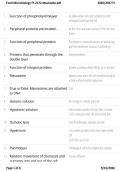
1. Function of phospholipid bilayer To allow certain ions and nutrients to enter
(transport) and leave the cell
2. Peripheral proteins are located... on the inner and outer surface of the cell mem-
brane
3. Function of peripheral proteins Participate in chemical reactions as well as sup-
port the membrane structure (scaffolding)
4. Proteins that penetrate through the Integral proteins
double layer
5. Function of integral proteins provide a pathway where things go in and out
6. Mesosome Appears near where the cell membrane begins
to fold in/divide before replication
7. True or false: Mesosomes are attached True
to DNA
8. Isotonic solution No change in osmotic pressure
9. Hypotonic solution -More water outside cell than there is inside
-H2O molecules enter cell and cell will lyse
10. Osmotic lysis Cells fill with water, explode, and die
11. Hypertonic -Less water outside of cell, more water inside
cell
-H2O falls out of cell
12. Plasmolysis Shrinkage of cell during hypertonic solution
13. Random movement of chemicals and Passive diffusion
nutrients into and out of the cell
1/8
Page 1 of 8 9/15/2026
, Food Microbiology FS 2172-Mustapha.pdf 2026/2027!!!
Food Microbiology: FS 2172-Mustapha
Study online at https://quizlet.com/_21yz61
14. O2 cells migrate into cell until equilibri- Simple diffusion
um
15. Cell needs enzyme to carry out diffusion Facilitated diffusion
16. When H2O moves from high concentra- Osmosis
tion to low concentration until equilibri-
um
17. True or false: Active transport is NOT a False
highly specific event
18. True or false: Active transport requires True
energy while passive transport does not
19. Occurs when cell needs a molecule Active transport
in low concentration outside the cell,
needs E and enzymes in the form of ATP
to bring it in
20. -Uses E from phosphate molecules Group translocation
-Substance is chemically altered as it
passes through the membrane
21. Structures within cytoplasmic mem- -Cytoplasm
brane -Nuclear area
-Plasmids
-Ribosomes
-Inclusion bodies (granules)
22. Where genetic material is found Nuclear area
23. Site of protein synthesis Ribosomes
2/8
Page 2 of 8 9/15/2026
Food Microbiology: FS 2172-Mustapha
Study online at https://quizlet.com/_21yz61
1. Function of phospholipid bilayer To allow certain ions and nutrients to enter
(transport) and leave the cell
2. Peripheral proteins are located... on the inner and outer surface of the cell mem-
brane
3. Function of peripheral proteins Participate in chemical reactions as well as sup-
port the membrane structure (scaffolding)
4. Proteins that penetrate through the Integral proteins
double layer
5. Function of integral proteins provide a pathway where things go in and out
6. Mesosome Appears near where the cell membrane begins
to fold in/divide before replication
7. True or false: Mesosomes are attached True
to DNA
8. Isotonic solution No change in osmotic pressure
9. Hypotonic solution -More water outside cell than there is inside
-H2O molecules enter cell and cell will lyse
10. Osmotic lysis Cells fill with water, explode, and die
11. Hypertonic -Less water outside of cell, more water inside
cell
-H2O falls out of cell
12. Plasmolysis Shrinkage of cell during hypertonic solution
13. Random movement of chemicals and Passive diffusion
nutrients into and out of the cell
1/8
Page 1 of 8 9/15/2026
, Food Microbiology FS 2172-Mustapha.pdf 2026/2027!!!
Food Microbiology: FS 2172-Mustapha
Study online at https://quizlet.com/_21yz61
14. O2 cells migrate into cell until equilibri- Simple diffusion
um
15. Cell needs enzyme to carry out diffusion Facilitated diffusion
16. When H2O moves from high concentra- Osmosis
tion to low concentration until equilibri-
um
17. True or false: Active transport is NOT a False
highly specific event
18. True or false: Active transport requires True
energy while passive transport does not
19. Occurs when cell needs a molecule Active transport
in low concentration outside the cell,
needs E and enzymes in the form of ATP
to bring it in
20. -Uses E from phosphate molecules Group translocation
-Substance is chemically altered as it
passes through the membrane
21. Structures within cytoplasmic mem- -Cytoplasm
brane -Nuclear area
-Plasmids
-Ribosomes
-Inclusion bodies (granules)
22. Where genetic material is found Nuclear area
23. Site of protein synthesis Ribosomes
2/8
Page 2 of 8 9/15/2026