

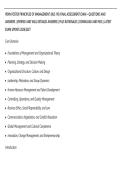
PENN FOSTER PRINCIPLES OF MANAGEMENT (BUS 110) FINAL ASSESSMENT EXAM – QUESTIONS AND
ANSWERS | VERIFIED AND WELL DETAILED ANSWERS | PLUS RATIONALES | DOWNLOAD AND PASS | LATEST
EXAM UPDATE 2026/2027
Core Domains
Foundations of Management and Organizational Theory
Planning, Strategy, and Decision Making
Organizational Structure, Culture, and Design
Leadership, Motivation, and Group Dynamics
Human Resource Management and Talent Development
Controlling, Operations, and Quality Management
Business Ethics, Social Responsibility, and Law
Communication, Negotiation, and Conflict Resolution
Global Management and Cultural Competence
Innovation, Change Management, and Entrepreneurship
Introduction
,This comprehensive final assessment evaluates mastery of core management principles essential for effective
organizational leadership. It measures understanding of foundational theory, strategic planning, organizational
behavior, and operational control. Through multiple-choice and scenario-based questions, candidates demonstrate
critical thinking and decision-making skills. The exam emphasizes real-world application, ethical reasoning, and
regulatory compliance, preparing managers to navigate complex business environments. Each question includes a
detailed rationale to reinforce learning and ensure professional readiness.
SECTION ONE: QUESTIONS 1–50
1. Which management function involves defining goals, establishing strategy, and developing plans to coordinate
activities?
A. Organizing
B. Leading
C. Planning
D. Controlling
🟢 Correct Answer: C. Planning
🔴 Explanation: Planning is the primary management function that establishes objectives and determines the best
course of action to achieve them, providing the foundation for organizing, leading, and controlling.
,2. A manager who focuses on building a positive work environment and motivating employees is primarily
engaged in which function?
A. Planning
B. Organizing
C. Leading
D. Controlling
🟢 Correct Answer: C. Leading
🔴 Explanation: Leading involves directing and influencing employees, shaping organizational culture, and
motivating staff to achieve high performance, distinguishing it from the more structural functions of planning and
organizing.
3. According to Henri Fayol, which principle suggests that a worker should receive orders from only one superior?
A. Unity of direction
B. Unity of command
C. Scalar chain
D. Esprit de corps
🟢 Correct Answer: B. Unity of command
, 🔴 Explanation: Fayol's principle of unity of command states that an employee should report to only one manager
to avoid conflicting instructions, confusion, and inefficiency.
4. What is the primary focus of the quantitative approach to management?
A. Human behavior in organizations
B. Applying mathematical models and statistics to improve decision making
C. Understanding organizational culture
D. Enhancing employee motivation
🟢 Correct Answer: B. Applying mathematical models and statistics to improve decision making
🔴 Explanation: The quantitative approach, including management science and operations research, uses
mathematical and statistical tools to optimize resource allocation, production, and logistics.
5. In the context of the systems approach, an organization that interacts with its external environment is known
as a(n):
A. Closed system
B. Open system
C. Isolated system
D. Static system
ANSWERS | VERIFIED AND WELL DETAILED ANSWERS | PLUS RATIONALES | DOWNLOAD AND PASS | LATEST
EXAM UPDATE 2026/2027
Core Domains
Foundations of Management and Organizational Theory
Planning, Strategy, and Decision Making
Organizational Structure, Culture, and Design
Leadership, Motivation, and Group Dynamics
Human Resource Management and Talent Development
Controlling, Operations, and Quality Management
Business Ethics, Social Responsibility, and Law
Communication, Negotiation, and Conflict Resolution
Global Management and Cultural Competence
Innovation, Change Management, and Entrepreneurship
Introduction
,This comprehensive final assessment evaluates mastery of core management principles essential for effective
organizational leadership. It measures understanding of foundational theory, strategic planning, organizational
behavior, and operational control. Through multiple-choice and scenario-based questions, candidates demonstrate
critical thinking and decision-making skills. The exam emphasizes real-world application, ethical reasoning, and
regulatory compliance, preparing managers to navigate complex business environments. Each question includes a
detailed rationale to reinforce learning and ensure professional readiness.
SECTION ONE: QUESTIONS 1–50
1. Which management function involves defining goals, establishing strategy, and developing plans to coordinate
activities?
A. Organizing
B. Leading
C. Planning
D. Controlling
🟢 Correct Answer: C. Planning
🔴 Explanation: Planning is the primary management function that establishes objectives and determines the best
course of action to achieve them, providing the foundation for organizing, leading, and controlling.
,2. A manager who focuses on building a positive work environment and motivating employees is primarily
engaged in which function?
A. Planning
B. Organizing
C. Leading
D. Controlling
🟢 Correct Answer: C. Leading
🔴 Explanation: Leading involves directing and influencing employees, shaping organizational culture, and
motivating staff to achieve high performance, distinguishing it from the more structural functions of planning and
organizing.
3. According to Henri Fayol, which principle suggests that a worker should receive orders from only one superior?
A. Unity of direction
B. Unity of command
C. Scalar chain
D. Esprit de corps
🟢 Correct Answer: B. Unity of command
, 🔴 Explanation: Fayol's principle of unity of command states that an employee should report to only one manager
to avoid conflicting instructions, confusion, and inefficiency.
4. What is the primary focus of the quantitative approach to management?
A. Human behavior in organizations
B. Applying mathematical models and statistics to improve decision making
C. Understanding organizational culture
D. Enhancing employee motivation
🟢 Correct Answer: B. Applying mathematical models and statistics to improve decision making
🔴 Explanation: The quantitative approach, including management science and operations research, uses
mathematical and statistical tools to optimize resource allocation, production, and logistics.
5. In the context of the systems approach, an organization that interacts with its external environment is known
as a(n):
A. Closed system
B. Open system
C. Isolated system
D. Static system


