
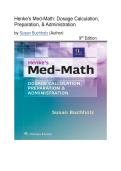
Henke's Med-Math: Dosage Calculation,
Preparation, & Administration
by Susan Buchholz (Author)
9th Edition
,TABLE OF CONTENTS
Chapter 1: Arithmetic Needed for Dosage
Chapter 2: Metric and Household Systems of Measurement
Chapter 3: Drug Abbreviations, Labels, and Packaging
Chapter 4: Calculation of Oral Medications—Solids and Liquids
Chapter 5: Liquids for Injection
Chapter 6: Calculation of Basic IV Drip Rates
Chapter 7: Special Types of IV Calculations
Chapter 8: Dosage Problems for Infants and Children
Chapter 9: Information Basic to Administering Drugs
Chapter 10: Administration Procedures
,TEST BANK
Henke's Med-Math: Dosage Calculation, Preparation, and
Administration, 9th Edition (Buchholz, 2020)
Chapters 1–10
CHAPTER 1: ARITHMETIC NEEDED FOR DOSAGE
Multiple Choice Questions
1. Simplify the fraction 15/20 to its lowest terms.
A) 1/2
B) 2/3
C) 3/4
D) 4/5
Answer: C
Rationale: Both 15 and 20 can be divided by 5. 15 ÷ 5 = 3 and 20 ÷ 5 = 4, yielding 3/4. This is the simplest
form because 3 and 4 share no common factor other than 1.
2. Which fraction has the largest value?
A) 1/150
B) 1/100
C) 1/200
D) 1/250
Answer: B
Rationale: When the numerators are equal, the fraction with the smallest denominator has the greatest
value. 1/100 > 1/150 > 1/200 > 1/250.
3. Add: 3/4 + 1/8 = ?
A) 4/12
B) 4/8
C) 7/8
D) 1/2
Answer: C
Rationale: Find the LCD (8). Convert 3/4 to 6/8. Then 6/8 + 1/8 = 7/8.
, 4. Multiply: 1/4 × 2/3 = ?
A) 3/7
B) 1/6
C) 2/7
D) 2/12
Answer: B
Rationale: Multiply numerators: 1 × 2 = 2. Multiply denominators: 4 × 3 = 12. 2/12 reduces to 1/6.
Although D is mathematically equivalent, 1/6 is the reduced answer.
5. Divide: 3/4 ÷ 1/2 = ?
A) 3/8
B) 1 1/2
C) 3/2
D) Both B and C
Answer: D
Rationale: To divide fractions, invert the divisor and multiply: 3/4 × 2/1 = 6/4 = 3/2 = 1 1/2. Both B and C
represent the same value.
6. Convert the fraction 2/5 to a decimal.
A) 0.25
B) 0.4
C) 0.45
D) 2.5
Answer: B
Rationale: Divide the numerator by the denominator: 2 ÷ 5 = 0.4.
7. Multiply: 0.25 × 0.4 = ?
A) 0.1
B) 0.01
C) 1.0
D) 0.065
Answer: A
Rationale: Multiply 25 × 4 = 100. Count decimal places: 0.25 has two, 0.4 has one, total three decimal
places. Place the decimal: 0.100 = 0.1.
Preparation, & Administration
by Susan Buchholz (Author)
9th Edition
,TABLE OF CONTENTS
Chapter 1: Arithmetic Needed for Dosage
Chapter 2: Metric and Household Systems of Measurement
Chapter 3: Drug Abbreviations, Labels, and Packaging
Chapter 4: Calculation of Oral Medications—Solids and Liquids
Chapter 5: Liquids for Injection
Chapter 6: Calculation of Basic IV Drip Rates
Chapter 7: Special Types of IV Calculations
Chapter 8: Dosage Problems for Infants and Children
Chapter 9: Information Basic to Administering Drugs
Chapter 10: Administration Procedures
,TEST BANK
Henke's Med-Math: Dosage Calculation, Preparation, and
Administration, 9th Edition (Buchholz, 2020)
Chapters 1–10
CHAPTER 1: ARITHMETIC NEEDED FOR DOSAGE
Multiple Choice Questions
1. Simplify the fraction 15/20 to its lowest terms.
A) 1/2
B) 2/3
C) 3/4
D) 4/5
Answer: C
Rationale: Both 15 and 20 can be divided by 5. 15 ÷ 5 = 3 and 20 ÷ 5 = 4, yielding 3/4. This is the simplest
form because 3 and 4 share no common factor other than 1.
2. Which fraction has the largest value?
A) 1/150
B) 1/100
C) 1/200
D) 1/250
Answer: B
Rationale: When the numerators are equal, the fraction with the smallest denominator has the greatest
value. 1/100 > 1/150 > 1/200 > 1/250.
3. Add: 3/4 + 1/8 = ?
A) 4/12
B) 4/8
C) 7/8
D) 1/2
Answer: C
Rationale: Find the LCD (8). Convert 3/4 to 6/8. Then 6/8 + 1/8 = 7/8.
, 4. Multiply: 1/4 × 2/3 = ?
A) 3/7
B) 1/6
C) 2/7
D) 2/12
Answer: B
Rationale: Multiply numerators: 1 × 2 = 2. Multiply denominators: 4 × 3 = 12. 2/12 reduces to 1/6.
Although D is mathematically equivalent, 1/6 is the reduced answer.
5. Divide: 3/4 ÷ 1/2 = ?
A) 3/8
B) 1 1/2
C) 3/2
D) Both B and C
Answer: D
Rationale: To divide fractions, invert the divisor and multiply: 3/4 × 2/1 = 6/4 = 3/2 = 1 1/2. Both B and C
represent the same value.
6. Convert the fraction 2/5 to a decimal.
A) 0.25
B) 0.4
C) 0.45
D) 2.5
Answer: B
Rationale: Divide the numerator by the denominator: 2 ÷ 5 = 0.4.
7. Multiply: 0.25 × 0.4 = ?
A) 0.1
B) 0.01
C) 1.0
D) 0.065
Answer: A
Rationale: Multiply 25 × 4 = 100. Count decimal places: 0.25 has two, 0.4 has one, total three decimal
places. Place the decimal: 0.100 = 0.1.


