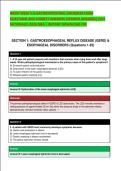
NR507 WEEK 5–6 GASTROINTESTINAL DISORDERS EXAM
QUESTIONS AND CORRECT ANSWERS (VERIFIED ANSWERS) PLUS
RATIONALES 2026 Q&A | INSTANT DOWNLOAD PDF
SECTION 1: GASTROESOPHAGEAL REFLUX DISEASE (GERD) &
ESOPHAGEAL DISORDERS (Questions 1-25)
Question 1
1. A 52-year-old patient presents with heartburn that worsens when lying down and after large
meals. Which pathophysiological mechanism is the primary cause of this patient's symptoms?
A) Excessive gastric acid production
B) Dysfunction of the lower esophageal sphincter (LES)
C) H. pylori infection of the gastric mucosa
D) Delayed gastric emptying only
Answer
Answer B: Dysfunction of the lower esophageal sphincter (LES)
Rationale
The primary pathophysiological defect in GERD is LES dysfunction. The LES normally maintains a
resting pressure of approximately 20 mm Hg; when this pressure drops or the sphincter relaxes
spontaneously, stomach contents reflux upward. ---
Question 2
2. A patient with GERD most commonly develops symptoms because:
A) Gastric acid production is absent
B) Lower esophageal sphincter tone is decreased
C) Gastric emptying is always accelerated
D) The pyloric sphincter remains closed
Answer
Answer B: Lower esophageal sphincter tone is decreased
,Rationale
GERD primarily results from decreased LES tone, allowing acidic gastric contents to reflux into the
esophagus. Chronic acid exposure damages the esophageal mucosa. ---
Question 3
3. Which condition is the strongest risk factor for esophageal adenocarcinoma?
A) Achalasia
B) Barrett's esophagus
C) Esophageal varices
D) Mallory-Weiss tear
Answer
Answer B: Barrett's esophagus
Rationale
Barrett's esophagus develops after chronic GERD causes replacement of normal squamous
epithelium with columnar epithelium (intestinal metaplasia). This significantly increases the risk of
esophageal adenocarcinoma. ---
Question 4
4. A client with GERD is prescribed omeprazole (Prilosec). The nurse practitioner instructs the
client to take the medication:
A) At bedtime with a snack
B) With meals to reduce GI upset
C) 30–60 minutes before the first meal of the day
D) Twice daily regardless of meal timing
Answer
Answer C: 30–60 minutes before the first meal of the day
Rationale
Proton pump inhibitors (PPIs) like omeprazole are most effective when taken 30–60 minutes before
eating, allowing peak plasma concentration to coincide with active proton pump stimulation during
meals. ---
,Question 5
5. Which finding is most characteristic of achalasia?
A) Increased LES relaxation
B) Failure of LES relaxation with impaired esophageal peristalsis
C) Excess gastric acid secretion
D) Hypertrophy of gastric rugae
Answer
Answer B: Failure of LES relaxation with impaired esophageal peristalsis
Rationale
Achalasia results from degeneration of inhibitory neurons within the myenteric plexus, preventing LES
relaxation and causing absent or ineffective peristalsis. Patients present with dysphagia to solids and
liquids. ---
Question 6
6. A patient with scleroderma is at increased risk for which esophageal complication?
A) Esophageal varices
B) Esophageal dysmotility and reflux
C) Barrett's esophagus
D) Esophageal cancer
Answer
Answer B: Esophageal dysmotility and reflux
Rationale
Scleroderma causes smooth muscle atrophy and fibrosis in the esophagus, leading to decreased LES
pressure and impaired peristalsis, significantly increasing GERD risk. ---
Question 7
7. A patient presents with progressive solid food dysphagia and heartburn. Long-standing
GERD with this finding most likely indicates:
, A) Esophageal cancer
B) Peptic stricture
C) Achalasia
D) Esophageal spasm
Answer
Answer B: Peptic stricture
Rationale
Long-standing GERD can lead to progressive solid food dysphagia due to peptic stricture formation
from chronic inflammation and fibrosis. ---
Question 8
8. Which finding on biopsy confirms Barrett's esophagus?
A) Squamous cell hyperplasia
B) Intestinal metaplasia with goblet cells
C) Eosinophilic infiltration
D) Fibrosis of the lamina propria
Answer
Answer B: Intestinal metaplasia with goblet cells
Rationale
Barrett's esophagus is diagnosed when intestinal metaplasia (columnar epithelium with goblet cells)
replaces the normal squamous epithelium of the distal esophagus. ---
Question 9
9. A patient with GERD reports chest pain. Which finding helps distinguish GERD-related chest
pain from cardiac chest pain?
A) Burning quality of pain
B) Pain relieved by antacids
C) Radiation to the jaw
D) Exertional onset
QUESTIONS AND CORRECT ANSWERS (VERIFIED ANSWERS) PLUS
RATIONALES 2026 Q&A | INSTANT DOWNLOAD PDF
SECTION 1: GASTROESOPHAGEAL REFLUX DISEASE (GERD) &
ESOPHAGEAL DISORDERS (Questions 1-25)
Question 1
1. A 52-year-old patient presents with heartburn that worsens when lying down and after large
meals. Which pathophysiological mechanism is the primary cause of this patient's symptoms?
A) Excessive gastric acid production
B) Dysfunction of the lower esophageal sphincter (LES)
C) H. pylori infection of the gastric mucosa
D) Delayed gastric emptying only
Answer
Answer B: Dysfunction of the lower esophageal sphincter (LES)
Rationale
The primary pathophysiological defect in GERD is LES dysfunction. The LES normally maintains a
resting pressure of approximately 20 mm Hg; when this pressure drops or the sphincter relaxes
spontaneously, stomach contents reflux upward. ---
Question 2
2. A patient with GERD most commonly develops symptoms because:
A) Gastric acid production is absent
B) Lower esophageal sphincter tone is decreased
C) Gastric emptying is always accelerated
D) The pyloric sphincter remains closed
Answer
Answer B: Lower esophageal sphincter tone is decreased
,Rationale
GERD primarily results from decreased LES tone, allowing acidic gastric contents to reflux into the
esophagus. Chronic acid exposure damages the esophageal mucosa. ---
Question 3
3. Which condition is the strongest risk factor for esophageal adenocarcinoma?
A) Achalasia
B) Barrett's esophagus
C) Esophageal varices
D) Mallory-Weiss tear
Answer
Answer B: Barrett's esophagus
Rationale
Barrett's esophagus develops after chronic GERD causes replacement of normal squamous
epithelium with columnar epithelium (intestinal metaplasia). This significantly increases the risk of
esophageal adenocarcinoma. ---
Question 4
4. A client with GERD is prescribed omeprazole (Prilosec). The nurse practitioner instructs the
client to take the medication:
A) At bedtime with a snack
B) With meals to reduce GI upset
C) 30–60 minutes before the first meal of the day
D) Twice daily regardless of meal timing
Answer
Answer C: 30–60 minutes before the first meal of the day
Rationale
Proton pump inhibitors (PPIs) like omeprazole are most effective when taken 30–60 minutes before
eating, allowing peak plasma concentration to coincide with active proton pump stimulation during
meals. ---
,Question 5
5. Which finding is most characteristic of achalasia?
A) Increased LES relaxation
B) Failure of LES relaxation with impaired esophageal peristalsis
C) Excess gastric acid secretion
D) Hypertrophy of gastric rugae
Answer
Answer B: Failure of LES relaxation with impaired esophageal peristalsis
Rationale
Achalasia results from degeneration of inhibitory neurons within the myenteric plexus, preventing LES
relaxation and causing absent or ineffective peristalsis. Patients present with dysphagia to solids and
liquids. ---
Question 6
6. A patient with scleroderma is at increased risk for which esophageal complication?
A) Esophageal varices
B) Esophageal dysmotility and reflux
C) Barrett's esophagus
D) Esophageal cancer
Answer
Answer B: Esophageal dysmotility and reflux
Rationale
Scleroderma causes smooth muscle atrophy and fibrosis in the esophagus, leading to decreased LES
pressure and impaired peristalsis, significantly increasing GERD risk. ---
Question 7
7. A patient presents with progressive solid food dysphagia and heartburn. Long-standing
GERD with this finding most likely indicates:
, A) Esophageal cancer
B) Peptic stricture
C) Achalasia
D) Esophageal spasm
Answer
Answer B: Peptic stricture
Rationale
Long-standing GERD can lead to progressive solid food dysphagia due to peptic stricture formation
from chronic inflammation and fibrosis. ---
Question 8
8. Which finding on biopsy confirms Barrett's esophagus?
A) Squamous cell hyperplasia
B) Intestinal metaplasia with goblet cells
C) Eosinophilic infiltration
D) Fibrosis of the lamina propria
Answer
Answer B: Intestinal metaplasia with goblet cells
Rationale
Barrett's esophagus is diagnosed when intestinal metaplasia (columnar epithelium with goblet cells)
replaces the normal squamous epithelium of the distal esophagus. ---
Question 9
9. A patient with GERD reports chest pain. Which finding helps distinguish GERD-related chest
pain from cardiac chest pain?
A) Burning quality of pain
B) Pain relieved by antacids
C) Radiation to the jaw
D) Exertional onset